Integrated Pest Management (IPM) has become the most advanced and sustainable model for protecting crops without compromising the balance of the agricultural ecosystem. This modern approach is not based on eliminating pests at any cost, but on intelligent prevention, monitoring, and control, combining biological, physical, and, only when necessary, chemical tools.
In recent years, IPM has gained prominence in Europe's most technologically advanced greenhouses and farms, driven by the need to reduce the use of insecticides and minimize their impact on pollinators and auxiliary fauna. Legislation, markets, and producers' own environmental awareness have accelerated this transition toward more selective and sustainable control.
In this new paradigm, colored sticky traps are consolidated as an essential pillar. Their function goes far beyond trapping insects: they allow pest populations to be monitored, early outbreaks to be detected, and precise decisions to be made before damage is visible. But their effective use requires a key condition: they must be compatible with biological control, avoiding the accidental capture of natural enemies—such as Orius, Encarsia, or Amblyseius—that naturally keep pests at bay.
The future of IPM, therefore, lies in strategically integrating these traps into a balanced system, where technology, observation, and biology work together to achieve healthier, more sustainable, and more profitable crops.
Sticky traps: more than a control, a diagnostic tool
Within an Integrated Pest Management (IPM) program, sticky colored traps are much more than simple capture tools: they are a continuous monitoring system that allows us to know the actual health status of the crop and anticipate control decisions before pests reach critical levels.
 © JH Hydroponic Systems S.L.
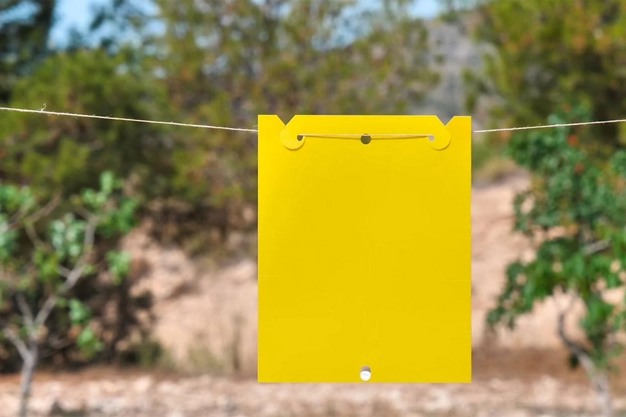
Each color of trap serves a specific purpose based on the biology of the target insect. Yellow traps primarily attract whiteflies (Bemisia tabaci, Trialeurodes vaporariorum) and leaf miners (Liriomyza spp.), both of which are common pests in horticultural crops. Blue traps are designed to control thrips (Frankliniella occidentalis), a notoriously difficult pest to manage in greenhouse environments. Black traps, on the other hand, are used in areas prone to fungus gnats (Bradysia spp.), which typically infest moist substrates and hydroponic systems.
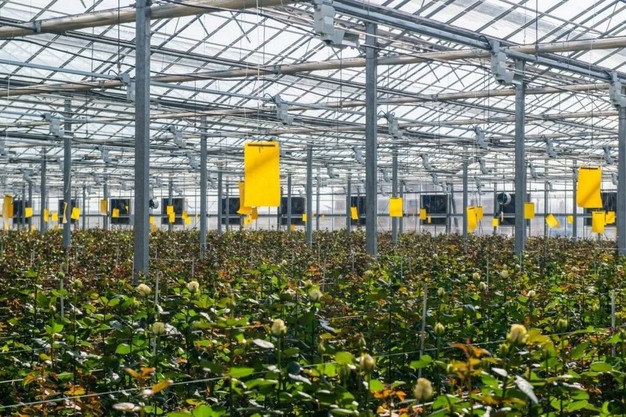
In monitoring, traps are strategically placed (one every 200–500 m²) to detect presence and assess population dynamics.
In mass trapping, the density is increased (one every 20–50 m²) to directly reduce the adult population and slow expansion.
Unlike chemical methods, color traps do not generate resistance, contaminate, or leave residues, making them a tool compatible with organic farming and sustainable certification programs. Furthermore, their continuous use provides valuable information: the number of individuals captured, the frequency of inspection (ideally weekly), and population trends allow for precise adjustment of the IPM strategy.
Biological control: the invisible ally of the modern grower
In truly effective Integrated Pest Management (IPM), sticky traps don't work alone. They are the first line of detection, but biological control maintains the natural balance within the crop. The combination of both strategies allows the grower to act intelligently: detecting, correcting, and preventing without disrupting the greenhouse ecosystem.
Natural enemies are the invisible allies of modern growers, playing a crucial role in sustainable pest management. They fall into three main groups. Predators, such as Amblyseius swirskii and Orius laevigatus, actively feed on thrips, mites, and small larvae. Parasitoids, including Encarsia formosa and Aphidius colemani, target pests like whiteflies and aphids by laying their eggs on them, effectively disrupting their life cycle. Finally, entomopathogens and beneficial soil microorganisms, such as Beauveria bassiana and Trichoderma spp., act against larvae, fungal spores, and pathogens, enhancing crop health from the root up.
The synergy between sticky traps and biological control creates a permanent monitoring and defense system, without relying on harsh chemical treatments. In addition to reducing insecticide use, this approach improves crop sustainability, protects biodiversity, and meets the European market's zero-waste demands.
Ultimately, integrating traps and beneficial organisms is not just a technical decision: it is a commitment to a smarter, more profitable, and more environmentally friendly agricultural model.
Integrating sticky traps without harming beneficial insects
The effectiveness of Integrated Pest Management (IPM) depends not only on the tools used, but also on how they are applied. In the case of chromatic sticky traps, their proper installation can make the difference between a balanced system and an unbalanced ecosystem. Integrating them without interfering with beneficial insects requires planning, precision, and crop knowledge.
The first step is strategic placement. Traps should be placed at key points such as air inlets, vents, and areas prone to infestation, avoiding areas where biological aids are released. This allows pests to be intercepted at their point of entry without endangering predators or parasitoids operating within the crop.
Trap density varies depending on the type of crop and the area: denser crops or those with a history of pests require a more comprehensive monitoring network, while moderate coverage may be sufficient in the initial stages. It's also important not to place traps at the flight height of natural enemies, especially in crops with recent releases of Orius or Amblyseius, as they could be caught by mistake.
Timing also matters: it's recommended to place traps before release if the goal is to monitor initial pest populations, or afterward if the goal is to control outbreaks without interfering with auxiliary pests. Furthermore, using specific colors—such as blue traps for thrips or yellow traps for whiteflies—reduces accidental captures.
Don't forget to replace them periodically: a saturated trap becomes ineffective and can skew monitoring data. Maintaining a constant replacement ensures accurate information and timely action.
Common mistakes when using sticky traps with biological control
To maximize the effectiveness of Integrated Pest Management (IPM), it is essential to understand the most common mistakes when combining sticky traps with natural enemies. Avoiding them helps maintain a balance between pest monitoring and the preservation of beneficial insects.
 © JH Hydroponic Systems S.L.
One of the most common mistakes is placing too many traps or too close to the crop, which can interfere with the activity of the auxiliaries and distort monitoring data. It is also common to fail to replace saturated traps, thereby losing their attractiveness and compromising the reliability of pest monitoring.
Lack of systematic record-keeping or counting is another common mistake: without accurate data on the number and type of insects captured, it is impossible to make informed decisions about natural enemy releases or the application of corrective measures.
Finally, failure to coordinate trap placement with the release of beneficial insects can lead to accidental captures, reducing the effectiveness of biological control and requiring repeated releases, which increases costs and effort for the crop.
Avoiding these errors ensures a balanced, sustainable, and effective IPM, where traps and biological control work hand in hand to protect the crop.
Global benefits of a modern MIP integration
Integrating sticky traps and biological control into modern Integrated Pest Management (IPM) offers benefits that go beyond simple pest control. In terms of efficiency, it allows for more stable and predictable control, reducing dependence on chemicals and preventing resistance.
From a sustainability perspective, this approach minimizes environmental impact, favors organic production, and is compatible with certifications such as GlobalGAP, demonstrating a clear commitment to responsible practices.
The economic savings are also significant: fewer treatments, less chemical waste, and reduced operating costs contribute to greater profitability. Finally, product quality is clearly improved, with healthier plants, better-looking fruits, and a longer post-harvest life, generating added value in demanding markets.
For more information:
Hydroponic Systems
Email: [email protected]
www.hydroponicsystems.eu