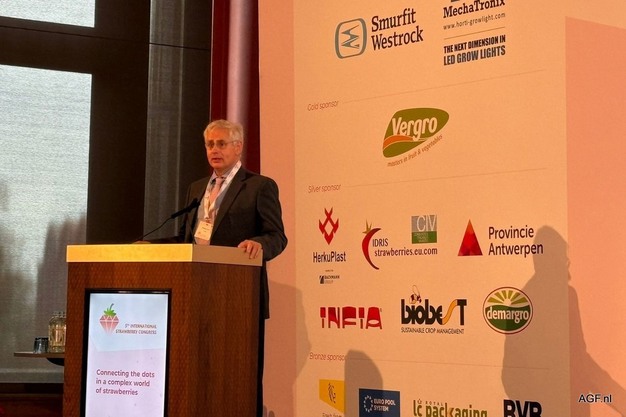
At the International Strawberry Congress, Philippe Binard of Freshfel Europe gave an insight into consumption trends within the European strawberry sector and the challenges ahead in an uncertain world. "Fruits and vegetables can play a key role in promoting health and sustainability."
 © Jannick Flach | HortiDaily.com
Philippe Binard at the past International Strawberry Congress
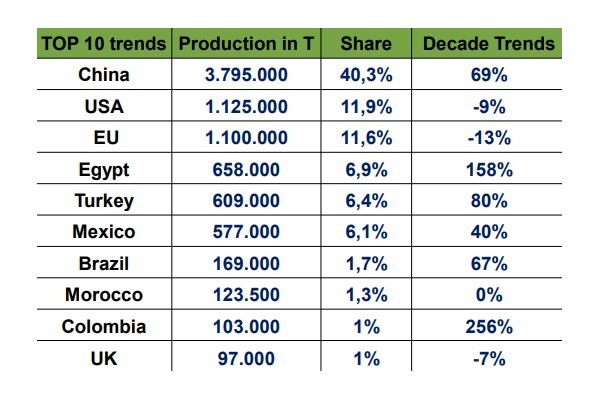
Philippe first addressed current trends. "The European strawberry and vegetable sector is still very much local and seasonal: more than half of production remains in the country of origin. Yet there is also a lot of reciprocal trade within and outside the EU, with imports and exports complementing each other seasonally. Globally, China is the largest producer (40%), followed by the US (11.9%) and the EU (11.6%). New players such as Egypt, Turkey, and Mexico are growing fast." Philippe also sees a declining trend in production in Western countries due to changing climatic conditions, cultivation, labour, and energy costs.
 © COMTRADE - Freshfel Europe
"Within Europe, Spain supplies almost 30%, followed by Poland (15%), Italy and Germany (both about 11%)," he continues. "Intra-EU trade is crucial: About 40% of production is traded this way. Germany is the biggest buyer, while Spain, Poland, and the Netherlands are the main suppliers. Outside the EU, exports go mainly to the UK, Switzerland, Norway, and Belarus. Since Brexit, Spain has lost market share in the UK, while Morocco and Egypt have grown. An important trend is the rise of blue 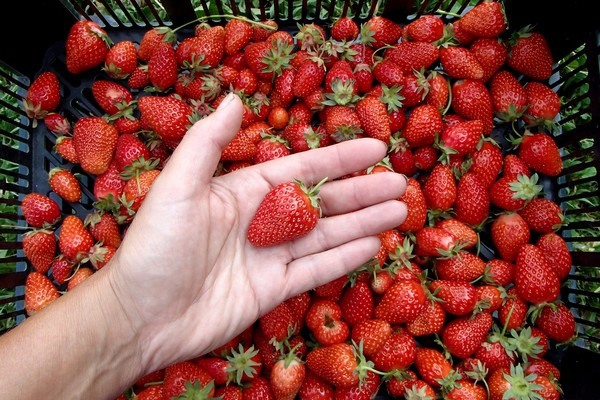 © Dreamstimeberries: While strawberries remained stable in volume, their market share fell from 75% to 50%. Yet the strawberry market still represents sales of over €2.7bn in the EU."
However, Philippe warns that the sector faces challenges. "Trade rules and WTO agreements are under increasing pressure, and EU agricultural policy is constantly changing. At the same time, there are great opportunities: strawberries and other fruits and vegetables have low environmental impact and important health benefits (including vitamin C, antioxidants, diabetes support, digestion, and weight management). The future calls for increased competitiveness, better health communication, maintaining the single market, and responding to major challenges such as climate change, geopolitical tensions, and the growing obesity epidemic. Fruits and vegetables can play a key role in promoting health and sustainability."
For more information:
Philippe Binard
Freshfel Europe
[email protected]
www.freshfel.org