This year's edition takes place in the heart of Amsterdam, where attendees gathered at the historic Koepelkerk. Fortunately, everyone managed to dodge the city's famous bike rush hour to join the Vertical Farming World Congress as it opened its doors. Industry players from across the globe convened to explore a wide range of topics shaping the future of vertical farming.
"We've seen enough of farms trying to reinvent the wheel on their own. The industry used to be secretive, almost combative, but that time is over. If vertical farming wants to survive, we have to work together and stop pretending we'll figure it out by ourselves."
That statement captures the mood of this year's Congress. The days of hype and isolation are behind us. Now, it's about finding what works, sharing lessons, and demonstrating that business models can sustain themselves in the real world.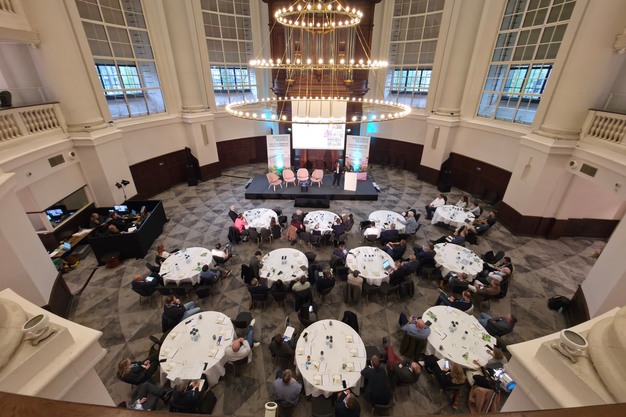 © Rebekka Boekhout | HortiDaily.com
The venue: De Koepelkerk
Moving beyond lettuce
"I've seen heads of lettuce grown five years ago by companies that no longer exist," said Ard van de Kreeke, CEO at Growy. "Why would you grow such an easy, price-sensitive product when open-field growers can do it for far less?" Lettuce was among the first crops grown in vertical farms, but it also exposed how fragile the economics can be.
"You have to be able to reach a proper product price to justify the capex," said Tisha Livingston, Co-Founder of 80 Acres Farms and CEO of Infinite Acres. She pointed out that greenhouses often have more flexibility in balancing costs and yields.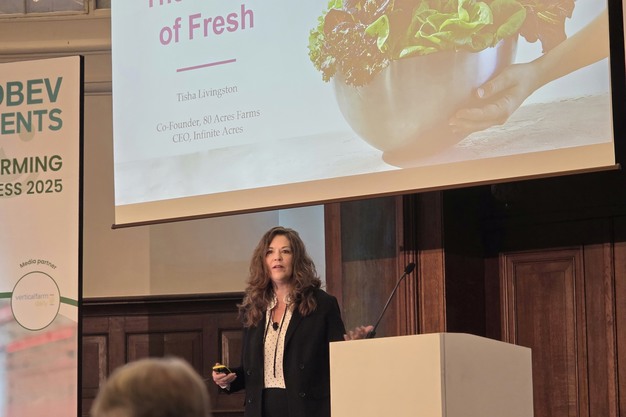 © Rebekka Boekhout | HortiDaily.com
Tisha Livingston, Co-Founder of 80 Acres Farms and CEO of Infinite Acres
Investment reality check
"The only way vertical farming works is if it's profitable at scale," said Henry Gordon-Smith of Agritecture. Gordon-Smith noted that most vertical farms today operate on a small scale, each facing its own set of challenges and opportunities. In many regions, he explained, large-scale affordable production remains out of reach for now, but strong business cases can still be built around premium, niche, and quality-driven segments.
Much of the innovation emerging from vertical farming, he added, is also proving valuable to greenhouses and even open-field agriculture, reinforcing the idea that the sector's future lies in complementing, rather than competing with, traditional farming systems.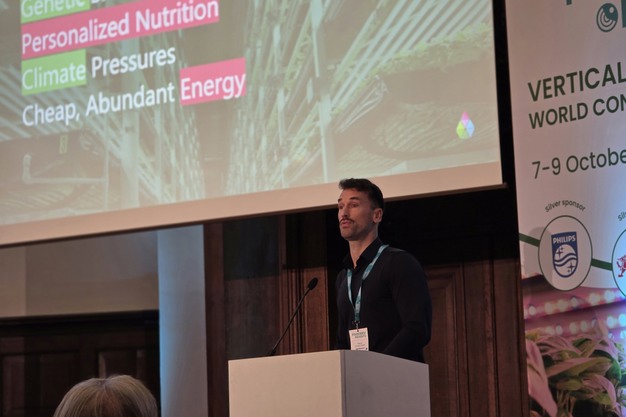 © Rebekka Boekhout | HortiDaily.com
Henry Gordon-Smith, Founder and CEO of Agritecture
As for funding, the hype-driven narrative no longer fits. "Vertical farming is asset-heavy, low-margin, and high-volume," said David Verbitsky, Managing Director of Verbitsky Capital. "It looks like debt capital is better suited for vertical farming than venture capital."
Peter Bachmann, Managing Director of Gresham House, added that locking in fixed contracts helps demonstrate profitability. The transition to profitability is happening slowly but steadily. However, Dr Phillip Lee, Managing Director of Evolve International, reminded attendees that investors now expect realism in what he called "the most competitive industry on the planet."
"If you don't have real growers running your farm, you're unlikely to succeed," he said. Verbitsky added, "We've been profitable for years. Lower your costs, sustain production, grow your top line, and show a business plan that actually makes sense." © Rebekka Boekhout | HortiDaily.com
Richard Hall, Chair of FoodBev Media, with Dr. Philip Lee, MD of Evolve International, Peter Bachmann, MD of Gresham House, and David Verbitsky, President and MD of Verbitsky Capital
From competition to collaboration
Livingston recalled how, in the early days, vertical farms competed more than they collaborated. That mindset is now shifting. "There's plenty of room to grow, but we need to build together."
Bachmann agreed. "Be open, be proactive, and stop pretending we'll figure it all out alone. We want everyone to succeed. If we can align on best practices, financing, and data transparency, the whole sector benefits."
For more information:
Foodbev Media
[email protected]
www.foodbevevents.com