How can growers save energy using practical, affordable, and profitable techniques? That's the key question behind the Energlik project. This four-year research program is now nearing completion. Recently, researchers and grower Jelle De Ryck from Tomerel shared the latest updates from the final trial crop. Jelle carried out a real-world test using double screens in a non-lighted tomato greenhouse.
In 2024, researchers working in the greenhouse at Sint-Katelijne-Waver achieved an impressive 48% reduction in energy use compared to the reference crop. This year, they expect to save even more.
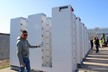
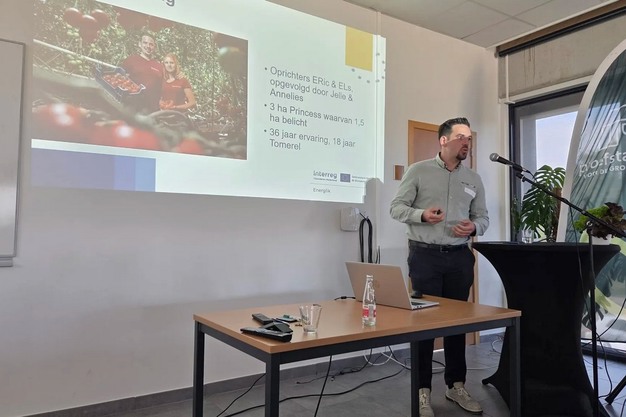 © EnerglikJelle De Ryck of Tomerel shared his experiences as a demo partner in the Energlik project.
Tomerel's experience in 2025
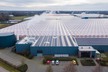
Tomato grower Tomerel, based in Melsele, joined the Energlik project as a demonstration partner. In their 1.5-hectare, non-lighted greenhouse, they focused on double screening and fine-tuning their climate control strategies.
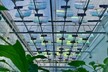
Originally, the greenhouse was equipped with an eight-year-old Luxous 1147 screen cloth from Svensson. In 2025, a second layer was added underneath—a 1147 Luxous H2no FR screen. During the crop review session, held on Thursday afternoon, grower Jelle De Ryck explained that he had the screens installed with a deliberate overlap when opening and closing. This setup later proved very useful for ventilation and dehumidification management.
Along with the new screen installation, two PAR sensors from Aranet were added—one above the truss, above the top screen, and another at crop-wire height. Jelle also monitors energy use closely with calorimeters on both the pipe rail and the low-temperature heating system.
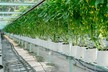
The crop, Marinice grafted on Maxifort rootstock, was planted on rockwool on January 8, 2025. The initial stem density was 2.5 stems per square meter, increasing to 3.75 by the end of the cycle. The first flowering occurred on January 21, and in total, 30 trusses were produced.
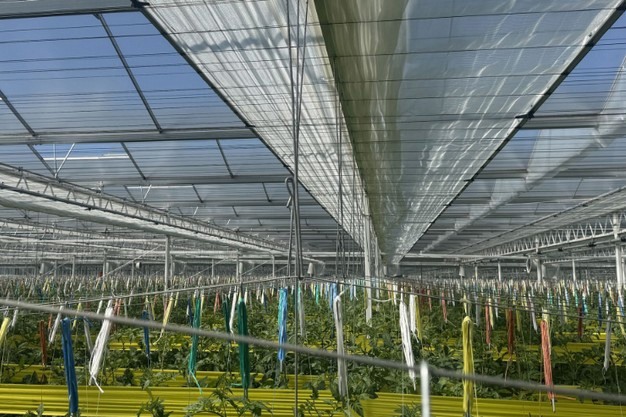 © TomerelDouble screens in the greenhouse at Tomerel
High relative humidity
The 2025 season didn't go entirely smoothly for Jelle. At one point, he had to manage three weeks without a climate computer, and he also faced issues with crazy roots, a condition that makes managing humidity even more challenging.
Jelle admits it's difficult to compare the 2024 and 2025 crops directly. The 2024 season lasted seven weeks longer, and the outdoor conditions were quite different—for instance, spring 2024 was noticeably darker. These variations make it tricky to draw one-to-one conclusions about performance or energy savings.
Still, there's one result Jelle is particularly pleased with: in 2025, he managed to dehumidify the greenhouse without using any pipe heating. He relied entirely on smart control of the screens and vent openings. Early in the crop, that was quite a challenge. At one point, the relative humidity shot up to 95%—far too high, as every tomato grower knows—but through careful adjustments, he managed to bring it back under control.
It was a valuable learning experience, showing how strategic use of screening and ventilation can keep the greenhouse climate stable, even without additional heat input.
No need for boiler heat
After crunching the numbers, Jelle shared during his presentation on October 2 that his non-lighted greenhouse achieved an 11% energy saving compared to the reference crop at the Research Station for Vegetable Production (Proefstation voor de Groenteteelt) in Sint-Katelijne-Waver. He was clearly satisfied with the outcome. Even during the coldest days of the season, he didn't need any additional heat from the boiler—something that used to be unavoidable in previous winters. For him, that's clear proof that he saved energy and that the combination of screen types played a key role.
Interestingly, despite the first quarter of 2025 being two degrees Celsius colder than in 2024, he still managed to save 5% on gas.
During the Energlik event, where both Jelle's findings and the researchers' own trial results were discussed, it became clear that growers are eager for more guidance when it comes to energy saving and adopting new technologies or climate strategies. The average Flemish grower simply doesn't have the same freedom as researchers to spend hours fine-tuning climate settings and experimenting with parameters.
Lieve Wittemans from the Research Station for Vegetable Production acknowledged this reality. She emphasized the value of involving practical, hands-on growers like Jelle in such trials. More than the exact numbers, it's about showing what's possible in real greenhouse conditions. When one grower demonstrates that new techniques truly work, it inspires others to explore them too—and that's where real progress begins.
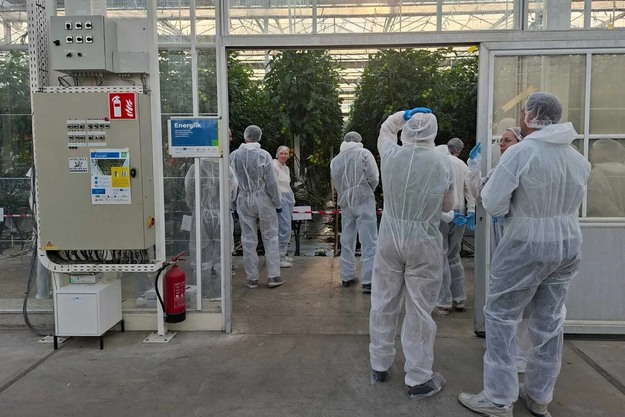 © EnerglikExceptionally, a group visit to the demo greenhouse at the Proefstation voor de Groenteteelt was possible on October 2. Without mobile phones or cameras. This photo comes from the researchers.
Update from the 2025 Trial in Sint-Katelijne-Waver
In 2024, researchers at the greenhouse in Sint-Katelijne-Waver achieved an impressive 48% reduction in energy use compared to the reference crop. The savings were particularly strong at night, reaching 52%, and 41% during the day. However, the researchers did observe some impact on yield—by June, production was about 10% lower than the reference crop. Even though the plants made up some of that difference toward the end of the season, they didn't fully catch up. For the tomato variety Bronski, the trial ended 2% below the reference yield, while Tobinaro actually performed 3% better than the reference.
These significant energy savings were achieved with relatively simple adjustments to climate control and screening strategies. The reference crop used a single Luxous 1147 screen cloth, while the trial crop used two layers: an aluminum night screen and an AC film that allowed high light transmission during the day.
The 2024 trials relied heavily on sensor-based climate control. A pyrgeometer was used to measure outgoing radiation, helping determine the optimal moments to close the screens. This was particularly beneficial in May, when the researchers found they could close the screens more frequently without compromising light levels. Additionally, two PAR sensors were used to fine-tune decisions about when to open the screens, ensuring the plants received the right balance of light and energy efficiency.
The results highlight how thoughtful use of data and relatively small tweaks in greenhouse management can lead to substantial energy savings while maintaining strong crop performance.
 © Energlik
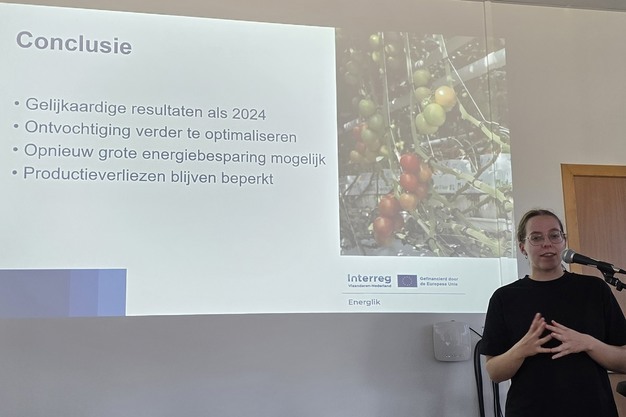
Evelien Rosier from the Proefstation voor de Groenteteelt discussed the trial results and compared the cultivations from 2024 and 2025
Adding dehumidification
In the 2025 trial, researchers added a dehumidification system to the setup. The system, called Air&Energy, was developed by Maurice Kassenbouw. In addition, the two screen layers were swapped in position, a change based on insights shared by Filip Bronchart from Ghent University.
During the presentation on Thursday, it became clear that, once again, there's a slight lag in production compared to the reference crop. However, the team is also achieving another remarkable level of energy savings. According to Evelien Rosiers from the Research Station for Vegetable Production, the ongoing trial is currently showing an energy reduction of around 51%.
One point of attention is the energy consumption of the dehumidification system itself, since dehumidifiers run on electricity. While the system effectively helps control humidity and improves climate stability, its electrical demand is an important factor in calculating total energy efficiency.
Overall, the 2025 results suggest that combining smart screen management with active dehumidification can push energy savings even further, though optimizing the balance between gas and electricity use will remain a key focus for the researchers.
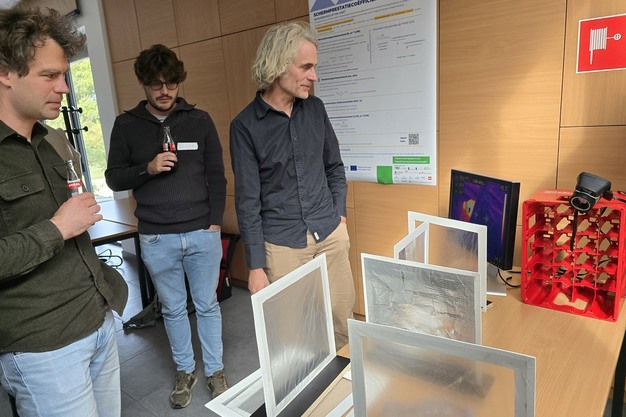 © EnerglikFilip Bronchart from the University of Ghent demonstrated how to compare screen cloths, including with the help of a thermal camera.
More figures
The presentations from the October 2 meeting can be viewed here on the Energlik website (link in Dutch).