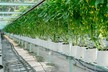
Greenhouse growers today are facing a perfect storm of rising energy prices, unpredictable CO₂ supply chains, and increasing pressure to reduce emissions. With traditional CO₂ sources, mainly from industrial emitters, becoming less reliable due to decarbonisation efforts, many growers are left scrambling for alternatives.
"We're seeing large emitters divert their CO₂ to permanent storage to meet climate targets," says Camille Hanna of Skytree. "That's great for emissions reporting, but it's leaving secondary users like greenhouses without the CO₂ they depend on."
For growers who already know Direct Air Capture (DAC), the next question is practical: Can DAC replace liquid CO₂ cost-effectively, reliably, and at scale?
The Skytree team believes the answer is a firm yes, and some greenhouse growers across Europe are already proving it in the field.
 © Skytree
CO₂ from the air
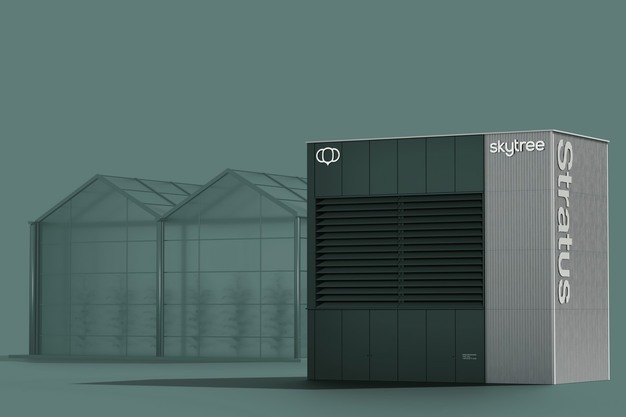
"Our modular DAC units pull CO₂ from ambient air, purify it to food- and greenhouse-grade quality, and deliver it directly to where it's needed," she explains. "It's a circular, decentralized model that offers full independence from fossil fuel-based suppliers."
In areas where CO₂ access is limited or unreliable, growers can now generate their own supply on-site. "You don't have to rely on a truck arriving or a boat docking. You've got CO₂, on demand, whenever you need it."
Like solar panels, but for CO₂
For greenhouse growers already using liquid CO₂, the switch is surprisingly straightforward. "You just stop ordering liquid CO₂," she says, "and instead install one or more of our DAC units at your facility."
The modularity is key. "Think of it like solar panels. The more CO₂ you need, the more units you install. It could be three units or 100, depending on the size of your operation."
Each unit can capture around 2.5 tonnes of CO₂ per day, which covers about three hectares of greenhouse space. "That's based on a typical usage rate of 100 kg of CO₂ per hour per hectare," she adds.
Waste heat and smart operation
One of the concerns among growers, particularly in places like the UK with high energy costs, is whether DAC is financially viable. Skytree has thought this through.
"The most energy-intensive part of DAC is heating the capture material, or sorbent," Hanna says. "But many growers already generate heat through gas boilers or CHP systems. In summer, when they don't need the heat, they're burning gas just to make CO₂, which is crazy when you think about it."
That waste heat can be reused to power the DAC units. "We can leverage existing waste heat, significantly reducing electricity consumption and operating costs."
Additionally, Skytree's systems are flexible to operate, allowing growers to shut down during peak electricity pricing and restart when rates drop. "We're actively working in the flexible energy market in the Netherlands and aim to bring that model to other regions."
When asked about the ideal energy source, Hanna is clear: "Renewable energy is always the best."
Whether it's solar, wind, or hydropower, Skytree's DAC units are compatible with various sources. "But even if renewables aren't available, the units still offer a cleaner alternative compared to traditional CO₂ supply chains."
 © Skytree
Seamless installation, low maintenance
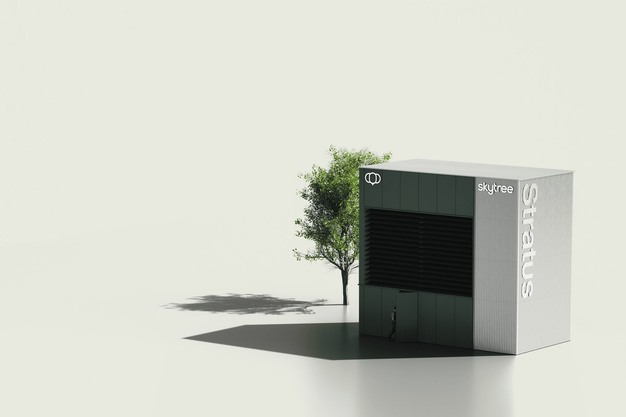
"All you need is a concrete pad and some basic piping," she notes. Skytree provides full support during assembly and commissioning.
Captured CO₂ is stored in a tank and delivered in the same way liquid CO₂ would be, so dosing systems don't need to change. "From an operational standpoint, it's business as usual for the grower."
She mentions that the primary consumable is their capture material, which only needs replacing every five years. " This is also included in our annual maintenance package."
Sustainability drive
Beyond cost and convenience, DAC aligns with the broader climate goals many growers are now being asked to meet.
"In the Netherlands, for instance, growers must phase out natural gas by 2030. If they stop burning gas, they lose both heat and CO₂. DAC becomes a critical piece of the puzzle to replace that CO₂ and meet sustainability targets."
Proof it works
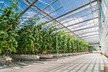
In 2024, Skytree installed its first commercial unit at WUR. "They ran a year-long pilot comparing DAC-sourced CO₂ to traditional liquid CO₂ on cucumber growth," she shares.
"There was no significant difference in yield or plant health. That's exactly what we hoped for as it proves DAC is a viable, one-to-one replacement."
Looking ahead, Skytree is expanding rapidly. "We've publicly announced partnerships with growers like Koppert Cress and Harry Wubben Flowers through our Pioneer programme," she adds. "And our 2026 order book is already filling up."
For more information:
Skytree
[email protected]
www.skytree.eu