During a recent Israeli agri-tech trade mission to South Africa, Ruhann van der Walt, Field Service Representative at BioBee South Africa, addressed an audience of growers and industry professionals on the practical implementation of biological pest control and integrated pest management strategies. His insights highlighted BioBee's commitment to environmentally friendly, economically feasible, and scientifically proven alternatives to conventional chemical pesticide use.
The puzzle is pest management as a whole
"We don't just release insects," he begins. "What we're working on is called IPM and I always say it's part of a puzzle. You have to build it into your programme and not as the entire solution to existing problems."
That puzzle, according to Ruhann, is what allows growers to reduce dependency on synthetic pesticides while maintaining, and in many cases improving, fruit quality and yield. BioBee's mission, as he framed it, is clear: "To help you, the growers, the industry, to implement these biological predators into your chemical programmes, to reduce your chemicals so they are much more sustainable for the future."
 © HortiDaily
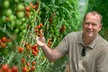
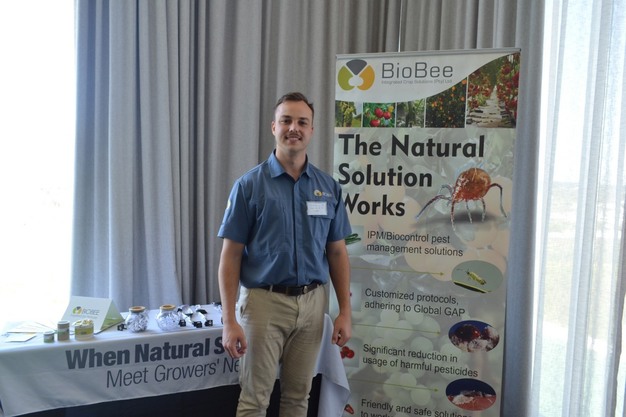
Ruhann van der Walt, BioBee Field Representative, at the Israel - South Africa trade mission connecting event
BioBee's global reach, local expertise
BioBee South Africa is part of the international BioBee network, originally founded in Israel. With sister companies in the USA, Canada, Mexico, Colombia, Chile, and Peru, BioBee is a global leader in biological pest control and natural pollination. Notably, the South African arm is the only BioBee branch not fully owned by the Israeli parent company. "We have local investment partners like H2O here in South Africa," he notes, "which helps us stay connected to the realities on the ground."
From citrus orchards in Citrusdal to vineyards in the Western Cape and berry farms in the north, BioBee South Africa has boots on the ground. "We want people on the farm," he emphasizes. "We want to scout with you, support you, and help implement tailor-made IPM programmes."
Scouting as a cornerstone of success
"Scouting is very important. It's not just about the release. You have to go scout to see if you are successful or not. Are the beneficials going up or not? We need the data, and technology today is helping us get better knowledge."
He explains how BioBee's field teams work directly with growers, offering technical advice, monitoring pest populations, and making real-time adjustments to biological programmes. "It's about building a winning strategy tailored to the grower's needs."
 © Amandus Strydom – Aviemedia
Predators at work: Nature's pest control
A highlight of the presentation was Ruhann's deep dive into the beneficial insects BioBee produces and supplies. "We supply the agricultural sector with beneficial insects like Cryptolaemus montrouzieri – the mealybug destroyer – Aphidius, a parasitoid wasp, and Phytoseiulus persimilis, a red spider mite predator."
Describing how these natural enemies work, he explains, "The parasitoid lays its egg inside the pest, eats it, and flies out to search for more. When you see them work, it's incredible to see just how nature works. That's what we want to help you implement: nature's solution, the natural way."
Crop focus: From citrus to berries
"Citrus is our biggest market in South Africa," he elaborates, "from the Eastern Cape to the North. But we also work extensively with table grapes, wine grapes, strawberries, stone fruit, ornamentals, vegetables, and increasingly, blueberries and peppers."
He pointed to red spider mite as a growing concern in many of these crops and highlighted new research efforts focused on watermelon. "A lot of research has been done in Israel on the control of red spider mite on watermelons, and we're really looking to grow that in South Africa."
Pollination innovation: Beyond the bee
On the pollination front, he acknowledges limitations in the current use of bee species in South Africa. "The bees we supply in South Africa are not the correct bees for pollination," he says. "That's why we've started collaborating with BloomX, an artificial pollination company. It works! You collect the pollen and reapply it when the flower turns female, which increases yield and crop quality."
Although bumblebees are a key part of BioBee's natural pollination strategy globally, they are not yet introduced in South Africa due to regulatory and ecological factors. However, Ruhann hinted that the new technologies are helping bridge this gap.
"We are currently looking for solutions to problems that haven't even become problems yet," he remarks. "That's why we have an R&D team here and in Israel. We are really invested in the industry."
For more information:
BioBee
Ruhann van der Walt, Field Representative
[email protected]
biobee.co.za