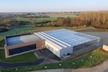
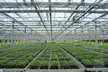
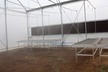
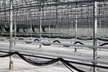
The Manavgat area of Antalya, the biggest banana-producing city in Turkey, has seen a sharp rise in greenhouse production in recent years. The harvest has started, and banana production has increased in Manavgat and numerous coastal regions thanks to incentives for greenhouse production.
With the aid of subsidized agricultural loans, grants, and producer support, banana production—which until 2015 could only be carried out openly in the Gazipasa and Alanya districts of Antalya and the Anamur and Bozyazi districts of Mersin—has nearly quadrupled. For many years, bananas were grown in open spaces along the shore in Anamur, Bozyazi, Alanya, and Gazipasa. Today, they may be harvested all year round in greenhouses in practically every coastal district of these two provinces, especially in Manavgat.
Banana production, which ranged from 210 to 270,000 tons between 2010 and 2015, has climbed significantly since 2016, according to the Turkish Statistical Institute's (TurkStat) annual crop production statistics, which are based on data from the Ministry of Agriculture and Forestry. From 2016 to 2021, it increased from 305,000 tons to 997,000 tons. In 2023 and 2024, it dropped to 930 thousand and 875 thousand tons, respectively.
Over 2,000 hectares have been planted in greenhouse areas in the Manavgat district, which has grown to be one of the most significant hubs for greenhouse production. One of the pioneers of greenhouse banana production in Manavgat, Mustafa Sami Atalay, who has been growing bananas in greenhouses for eight years, explained that the number of greenhouses has rapidly increased from 30 - 50 hectares seven years ago to over 2,000 - 2,500 hectares today. According to Atalay, while bananas can be grown in open fields in Gazipasa and Alanya, which are located east of the Alara Stream in Antalya, they cannot be grown in open fields in areas west of the stream, including Manavgat and Serik, but they can be grown in greenhouses. "Banana harvesting is generally done twice, once in the September-November period, and once in the February-April period," Atalay stated, referring to the fact that the harvest season has now begun for banana production in both open fields and many greenhouses.
Mr. Atalay added, "A few greenhouses are capable of harvesting for a full year. This is because it is all about heating and sprouting. Bananas can be harvested throughout these two times if you wait for the sprouting phase. But if you do it in a greenhouse, you may save almost three months' worth of earnings by using the first seedlings to grow and by building the heating and climatic control systems."
An average of 8 tons of bananas are produced per 1,000 square meters, according to Atalay. He added, " In previous years, if the price was around $1/ kg, banana farmers would make money. However, labor, diesel, and fertilizer costs have skyrocketed in recent years. Therefore, now the price needs to be above 1 USD / kg for the banana growers to earn some profits."
Banana greenhouses don't produce greenhouse gases; rather, they produce oxygen, according to Atalay, who pointed out that a 1,000 square meter banana greenhouse has 180 trees."With drip irrigation, we provide water continuously—one, two, three hours a day," Atalay remarked in response to complaints about the excessive water use in banana cultivation. "All of this water is used by the plants. There is no evaporation, no bursting, and no water waste. You're using water, creating stuff, and making a substantial economic contribution. It cannot be produced without the use of water. It would be incorrect to think of water use as waste."
Souce: Iletisim Baskanligi