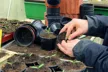
Positive results have been obtained from a project started by the CAYKUR Tea Research Institute in Rize to use leftover tea fibers in hydroponic agriculture. With a high water-holding capacity, a new, local substitute for cocopeat has been developed through work done in a specialized greenhouse. The newly developed product, named "teapeat", has produced great plant and seed yields and is intended to replace cocopeat imports for hydroponic farming.
An initiative to recycle leftover tea fibers—a vital agricultural resource in the Eastern Black Sea region—for use in soilless agriculture has been started by the CAYKUR Tea Research Institute. Numerous scholars and scientists from Recep Tayyip Erdogan University, Karadeniz Technical University, and Ankara University have backed the research, which has produced encouraging results. An innovative, regional substitute for "cocopeat", a natural soil made from coconut fibers by processing and compressing coconut shells, has been developed through research carried out in a dedicated greenhouse at the Ataturk Tea and Horticulture Research Institute. This new product is utilized in landscaping and agriculture because of its great water-holding capacity. Along with experiments on a variety of plants and seeds, the substance has been dubbed "teapeat," and it has produced positive effects on plants, including tomatoes, beans, and squash. "Teapeat" has entered the commercialization phase and is anticipated to contribute to greenhouse and landscaping applications in addition to playing a major role in preventing material imports for hydroponic agriculture.
"Here, our goal was to transform tea fibers and waste into a high-value-added product," explained Dr. Atilla Polat, Deputy Director of the Ataturk Tea and Horticulture Research Institute, in an explanation of the research. "Additionally, we wanted to offer a substitute for the "cocopeat" product, which is imported into our nation and causes a foreign exchange outflow. We produced the "teapeat" product and carried out initial research by putting tea fiber through several stages of processing. We, as an institute, carried out the first preliminary research ourselves. Production research on various plants and seeds was the main focus of this phase. We were successful with seeds like beans and squash. We also tested it on tomatoes and saplings, and after seeing excellent results, we started working on a larger-scale commercialization of this idea. Three universities are collaborating with us on this process."
Dr. Polat added, "Cocopeat is currently used in greenhouse activities in our country, especially for ornamental plants. Not all places have the right soil conditions, so growers use cocopeats for hydroponic production. Greenhouse operations enable more frequent harvests and higher yields per unit area. For instance, you can boost the yield from once or twice a year to four, five, or even six if you let it follow its natural cycle. Or, for example, you may receive one unit of yield during a typical cycle, but you can obtain two or three units by guaranteeing ideal circumstances in regulated areas. We hope that fiber-based goods made from tea will eventually replace coconut in the context of sustainable agriculture."
Source: DHA