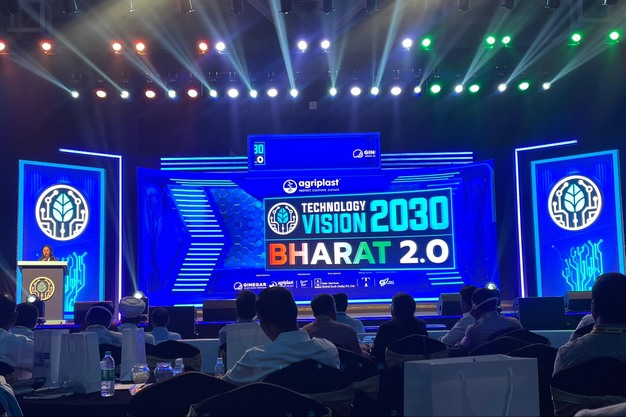
Bengaluru is the Indian hotspot of horticulture this week. Today, the trade show HortiConnect India kicked off, but yesterday Technology Vision 2030 conference took place, focusing on challenges and opportunities in the horticultural market. With over 600 growers present, a lot of knowledge was shared and spread.
 © Alysha Fernandes | HortiDaily.com
The conference opened with Mrs Ranjana Roy expressing the need for farmers to deal with ways to overcome climate uncertainties, shrinking farm lands and growing more with less. The conference sees the attendance of more than 600 farmers from across India who wish to get inspired and take home knowledge on protected cultivation, precision farming and data sciences.
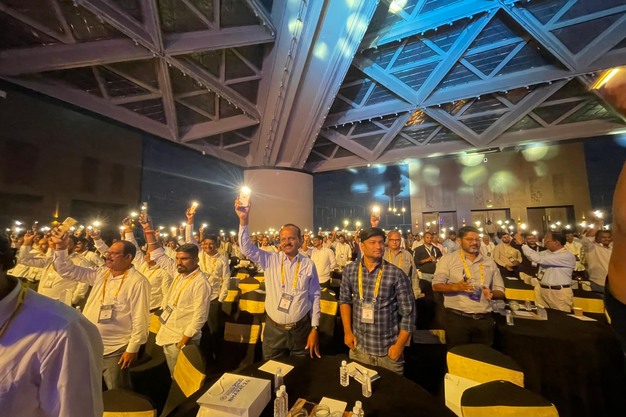 © Alysha Fernandes | HortiDaily.comRajeeb Roy continued the inaugural address with an interactive demonstration of how the conference intends to add value. He ask ed everyone in the audience to take out the lowest currency denomination, hold it up in their hands and then tear the note apart. Predictably, no one did so. And then he said, just the way they love their money, so should they be mindful of investments made in horticulture and greenhouses. He shared a 5M formula to success - having the right mindset, measurement tools, growing methods, mentorship and momentum. He concluded by saying it's a myth that Indian growers cannot match global yields and the conference speakers would later share case studies to fittingly prove otherwise.
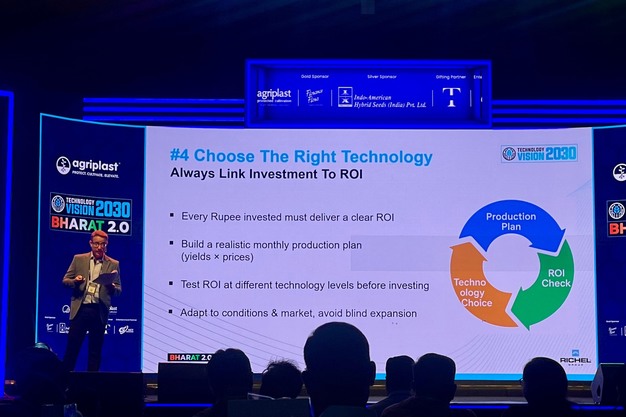 © Alysha Fernandes | HortiDaily.comJulien's topic was building the future of greenhouses in India. He started by saying that greenhouses are still in their earl y stages, which he sees as an opportunity. While describing different levels of greenhouses (low, mid and high tech), he explained that the majority of India's greenhouses are low tech or passive. He explained different kinds of growing challenges in India, 4 main ones being variable climate, low knowledge, low yields and lack of greenhouse design sense; then explained how greenhouses can overcome heat, monsoon, humidity, pest and productivity pressures. The next set of challenges facing greenhouse agripreneurs is bridging supply with demand, including distribution, pricing, cold chain and retail support. He summarized key success factors for greenhouse projects, which involve choosing the right climate, mastering growing before scaling, focusing on one crop at a time, and choosing the right technology.
 © Alysha Fernandes | HortiDaily.com
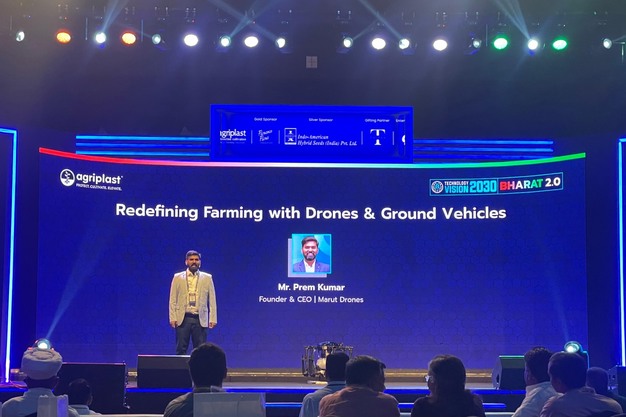
Prem Kumar spoke of how drones are supporting farming practices to enhance productivity by 2x, saving on input costs (energy and water), and saving on labour (one drone can do the work of 6-8 field workers). The biggest challenge, he said drones address is the cause of 40% of the farming community being afflicted by cancer due to pesticide spraying, about 145 million pesticide poisoning cases are reported per year. The other challenge is the lack of labour post covid and lack of knowledge on what plants need. Drones can be programmed to disburse ultra low volume formulations of pesticides, saving almost 90% chemicals and 25% water. They can be designed with spray nozzles specific to crop type. Besides this, they are currently being used in India for Ariel survey, crop health monitoring, transplanting and seeding to reduce seed wastage and ensure uniform planting, pollinating over 30 crops, including wheat, sugarcane, paddy, grape, pomegranate, mango, and banana.
 © Alysha Fernandes | HortiDaily.com
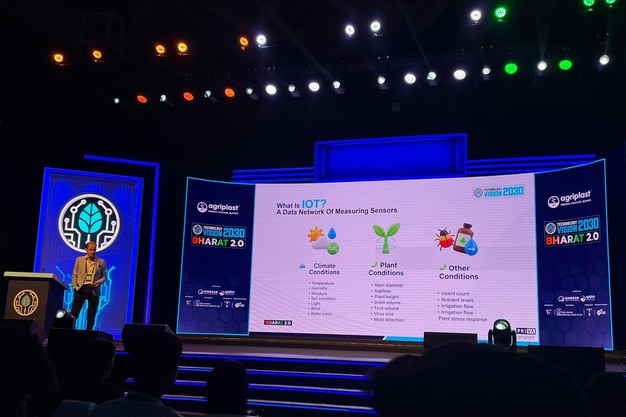
Next Eric and Raghu talked about the use of AI and IOT in farming. Eric opened with describing India's 150 million hectare landscape. Key crops continue to be banana, mango, potato, onion, tomato, cauliflower and eggplant. Inside greenhouses the focus is on high value crops like bell peppers, tomatoes, strawberries and roses. He also highlighted productivity challenges in India in the context of limited land availability, comparing a greenhouse in India with a low yield of 60-100 tons/hectare to the Netherlands having 500-600 t/ha for tomatoes. He touched on the role of IOT in monitoring climate (light, wind, water, temperature, humidity, moisture, soil) and plant conditions (stem diameter, sap flow, plant height, drain volume, fruit volume, virus size, mold detection.)
 © Alysha Fernandes | HortiDaily.com
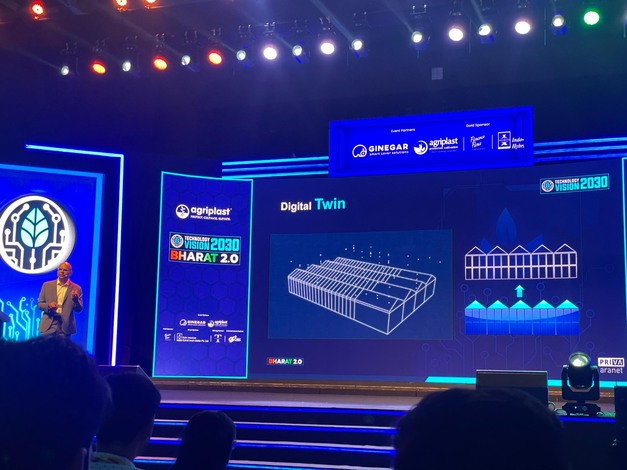
Raghu then took over the talk and emphasised the cost of human error/lack of knowledge on productivity. "Can't put your investment in the hands of someone who copies the previous day's irrigation data." He started with the concept of creating a virtual copy of greenhouses (called a digital twin) to be able to make them scalable and profitable through proper crop controls and planning with the help of cloud technology, IOT, AI, vision technology and robotics. He mentioned technologies developed by Priva for crop picking, pesticide dosing, pollination, crop scouting. He concluded with advice for first building strong basics and then focusing on building a reliable heart and brain for greenhouses, including automating irrigation, climate control and growing and implementing AI for that right growing architecture that removes all the guesswork.
 © Alysha Fernandes | HortiDaily.com
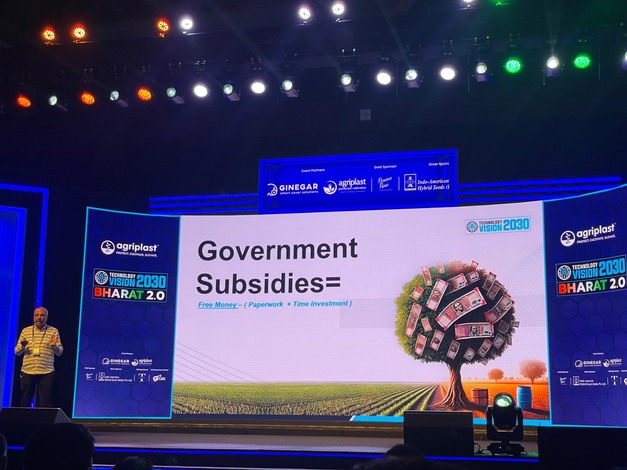
Brajendra Singh, Former Director of the Indian National Horticulture Board, addressed growers on the importance of shifting their mindset from simply farming to thinking like entrepreneurs. With capital access and government support improving, his presentation detailed various subsidies for horticulture and greenhouse projects—covering application processes, eligibility, documentation, and benefits. He concluded by urging participants to adopt modern farming systems while leveraging financial support to scale their horticultural ventures.
 © Alysha Fernandes | HortiDaily.com
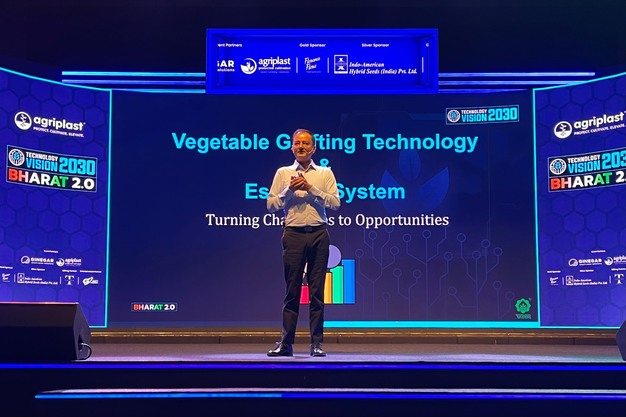
Vimal Chawda of VNR Seeds highlighted the role of grafted crops and espalier systems in boosting scale and profitability, both in greenhouses and open-field cultivation, while ensuring sustainability. He explained that grafted seedlings are effective for tackling soil-borne diseases, helping reduce significant losses in crops like tomatoes, eggplants, and bell peppers. Traditional solutions such as crop rotation, fumigation, and solarization, he noted, are less effective today due to low acceptance, yield impact, and land/weather constraints. Grafted seedlings, a technique pioneered in Japan where watermelon plants were grafted onto pumpkin rootstock, help combat biotic stress like bacterial wilt and root rot as well as abiotic stress from salinity, acidity, or nutrient imbalance. This method supports off-season production, stabilizes crop prices, and reduces chemical dependency, fostering sustainable agriculture. Similarly, through espalier techniques that enhance sunlight utilization, he showcased how guava and pomegranate benefit from high-density planting, easier management, and improved returns per acre.
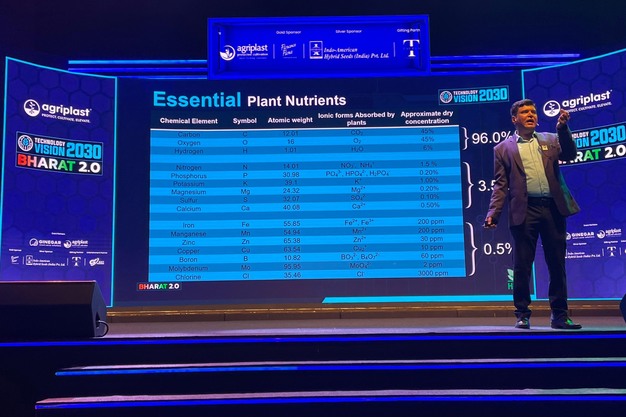 © Alysha Fernandes | HortiDaily.comSachin Kulkarni of Haifa Group, Israel, fo cused his talk on plant nutrition as a critical determinant of farming profitability. He emphasized that nutrition plays a central role whether cultivation is open-field, polyhouse, or hydroponic. His session shared practical, field-tested guidance tailored to Indian growers with limited resources and budgets, recommending cost-effective fertigation systems to improve yields, optimize water and input use, reduce mismanagement, and lower costs.
 © Alysha Fernandes | HortiDaily.com
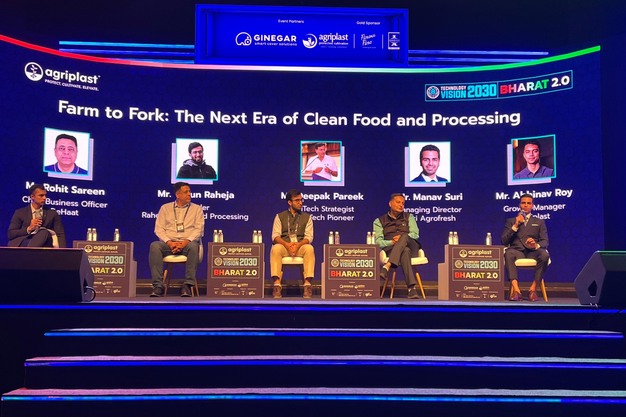
In a subsequent panel discussion moderated by Abhinav Roy (Agriplast Tech), Rohit Sareen (Dehaat), Varun Raheja (Raheja Solar Food Processing), Deepak Parikh (AgriChain), and Manav Suri (Suri AgroFresh) explored ways to turn challenges—particularly post-harvest losses—into opportunities. Raheja demonstrated how affordable solar tunnel dryers enable farmers to preserve produce without chemicals or electricity, transforming surplus into shelf-stable products and creating decentralized, clean food processing. Deepak highlighted government efforts to close infrastructure and subsidy knowledge gaps.
The panel also discussed how post-harvest losses often undo months of farmer effort, with many growers spending almost three-quarters of the year cultivating their crops only to lose them after harvest. To address this, Dehaat and SuriAgro Fresh are extending storage and logistical support backed by strong SOPs, helping farmers protect their produce and realize fair value for their hard work.
 © Alysha Fernandes | HortiDaily.com
When asked about farmer earnings, Deepak noted that while farmers contribute 70% of the work, they receive only 18% of the value. All panelists agreed that providing high-quality seeds is the first step toward improving outcomes. However, given India's lack of IP protection for breeders, they stressed the need for private sector collaboration with global partners. Rohit emphasized varietal innovation as key for enabling farmers to profitably sell their entire produce, especially in export markets. The panelists also underlined the importance of decentralized infrastructure, traceable supply chains, and delivering food that is not only nutritious but also responsibly sourced.
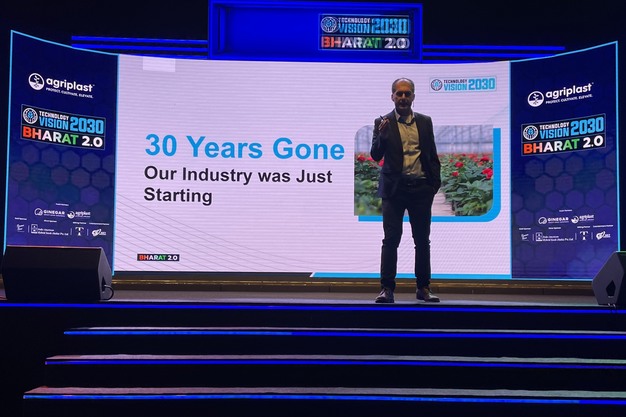
Alasker Napso of Ginegar showcased how advanced greenhouse films, specially designed for Indian conditions, play a transformative role in modern horticulture. He pointed out that these films are often misunderstood as simple plastic covers meant only to protect structures from rain, whereas in reality they are high-technology components critical to a greenhouse's performance and profitability.
 © Alysha Fernandes | HortiDaily.com
He explained that greenhouse films directly influence the shelf-life, productivity, and quality of crops by regulating several environmental factors. For instance, they can filter and control different parts of the light spectrum, manage solar radiation, and optimize diffusion—ensuring uniform light penetration that supports healthier, more consistent plant growth. By fine-tuning the balance of light direction and photosynthetically active radiation, growers can significantly improve yields, coloration, and fruit quality.
Equally important is the role of these films in protecting crops from external threats. Napso demonstrated how specific films are engineered to reduce insect entry and restrict viral transmission, thus minimizing pest pressure without over-reliance on pesticides. He also highlighted options like thermal films, which help stabilize temperatures during extreme weather, and anti-drip films that prevent condensation from falling onto plants and spreading disease. He concluded with saying, "adopting the right greenhouse cover is not merely a protective measure but a strategic investment for long-term productivity and sustainability.
 © Alysha Fernandes | HortiDaily.com
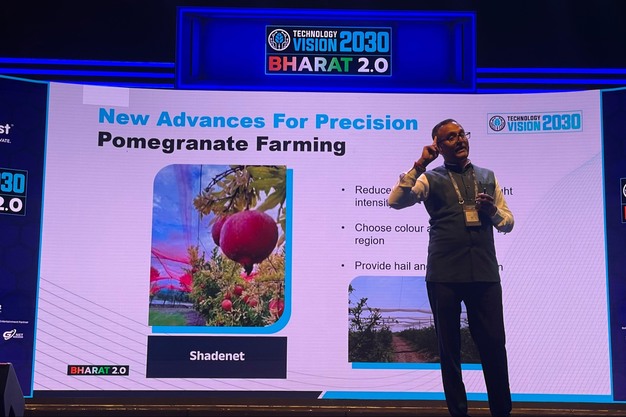
BT Gore of Farm DSS focused on pomegranate farming, noting that a healthy tree can live up to 50 years, though few farmers realize its full potential. Challenges such as water scarcity, soil salinity, and pest infestations could be overcome, he argued, by re-examining traditional practices with scientific approaches in fertigation, pest control, and regulated protected cultivation. He showcased how his team supports pomegranate growers in semi-arid regions using solutions like mulch films, weed mats, English covers, and shade nets—all aimed at tapping into the lucrative global market for pomegranates.
 © Alysha Fernandes | HortiDaily.com
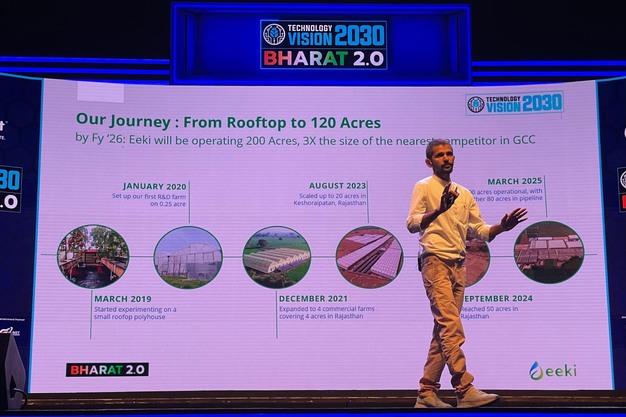
The final speaker on stage, Amit Kumar from Eeki, shared his team's greenhouse innovations in vegetable farming. Detailing the production of up to 17 kg of tomatoes per square meter with minimal water on Rajasthan's barren land, he described their journey of overcoming initial climatic and disease-related hurdles. Their research-led interventions in root health, temperature shock prevention, and nutrient absorption helped stabilize results. He emphasized that humidity management outweighed temperature control, while taller greenhouse designs and improved ventilation delivered better outcomes. Amit also addressed the critical issue of consistency in supply for Indian retailers, underscoring the importance of crop planning, SOPs, accountability, and continuous learning. Eeki's data-driven precision farming approach now extends across 100+ acres, producing affordable, high-quality vegetables without reliance on fertile soil or excess resources.
 © Alysha Fernandes | HortiDaily.com
The conference closed with a networking dinner and a vibrant cultural performance by the acclaimed Uzbekistani group Havas Guruhi, led by the Ermatov family, celebrated worldwide for their unique renditions of Indian music.

For more information:
Technology Vision 2030
https://www.agriplast.co.in/technology-vision-2030/
HortiConnect India 2025
Tel: +91 91646 78631
Email: [email protected]
www.horticonnectindia.com