When Hudson Takano checked on his experiment in the greenhouse at Colorado State University's Weed Research Laboratory, he thought he'd made a mistake.
That morning, Takano, a doctoral student in CSU's Department of Agricultural Biology, had sprayed a plot of plants with a new herbicide he'd been developing as part of a project overseen by weed science Professor Franck Dayan. When Takano checked the plants before heading home at the end of the day, they already looked unhealthy. It seemed the herbicide mixture was far more effective and quick-acting than Takano and Dayan had expected.
"I originally thought I'd sprayed the wrong product," said Takano, who now has a lead role developing crop protection products for Corteva Agriscience, a leading global agriculture company. "I repeated the study the next day and observed the same effect. It was a very surprising moment – and a really cool one."
"There are always concerns about the environmental impacts of pesticides and other compounds we are putting out in nature," Dayan said. "If we can find methods where we get the same control with lower amounts of pesticide, that's a great outcome."
This was back in 2019. Takano and Dayan had figured out that blending two common herbicides created a synergistic effect that made the resulting mixture more potent while also requiring much less of each herbicide to be effective. No one had unlocked this interaction before, and there have been more than 80 patent applications filed globally tied to the discovery, including in the United States, Brazil, Argentina and Australia.
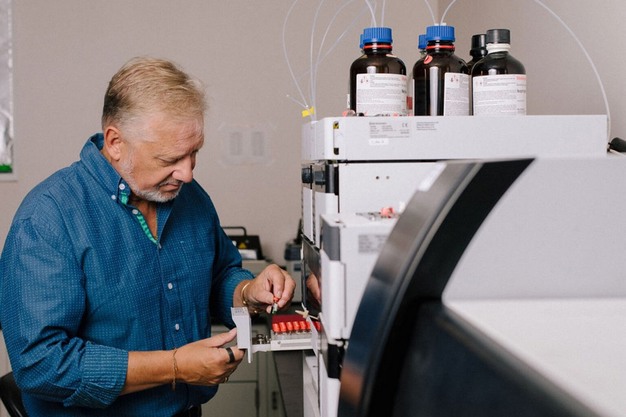 © Colorado State UniversityWeed science Professor Franck Dayan's research encompasses applied projects on herbicides and the evolution of resistance in weeds.
The herbicide discovery demonstrates how faculty innovations in the lab can move into commercial spaces to gain global reach, while also generating revenue to further support university research.
The research was initially funded by Bayer, a global pharmaceutical and life sciences company, under what's known as a sponsored research agreement. Bayer later sold part of the company that included this work to BASF, a leading chemical company based in Germany.
In this case, Dayan and Takano are co-inventors on the applications along with representatives from BASF. The CSU researchers and the university at large would receive royalties from any resulting commercial product developed by BASF — revenue that is reinvested in other research and technology transfer work at CSU.
"We were super excited," Dayan said. "The herbicide industry is a big industry — a big space where people are trying to come up with solutions, trying to be more creative than the way we've been in the last 80 years. So, the step forward on this is that you could use less herbicide for a better outcome."
The big business of controlling weeds
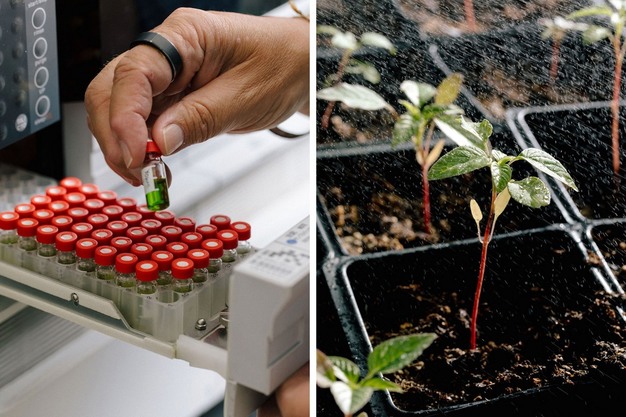
Controlling weeds is big business. The global herbicide market is valued at around $40 billion annually, and projections indicate it could surpass $65 billion in the next decade. Companies spend hundreds of millions each year on research and development, seeking new ways to increase food production for a booming population while also diminishing the potentially harmful environmental effects of herbicides.
 © Colorado State University
"The grand challenge," said Amy Charkowski, research associate dean in the College of Agricultural Sciences, "is to find entirely new ways to manage weeds that are both more sustainable and more targeted so that they have less environmental impact."
And it's not just herbicides companies are investigating; they are also exploring the use of lasers, drones and robots to control weeds in large-scale agricultural operations.
Dayan and Takano started their project in 2017. At the time, there was a particular herbicide, glufosinate, that worked especially well with certain crops, but only under the right environmental conditions: hot, sunny and humid. Bayer was interested in finding ways to improve glufosinate's effectiveness in other conditions and enlisted Dayan's lab to investigate.
"There are always concerns about the environmental impacts of pesticides and other compounds we are putting out in nature. If we can find methods where we get the same control with lower amounts of pesticide, that's a great outcome," said Franck Dayan.
First, Dayan and Takano needed to know more about how glufosinate worked on a molecular level. "In order to fix something, you first need to understand the problem," Takano said. "Professor Dayan and I did a number of studies to understand the different conditions and look at the metabolism of the plant."
They learned glufosinate worked by causing an accumulation of a particular toxic molecule in the plants, known as reactive oxygen species. "These are the same kinds of agents that make us age," Dayan said. "Plants have a lot of mechanisms to quell these things, but the herbicide makes so much of it accumulate that it overwhelms the plant."
Dayan and Takano then sought ways to manipulate the process. They discovered that combining glufosinate with a different class of herbicide, known as a PPO herbicide, caused an increase in the accumulation of reactive oxygen species, killing the weeds more quickly. What's more, it only required about half the normal amount of glufosinate and 1/30th the typical amount of the PPO product.
Charkowski said the discovery has the potential to greatly reduce the amount of herbicide being used. "This is a great example," she said, "of a scientist combining in-depth knowledge of plant metabolism and fundamental biology with agricultural knowledge and making a very high-impact and valuable discovery."
A dream come true
Takano was raised on a farm in southern Brazil. His father grew a diverse set of crops, including cassava, corn and soybeans. Takano remembers his father struggling at times to control the weeds. "We would have to hire people to come weed by hand," he said. "I was one of them!"
Takano represents the first generation in his family to pursue higher education. He received his bachelor's and master's degrees in agronomy and weed science in his home country. Then, he met CSU College of Agricultural Sciences Professor Phil Westra at a conference in Brazil and got excited about the idea of coming to study in Fort Collins. Takano applied and was accepted into a doctoral degree program in the Department of Agricultural Biology, graduating in 2020.
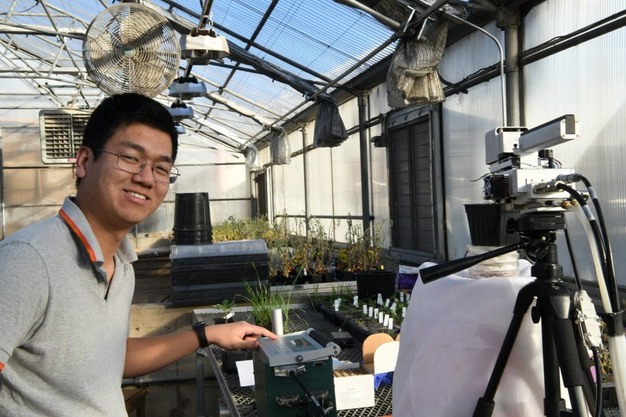 © Colorado State UniversityHudson Takano worked with Dayan on the groundbreaking project as a doctoral student
"This was almost like a dream come true," Takano said. "CSU has one of the best weed science programs in the world. To be able to work there and get my degree there – I was very excited and motivated by that."
Takano always thought he would eventually return home to help on the family farm. His time at CSU, however, also helped him realize that he can be useful from farther away. After earning his doctoral degree, he landed a job at a leading agriscience company, where he continues to work on developing new technology and products that can help farmers.
"I think that's one of the benefits of the type of science we do," Takano said. "Yes, it's a little more basic compared to some other ag research, but we're so close to growers and their problems; you can see the return on your work more rapidly."
In this case, some outstanding questions remain, including the need to better understand how crops that are resistant to glufosinate will tolerate this new mixture. But BASF has already invested significantly in this work — and Dayan hopes the company will eventually use the information to develop a new commercial product for the market.
Source: Colorado State University