Demethylation Inhibitor (DMI) fungicides have been used in agriculture for decades. Propiconazole, one of the earliest examples, was first registered in 1981 and remains in use today. Newer DMIs, such as mefentrifluconazole (Cevya), offer greater efficacy and more favorable toxicity profiles. All DMIs belong to FRAC code 3, meaning they are single-site fungicides susceptible to resistance development. For this reason, they should be applied in moderation and only as part of an integrated resistance management program.
In fruit production across the United States, DMIs are important tools against diseases such as powdery mildew and anthracnose in strawberry; brown rot and leaf rust in peach; leaf rust, mummy berry, Phomopsis twig blight, and septoria leaf spot in blueberry; and cane diseases, rusts, powdery mildew, rosette, and leaf spots in blackberry.
For strawberries, registered DMIs for powdery mildew control include flutriafol (Rhyme), difenoconazole (Inspire), mefentrifluconazole (Cevya), myclobutanil (Rally), tetraconazole (Mettle), and triflumizole (Procure). In South Carolina, powdery mildew is typically not a major issue in annual plasticulture systems outside tunnels, so DMIs are not commonly used. However, renewed interest in these fungicides has emerged because of their reported activity against Neopestalotiopsis disease.
Laboratory studies have shown that difenoconazole (Inspire) and propiconazole (Tilt) effectively inhibited Neopestalotiopsis mycelium, with average EC50 values of 0.2 and 0.5 µg/ml, respectively. By comparison, flutriafol (Rhyme) was less effective in vitro, with an EC50 of 8.4 µg/ml. In field trials conducted between 2020 and 2024, difenoconazole (applied as Inspire and Regev) and flutriafol (Rhyme) demonstrated the strongest suppressive action against Neopestalotiopsis fruit rot. These products were applied weekly or in biweekly rotations with Thiram (Baggio et al. 2021, 2023; Rebello et al. 2023, 2024; Gama et al. 2022). Interestingly, the grower standard programs—usually based on Thiram and Switch rotations—were only slightly more effective. Despite its weaker laboratory profile, flutriafol performed as well as difenoconazole in the field, even when applied at the same per-acre rate. Overall, trial results suggest that DMIs provide measurable, though limited, suppression of Neopestalotiopsis. Importantly, even the best treatments achieved less than 50% control, highlighting the difficulty of managing this disease with fungicides alone.
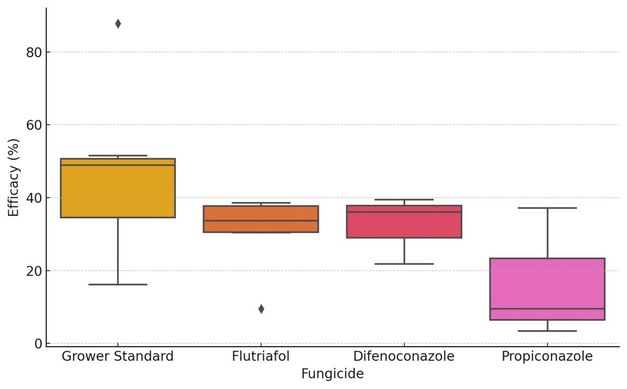 © Southern Region Small Fruits ConsortiumEfficacy (%) of DMI fungicides against Neopestalotiopsis fruit rot relative to the inoculated, untreated control of field trials published in Plant Disease Management Reports (PDMR) reports from 2020-2024.
Some drawbacks accompany DMI use. Certain fungicides in this group can act as plant growth regulators, causing stunting and other phytotoxic effects. Propiconazole, in particular, has been linked to growth suppression in strawberries. Studies have documented mild phytotoxicity such as stunting, leaf scorching, and dark green foliage (Freeman et al. 1997; De los Santos and Romero 2002). A later study found reduced yields in strawberries treated with propiconazole-containing products after multiple applications (Mertely et al. 2010).
Recent work at Clemson University's Musser Fruit Research Center tested the impact of DMI fungicides on 'Albion' strawberries. Treatments were applied at 10- to 14-day intervals, beginning seven days after planting and resuming in spring growth. All programs included Thiram, either alone or mixed with a DMI fungicide: Propi-Star (propiconazole), Inspire (difenoconazole), or Rhyme (flutriafol). Results showed that three consecutive fall applications of Thiram combined with Propi-Star slightly reduced canopy size, but there were no significant differences in yield. Similarly, in spring-only treatments, slight canopy reduction occurred with repeated Propi-Star use, but no yield loss was recorded.
In summary, DMI fungicides flutriafol (Rhyme) and difenoconazole (Inspire, Regev) caused no negative effects on strawberry growth or yield when applied up to three times in either fall or spring. Propiconazole (Propi-Star), however, produced minor stunting effects and should be used cautiously. Because DMIs are prone to resistance development, applications should be limited to no more than two or three per production season.