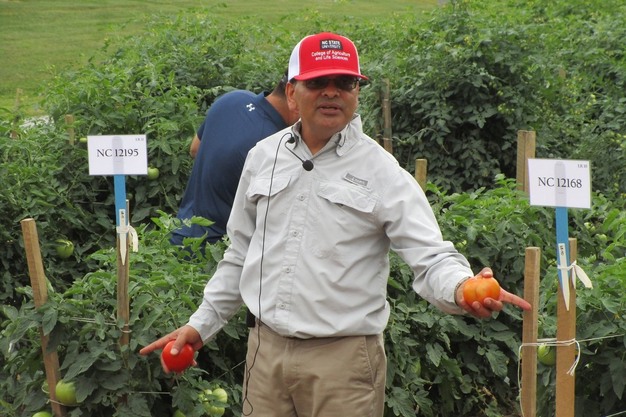
Tomatoes are an important crop around the world, not just in North Carolina. No one knows this better than Dr. Dilip Panthee, Associate Professor at N.C. State University and Head of the Tomato Breeding Program at the Mountain Horticultural Crops Research and Extension Center in Mills River. From growing up in Nepal to researching new tomato varieties for North Carolina growers, Dr. Panthee has spent many years in the tomato industry to improve and further the crop for farmers.
 © N.C. Department of Agriculture and Consumer Services
During his high school and college years, Dr. Dilip Panthee spent many hours in agricultural research in his hometown of Nepal. Following graduation, he worked as an Assistant Plant Breeder for many years before moving to the U.K. and obtaining his Master's Degree in Tomato Research. "The tomato has always been an important crop in Nepal, so my interest started very young," he said. "I studied other crops, including soybeans, but always came back to the tomato due to it's importance and vast varieties to research." In 2001, Dr. Dilip Panthee moved to the United States while studying soybean breeding. It wasn't until 2008 that he took the job as Assistant Professor at N.C. State University.
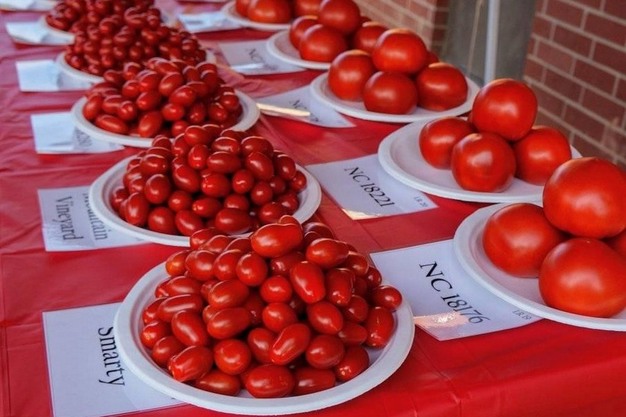
Since 2008, Dr. Panthee has grown from his title of Assistant Professor at the Mountain Horticultural Crops Research & Extension Center to Associate Professor and Head of the Tomato Breeding Program. Through his role, he conducts research on many tomato varieties and oversees students conducting research for their degrees. "I enjoy teaching students the hands-on aspect of research," he said. "I am able to help them take their classroom education and apply it in the field/greenhouses at the station." Each year, Dr. Panthee and his team work with three types of tomatoes to develop disease and heat-resistant varieties: Plum, Globe and Grape.
 © N.C. Department of Agriculture and Consumer Services
"With all three varieties, our objective is to improve heat resistance as well as disease resistance in the plant," Dr. Panthee said. "In disease resistance, we look at three factors: bacterial, fungal, and viral."
The Tomato Breeding Program is a public breeding program, meaning the seed developed through the program is available to farmers and home growers across the state. The goal of the program is not only to improve tomato varieties, but also enhance genetics, to ensure the best products. Since Dr. Panthee joined the team at NC State University, the program has released 13 hybrid varieties and 19 breeding lines to local growers.
"Initially we create the crosses in the fall and spring," he said. "Then we research and harvest in the summer. We have varieties that are grown in the greenhouse as well as varieties grown in the field so that we can test for different conditions." In fact, the Tomato Breeding Program works with farmers across the state, specifically in the Western region, to conduct on-farm trials. Farmers can contact Dr. Panthee to become a site for these trials. Ultimately, the on-farm trials are where the varieties are narrowed down into the most promising breeds.
When choosing which varieties to use or move forward with, Dr. Panthee and his team look at both conventional and molecular data. "Molecular data matters when choosing which varieties to use because our number one goal is to improve the genetics of the tomato variety," Dr. Panthee said. "If the genetics aren't good, then we go back to the drawing board."
 © N.C. Department of Agriculture and Consumer Services
Conventional data comes into play when the genetics of the breed were fine, but other factors caused it to be unsuccessful in the field or greenhouse. "DNA based data helps us to look at the conditions surrounding the plant, such as weather, heat, management, etc.," Dr. Panthee said. "From there we can determine what did work and what didn't work for the variety and either toss it or improve upon it in future years."
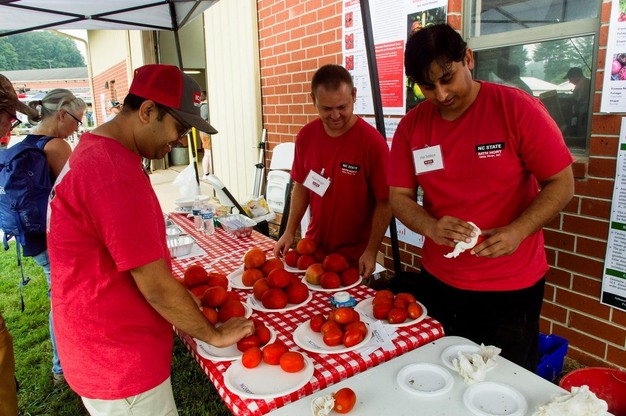
Once a seed variety is determined to be of high quality for farmers and home growers to use, it is released to seed companies across the state for purchase. "I highly recommend farmers and home growers to use seed from our research facility when growing tomatoes," Dr. Panthee said. "Not only are they more disease resistant, but they eliminate pesticide use due to their properties, which ultimately helps the grower and the environment." According to Dr. Panthee, his team has gotten countless compliments and feedback from farmers that use their seed in regard to how much it has helped them on the farm, as well as the quality of the tomatoes for customers.
For home growers, Dr. Panthee recommends using seed varieties from the research station and aiming for a high-flavored profile. "Look for varieties that grow year-round so that you can enjoy them all year long," he said. "When purchasing the seed developed at our facility, be sure to research what type of tomato you are looking for and how you would like to use it (ie: on sandwiches, in salsa or sauce, salad tomatoes, etc.)." One of his favorite varieties for fresh tomatoes on a salad is the Mountain Bebe, which can be purchased through local seed companies.
Source: North Carolina Department of Agriculture and Consumer Services