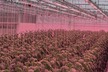
Plant factories using artificial lighting are a promising solution to food security and urban agricultural challenges. However, cultivation of fruit-bearing crops such as tomatoes remains limited due to their high light demands, long growth periods, and tall plant structure. In a recently published study, the research team aimed to develop an efficient cultivation system for tomatoes in a multilayer plant factory.
 © Frontiers in Horticulture
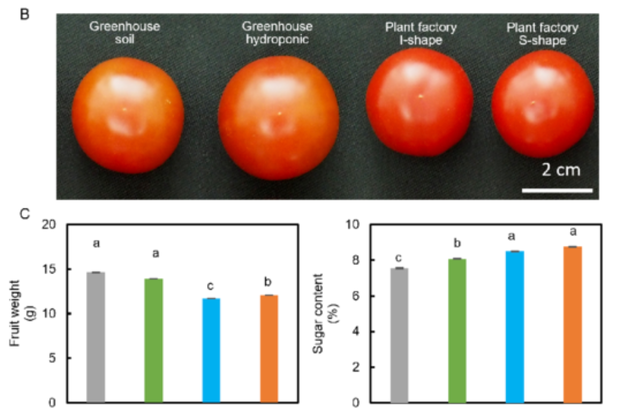
Mini tomatoes were hydroponically cultivated using white LEDs in a five-tier shelf system under two different cultivation methods. The conventional I-shaped method involved vertical growth on the top tier with downward lighting, while the novel S-shaped method trained each plant horizontally across the second to fourth tiers with lateral lighting on each level.
The S-shaped method enabled even light distribution, resulting in consistent photosynthetic rates throughout the canopy. In contrast, the I-shaped method suffered from strong light attenuation in the lower tiers, leading to reduced photosynthetic efficiency in shaded parts. Although total yield did not differ significantly between the two methods, the S-shaped method promoted earlier fruit maturation and improved fruit quality, including higher sugar content.
Compared with greenhouse cultivation, plant factory conditions ensured stable temperature and lighting, leading to compact plant morphology, shorter internodes, and higher SPAD values. Moreover, fruit quality was more consistent year-round, with higher lycopene and sugar contents. This study demonstrates that the S-shaped cultivation system offers significant advantages in light use efficiency, plant management, and fruit quality. It represents a scalable approach for enhancing tomato production in plant factories and may facilitate the introduction of other high-light-demanding fruit crops into vertical farming systems.
Read the complete research here.
Furuta, Hanaka & Qu, Yuchen & Ishizuka, Dan & Kawabata, Saneyuki & Sano, Toshio & Yamori, Wataru. (2025). A novel multilayer cultivation strategy improves light utilization and fruit quality in plant factories for tomato production. Frontiers in Horticulture. 4. 10.3389/fhort.2025.1633097.