This year marks the 10th anniversary of Ridder Climate Screens. What began in 2015 as a promising new chapter has since grown into a cornerstone of the Ridder portfolio.
 © Ridder Climate Screens
From the very start, Tiemo Bodemann, Joachim Keus, Stephanie van Heijningen, Arjan van der Klaauw, and Roeland Coopman were closely involved. Joachim recalls those early days, when the assortment included just five or six types of screen, spread across 23 article numbers. "We started with two types of energy-saving screens, clear and diffuse, a light diffusion screen, a blackout screen, a screen for assimilation lighting, and a roll-up sidewall screen," he says. The first installations went to five customers, including Alweco, Luiten, SchermNed, and A1.
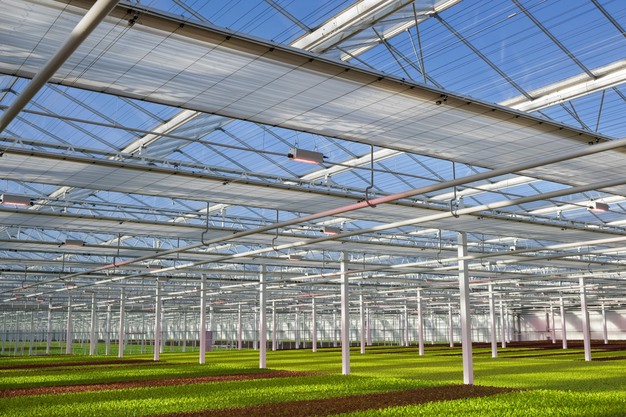
After this cautious start, 2018 brought an important step: the arrival of the first knitting machine in the Netherlands, which meant screens could be produced locally. Today, four machines run in two shifts at Maasdijk, producing more than 80 percent of Ridder's screen assortment, mainly energy-saving and RLD screens. "Those knitting machines are really pounding away," Joachim laughs. Over the years, Ridder has delivered screens for more than 10,000 hectares worldwide, offering solutions for every grower and every crop.
 © Ridder Climate Screens
Challenges and opportunities in the market
The current market for climate screens is complex. Economic headwinds and shrinking sales markets pose real challenges. "Globally, many screens are still being installed each year, but the real volumes are in export projects, and fortunately, those are picking up again. In Canada, for example, we're seeing larger projects re-emerge, backed by major investors," Joachim explains.
Other regions also show strong potential. "In Central Asia, new projects are being developed, and in Mexico we're working on building awareness among end users, who often source through Dutch installers. Outside the Netherlands, there are fewer local suppliers, which gives us a chance to strengthen our presence."
Market demand is also shifting with the rise of high-tech plastic greenhouses. "These structures require different specifications compared to glasshouses, but the need for screens, whether for energy savings or shading, will only continue to grow," he adds.
 © Ridder Climate Screens
Looking ahead
Ridder Climate Screens is still expanding and continues to invest in new machinery, with the goal of eventually moving all production to the Netherlands. While proud of the past decade, Joachim is even more focused on the future: "Each year we want to keep growing, together with our partners, and strengthen our position in the market."
The 10-year milestone will be celebrated at the Ridder end-of-summer gathering on 25 September in Maasdijk. It will be a perfect opportunity to reflect on the journey so far, look ahead to the future, and catch up with the Ridder team—including Joachim himself, who truly embodies the spirit of Ridder.
For more information:
Ridder
[email protected]
https://ridder.com/nl/