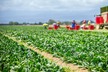
Thousands of acres of tomatoes are being harvested this season in the fertile plains of Penjwen district, located about 100 kilometers from Sulaimani. Buyers are arriving from the Kurdistan Region as well as central and southern Iraq.
The Penjwen food distribution center has become an important hub for marketing local produce. Farmer Omar Mahmood said he cultivated dozens of acres of tomatoes, noting that the crop is grown without harmful chemicals. He added that workers from the Kurdistan Region and neighboring western Iran assist daily with the harvest. "After the harvest, workers rest in the fields before trucks arrive to load and distribute the tomatoes," Mahmood told Kurdistan24.
Buyers expressed interest in the crop. "Iraqis love these tomatoes, saying they are beautiful and delicious. If harvested quickly, they could supply the entire country," said Hazim Ismail. Another buyer, Nasser Mohammed, described them as "the best tomatoes sufficient for all of Iraq and Kurdistan," while warning that Iranian tomato smuggling poses a risk to local farmers.
Tomato cultivation in Penjwen starts in late May, with harvesting running from early July until mid-November. The district includes three sub-districts and 188 villages, making it one of the more productive agricultural areas of the Kurdistan Region.
Other crops are also being prepared for export. Traders in Akre reported that 45 tons of locally grown sumac are ready for shipment to Turkey, with demand also coming from European and Asian markets. They said exports have raised local prices compared to last year.
In the Garmiyan independent administration, farmers are cultivating dates that ripen earlier than those from other Iraqi provinces, adding to the agricultural diversity of the Kurdistan Region.
The Kurdistan Regional Government (KRG) has placed agriculture at the center of its economic diversification policy. More than 3,000 tons of fruits and vegetables, mainly tomatoes, onions, and cucumbers, are exported daily to federal Iraq, with nearly 250,000 tons shipped so far this season. Investments include modern farming systems, weekly markets, and partnerships with countries such as the Netherlands.
Water scarcity remains a challenge. Springs like Kani Qulka in the Raparin administration's Bitwen Plain are drying up, leading farmers to adopt water-saving irrigation methods. Rain hose systems, known locally as "sonde barane," are being used to spray water evenly while reducing labor and consumption. Drip irrigation is also widely applied in orchards. The KRG has invested more than 265 billion dinars (about US$203 million) in water infrastructure, including nine new dams and 126 rainwater harvesting ponds, of which 23 are complete.
Source: Kurdistan24