In the Westland region, just outside The Hague, a pilot has started with exoskeletons. The pilot is an initiative of Skelex, a company based in The Hague that develops mechanical tools designed to reduce the physical strain of repetitive work and employment agency ProKonak.
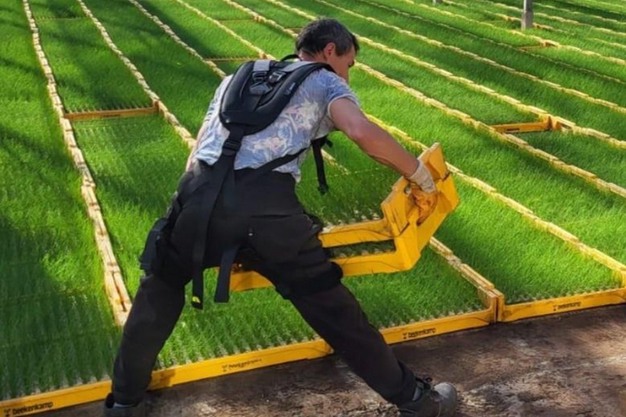
These exoskeletons provide support to the arms, shoulders, and lower back—areas often affected by repetitive tasks like tying plants, pruning, lifting crates, or working in squatting positions. Two models are being tested in the greenhouses. One supports workers performing overhead tasks such as tying tomato plants to strings; the other relieves strain during low-to-the-ground work like clipping or attaching items to potted plants.
 © Skelex
Bart Bakkum, Managing Director at Skelex: "The development of exoskeletons started at TU Delft and TNO to prevent back and other complaints during aircraft maintenance. Over 10 years, the original prototype evolved into a lightweight and ergonomic product, already being used by many people around the world in all kinds of industries."
If the pilot continues to show positive results, ProKonak plans to expand the use of exoskeletons to other phases of the production chain, such as packaging and logistics. Supporting workers at every level not only helps prevent long-term injury but also improves job satisfaction and performance in one of the Netherlands' most vital industries.
"We want our people to feel good, stay healthy, and enjoy their work," says Turgut Colakoglu, Accountmanager at ProKonak. "This isn't just about preventing injuries—it's about making physical work more sustainable in the long run, for everyone involved."
Interest in ergonomic solutions is growing, especially in sectors where automation cannot fully replace human labour. Schiphol Airport, for example, is testing similar exoskeletons in baggage handling operations. Meanwhile in France, Skelex products are already in use across vineyards, dairy farms, and even hospitals. Although large Dutch companies are exploring such innovations, early adopters are often independent professionals—like plasterers and window cleaners—who rely on physical resilience and are quick to embrace preventative tools.
For more information:
Skelex
Email: [email protected]
skelex.com/