The global horticulture industry is grappling with a significant shift in substrate supply chains, driven by reduced peat production and surging demand for coco coir. As growers worldwide face rising costs and localized shortages, a specialized coco coir producer HortGrow Solutions, is adapting to meet these challenges head-on. James Susaimuthu, CEO of HortGrow Solutions, provides insight into the current state of the substrate industry, the company's strategies for navigating supply chain pressures, and the future of sustainable soilless cultivation.
Rising costs and supply shortages
The past year has seen unprecedented pressure on coco coir supply chains. "Our raw materials pricing tripled in the last year due to persistent demand for coco peat products," he confirms. This spike is driven by a global surge in demand for bulk compressed coco peat, fueled not only by horticulture but also by increasing use in poultry farming in India and other industrial applications. Localized shortages have further compounded the issue, with James noting, "Ours as well as our supply partners' production capacity hasn't been enough to keep up with the demands this year so far."
Several factors contribute to these shortages. "Very high worldwide demand for the bulk compressed coco peat is the main driver." Additionally, environmental challenges such as poor rainfall and excessive disease pressure in key coconut-producing regions have reduced the productivity of coconut plantations, limiting the availability of coir, a byproduct of coconut husks. Within India, a growing number of nursery growers and high internal demand for substrate production are further straining supplies.
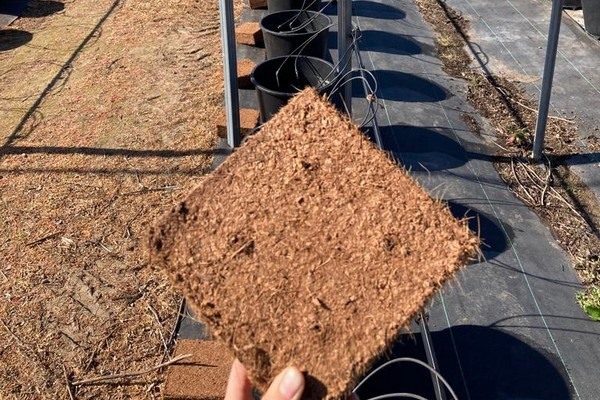 © Hortgrow Solutions LLC
Blackberry grow block
Adapting to supply chain pressures
To address these challenges, HortGrow has taken proactive steps. "We have increased our raw materials supply partners by creating several new partnerships and investing more with our existing partners." The company has also opened two new sites equipped with automated machinery to process raw materials at high volume while maintaining the premium quality HortGrow is known for. "Every year since we began operations in 2018, we have more than doubled our capacity and output," he adds. "In 2025, we have taken steps to further double our capacity by opening new locations and investing in high-efficiency machinery and tools."
HortGrow's focus on premium products, such as grow bags and grow cubes, has required innovative approaches to raw material sourcing. "We pay higher prices for the best quality raw materials and invest in processing equipment to maintain our competitive edge," he notes.
Strategic use of coco coir fractions
One of HortGrow's strategies for navigating shortages involves leveraging the versatility of coco coir's components chips, fiber, and pith. "Altering the ratios of the coco chips, fiber, and pith allows for managing the water/air holding and drainage properties of the substrate substantially, from 40% water-holding capacity to above 80%," he explains. By working closely with growers to create tailored blends, HortGrow helps clients optimize crop performance and extend substrate longevity during supply constraints. "Growers can create specific blends and test them to meet their objectives," he advises.
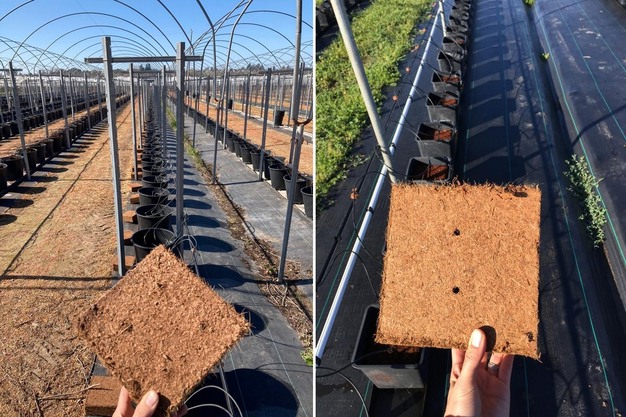
 © Hortgrow Solutions LLC
Raspberry grow block
Sustainability amid rising demand
"As we scale up production, we continue to focus and improve on increasing our water use efficiency in coir washing protocols by recapture, retreat, and reuse water," he says. The company has also invested in solar energy to reduce reliance on the grid, implemented large-scale rainwater capture to conserve groundwater, and created product segmentations to minimize raw material wastage by tailoring blends to specific grower needs.
Addressing misconceptions about coco coir's environmental impact, he clarifies, "Coco coir production is not causing large-scale environmental damage by cutting down forests to plant coconut trees. This is largely a myth." He emphasizes that coco coir is a byproduct of well-established coconut plantations primarily grown for oil, milk, and culinary uses, making its use as a growing medium environmentally beneficial. Additionally, the 1:5 compression ratio of coco coir reduces its carbon footprint during shipping compared to uncompressed peat moss.
 © Hortgrow Solutions LLC
The future of substrates
James anticipates significant shifts in soilless cultivation media. "As growers get better at learning how to grow in substrates, they reduce pot volumes sometimes by half and still get great yields and quality, thereby decreasing the amount of substrate used," he observes. Repurposing used substrates for lower-value crops and exploring alternative substrate options are also emerging trends. However, he notes, "So far, coco coir has proven to be a substrate of choice for many berry growers, greenhouse, and indoor growers due to its superior properties as growing media."
HortGrow is preparing for future growth with ambitious expansions. "We are adding two new sites for raw materials sourcing and processing in southern India that will ultimately triple our current capacity by 2026," he shares. The company has also opened a large storage site to mitigate seasonal supply fluctuations.
For growers struggling to secure substrates, he offers practical advice: "Establish a direct conversation with a manufacturer, fine-tune your specific needs with an experienced agronomist's support, visit your manufacturer's site if possible, and plan your needs up to one year in advance." He also recommends small-scale trials with different substrate blends to optimize return on investment and investing in precision farming tools to reduce substrate use while maintaining yields.
Pioneering sustainable production
HortGrow's vision extends beyond meeting demand to redefining sustainable substrate production. "We are pioneering how our factories are run, including worker standards, resource use efficiency, and reinvesting greatly in our operations and communities." By investing in advanced machinery, improving labor conditions, and aligning with partners like HortBio Technologies PVT LTD, HortGrow is focused on smart, sustainable, and eco-friendly substrate production.

For more information:
HortGrow Solutions
James Susaimuthu, CEO
[email protected]
www.hortgrow.com