Vertical farming in Japan is entering a new era, as the Japan Plant Factory Association (JPFA) wrapped up its second symposium in Tokyo, marking a significant shift in the industry's priorities—from mere yield maximization to integrated strategies for health, sustainability, and global food security.
Held at the Kashiwa-No-Ha Conference Center near Chiba University, the symposium brought together leaders from academia, industry, and international delegations to reflect on the current state and future direction of plant factories in Japan and worldwide.
 © Rebekka Boekhout | HortiDaily.com
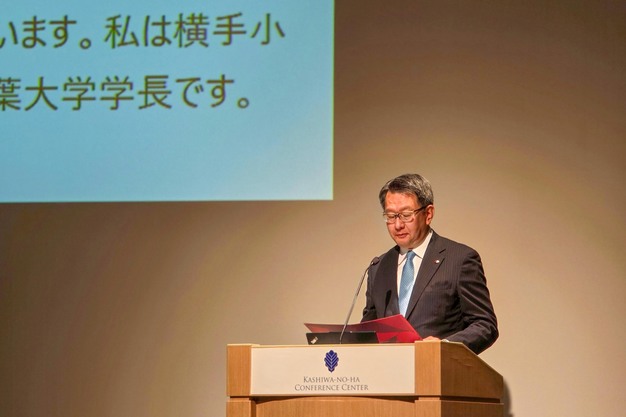
Koutaro Yokote, President of Chiba University, praised the JPFAs' research work on Plant Factories
From lettuce to life sciences
As it stands, 90% of Japan's vertical farms produce lettuce, with the remaining 10% focused on crops like herbs, strawberries, flowers, seedlings, and leafy greens such as mizuna and komatsuna. Even within lettuce production, there's diversity: 45% is generic lettuce, followed by full heads (25%), baby leaf (15%), and green leaf (15%).
Despite Japan being the birthplace of vertical farming, the sector continues to face persistent challenges—chief among them, high energy costs, which make up 26% of production expenses. Labor costs top the list at 33%, followed by depreciation (13%), and smaller shares for seeds, logistics, and water.
But the focus is shifting.
"We should not only focus on growing plants. Ideally, research should also address the effects on human health and on the environment," said Eri Hayashi, President of the JPFA. "That is why we see this as an interdisciplinary research field."
This interdisciplinary approach was apparent throughout the event, with presentations on pharmaceuticals, mental health, and even space farming—including promising trials of rice and soybean cultivation for Mars missions and oral vaccines developed in partnership with UC San Diego.
 © Vertical Farm Daily
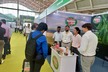
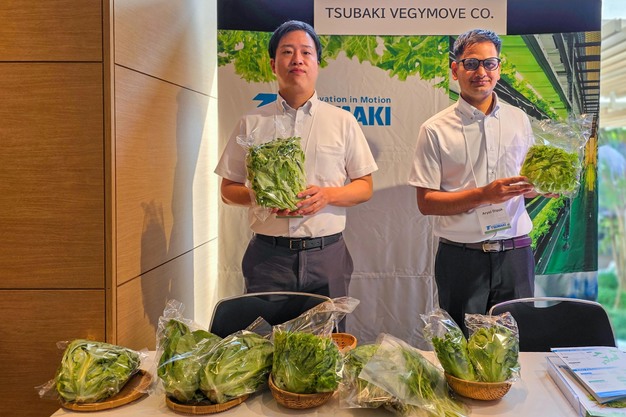
Shota Hirose and Aryal Dipak from Tsubaki
Strawberries, software, and scaling
Day two opened with a bold vision from Hiroki Koga, CEO of Oishii, a U.S.-based vertical strawberry farm that once sold berries for $50 per box but has now dropped the price to $7.99—and aims to reach 500 yen (~€2.80) per box in Japan.
"Our new megafarm is fully automated, runs on software and machine learning, which allows us to drive costs down massively," Koga said.
The facility uses hydropower and solar energy, producing more electricity than it consumes, setting a new bar for energy efficiency and economic feasibility.
 © Vertical Farm Daily
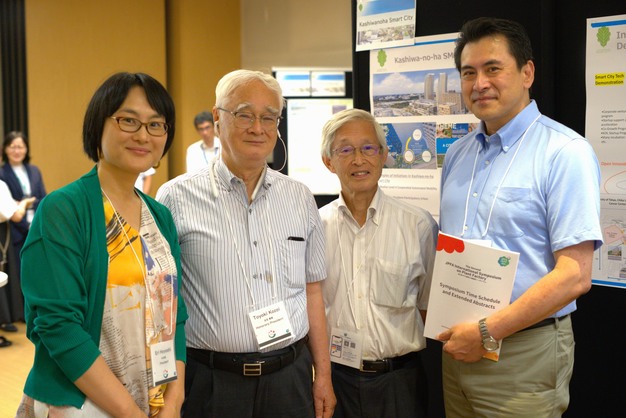
Three generations of JPFA presidents, from 'most recent to oldest': Eri Hayashi (current JPFA President) next to former JPFA presidents Toyoki Kozai and Toshitaka Yamaguchi, alongside Katsuya Tsuchihara of the National Cancer Center, Japan
Beyond leafy greens: The next frontier
Vertical farms are no longer confined to lettuce. Experts, including Paul Gauthier from QAAFI, emphasized that crops like mango, wasabi, pineapple, and papaya could be viable if technology continues to evolve. However, these crops present technical challenges due to their size and growth cycles, and their market prices and yields vary significantly.
Dynamic plant modeling emerged as a key tool for overcoming these barriers. Presenters demonstrated systems that integrate genetics, pest management, nutrient ratios, lighting, and airflow, enabling farms to forecast yields and fine-tune production schedules.
"If you know exactly how the plant responds, you can forecast yields, adapt crop schedules, and optimize energy efficiency," explained one expert.
Japanese companies like Macnica showcased advanced farm software platforms, helping growers manage labor, harvesting, and supply more effectively. Meanwhile, AI-driven platforms are now integrating fertilizer use, greenhouse gas emissions, and environment controls into single decision-making tools.
 © Rebekka Boekhout | HortiDaily.com
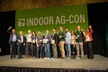
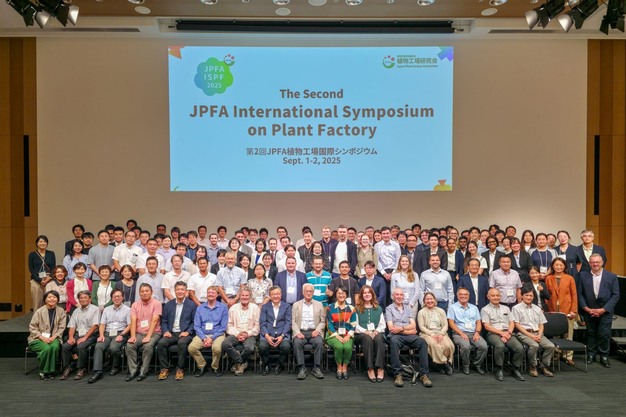
The JPFA Symposium participants of 2025
Global collaboration and future visions
The symposium also emphasized international collaboration, welcoming a Dutch horticultural delegation interested in trade and tech partnerships, particularly in light of Expo 2025 Osaka. The broader conversation touched on inclusive food access, regulatory frameworks, and how controlled environment agriculture (CEA) can address both urban and planetary challenges.
The closing remarks by Eri Hayashi confirmed the momentum won't stop here. The third JPFA International Symposium on Plant Factory will take place in Chiba, Japan, from August 31 to September 1, 2026.
What started as a lettuce-centric niche has evolved into a multidisciplinary ecosystem spanning technology, health, sustainability, and even space exploration. As Japanese vertical farming matures, the conversation is no longer just about growing more, but about growing smarter, cleaner, and more meaningfully—for people, the planet, and perhaps even Mars.
For more information: 
Japan Plant Factory Association
www.npoplantfactory.org