Until 2017, the thrips species found in Spanish horticultural crops were mainly Thrips tabaci and Frankliniella occidentalis. Their wide host range and the serious damage they cause, especially in peppers, played a "decisive role" in shaping IPM protocols, according to a recent IFAPA study.
In recent years, however, new species have started appearing in Spanish greenhouses fields, making it necessary to update those protocols. They all share some common traits: they belong to the suborder Terebrantia, family Thripidae, and they come from other continents. Among them are Thrips parvispinus, Scirtothrips dorsalis, and Scirtothrips aurantii.
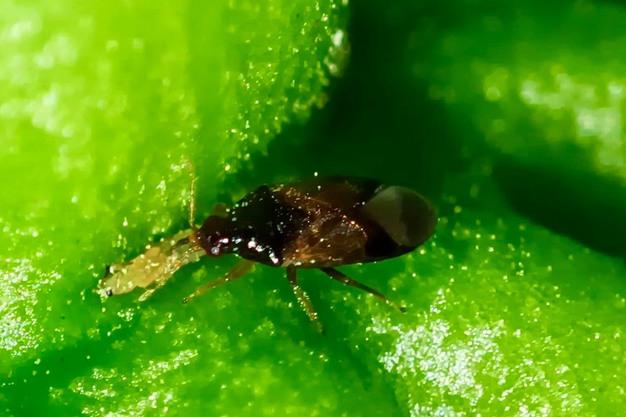 © EntonovaVictory in one of the invisible battles in greenhouses: Orius devouring Thrips parvispinus.
"Biocontrol companies are already developing and fine-tuning new protocols for these pests. But it's worth stressing that success is only possible if everyone is involved, just like we managed 15 years ago with Frankliniella occidentalis," says Paco Cara, CEO of Entonova.
"Biological control has proven time and again to be the best solution against thrips, because it's about maintaining balance in the ecosystem. When that balance is broken, the consequences are always negative. Just last year, some growers looking for a quick fix against parvispinus used a plant protection product that, far from being a miracle cure, actually weakened beneficial fauna and, paradoxically, fueled the pest."
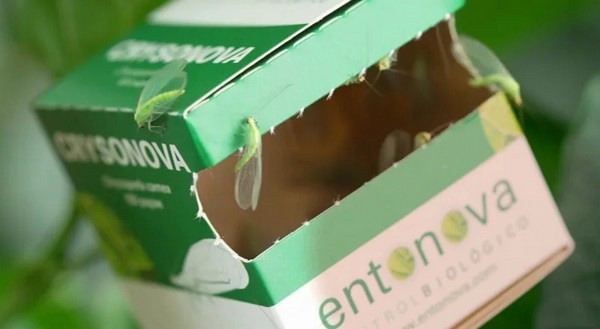
"At Entonova, we always emphasize the need for solutions that are both effective and practical," Paco adds. "For example, our Crysonova is unique, making releases much simpler. And after what happened last season, we've also developed a mite food to boost established populations in greenhouses and stimulate reproduction."
 © Entonova
Recommendations against parvispinus this season
One of Entonova's strongest technical approaches is conservation control. This involves introducing reservoir plants that provide food, shelter, and attractants for natural enemies of pests such as parvispinus, thereby enhancing their impact in affected areas.
"When you bring botanical diversity into a monoculture, you also generate faunal diversity. We've studied and selected plants that support beneficials, which we market in different formats: packs for indoor greenhouses, outdoor use, or our patented Entobox, a cereal pot about 10–12 cm tall inoculated with Rhopalosiphum padi, a cereal-specific aphid that can be parasitized or serve as food for other biological control organisms," Paco remarks. "This strategy adds to the use of specific auxiliaries such as Amblyseius swirskii, a true all-rounder that adapts very well in Almería, and Orius laevigatus, of which Entonova is a major producer.
"This season, in areas already planted like Dalías, Berja, and the Poniente, releases are already underway against parvispinus. Alongside Swirskii and mites, we recommend adding Orius and reinforcing hotspots with Orius nymphs."
"We adapt protocols every season"
Founded in 2010, Entonova started with Orius laevigatus and soon became the only Spanish producer of Chrysoperla carnea (green lacewing), both essential in the biological control of thrips and aphids. "One of our strengths is logistics: insects are bred and released in under 48 hours, which guarantees their viability and performance. Quality isn't only about the genetics of the beneficial, but also the speed and care with which it reaches the field," Paco notes.
"At Entonova, we also provide ongoing technical support, with a team specialized in organic and zero-residue farming working side by side with growers to adapt protocols each season. What works one year may not work the next. That's why we must pay close attention to nature and always collaborate with experts who can help ensure the success of the farm," concludes Paco Cara.
 © EntonovaFor more information:
Entonova S.L.
Amsterdam Street, 16
04710 Polig. La Redonda
Sta. Ma. del Águila El Ejido (Almería)
Tel.: +34 676 588 591
[email protected]
https://entonova.com