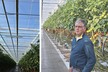
From season 2026, Swiss vegetable grower Meier Gemüse aims to be fossil-free. "The idea is to produce a large share of our electricity locally," says grower Ruedi Meier, explaining he's driven both by sustainability and a request for independence. In order to achieve this, the greenhouse operation plans to integrate a server-based heating system into the facility, which will be supplied with electricity generated via solar panels above their cherry tomato crop.
 © Meier Gemüse AG
Swiss family company Meier Gemuse grows on three locations in Switzerland and has been using residual heating in their greenhouses as much as possible, but the gas boiler remains an important feature in their heating system. If it goes as planned, in Aargau this installation no longer has to be used in the 2026 season. It's a wish from grower Ruedi Meier. "I would like to be independent from energy suppliers when it comes to energy", says Ruedi. "We've seen how volatile the market is: it disrupts easily, and as a grower there's not much you can do about it. The only way to step out of this system is to produce our energy ourselves and to produce it locally. Full energy autonomy remains a long-term goal rather than an immediate reality, Ruedi says. "But we're moving in that direction."
A key component of this transition is the planned integration of a server-based heating system. Developed by Swiss startup K51, this "server heating" system responds to the greenhouse's thermal demand. Computing operations begin only when heat is needed, making the system heat-driven rather than data-driven. The resulting waste heat is recovered to supply the greenhouse's heating needs.
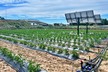
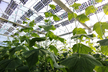
The system is planned to be operational from the 2026 season onward. Installing solar panels in the greenhouse is part of the farm's approach to generating as much on-site electricity as possible to power this new infrastructure. These modules, developed by Swiss agri-PV technology provider Voltiris, were installed earlier this year at the company's cherry tomato greenhouse and are now online and producing electricity. It is also the first commercial-scale application of this technology in a full-production greenhouse setting.
Integration without disrupting the crop cycle
The installation process began mid-March and was completed in stages while the cherry tomato crop was already established in the greenhouse, and although it did require some coordination for the Voltiris mechanics, it went as planned, not disrupting the crop. "
The modules are arranged above the crop canopy. Each unit functions similarly to a parabolic mirror system: a selective filter directs photosynthetically active radiation (PAR) to the crops below while redirecting the remaining wavelengths toward photovoltaic elements. The system adjusts dynamically to the sun's position to optimize energy capture without compromising light transmission required for plant growth.
Currently, 0.8 hectares of the greenhouse are covered with about 2,000 Voltiris modules. The farm grows multiple tomato varieties, but cherry tomatoes account for approximately 40% of the total surface area and happened to be the crop beneath the new panels at the time of installation.
So far, Meier reports no observable impact on yield or plant development. "After a month under the panels, we have not seen any differences—at least none that are negative," he says. While it is too early to commit to expanding the system, further deployment is under consideration.
 © Meier Gemüse AG
Market and economic context
Sustainability is a stated industry objective in the Swiss protected horticulture sector. Meier Gemuese is a member of the Verband Schweizerischer Gemüseproduzenten (VSGP), which has formally adopted a strategy to phase out fossil fuels. "Not all growers are at the same stage, but the direction is clear," he notes.
Although the Swiss are said to be fond of it, Ruedi expresses caution when it comes to consumer interest in sustainability. "There is a gap between what people say and how they behave at the point of sale. Price remains a major factor." And let's be clear: the energy savings from the panels are not yet expected to significantly affect the production price per kilo of tomatoes. "Even if the electricity were free, it wouldn't have a large impact on our production costs given current consumption levels," he laughs. However, he sees long-term economic viability in the concept and notes that his early adoption includes an element of support for the startup's commercialization phase. "Over time, with scaling and optimization, costs are likely to come down, and first projects are required to reach that stage. And it's about the philosophy behind the company that resonates to us. Producing tomatoes and electricity on the same footprint is efficient."