The global demand for raw materials for substrate production is increasing and there is a stronger focus on substrates that contain a lower proportion of peat and a higher proportion of renewable and circular raw materials. Van der Knaap Group has been working on making this transition for some years.
Responsible peat
For years, peat has been the main raw material in organic substrates. Peat has good water retention properties, is lightweight, has a low pH value and buffers nutrients. These are all positive traits for cultivation. However, the tendency recently has been a growing demand for substrates that contain a lower proportion of peat or that are completely peat-free.
Van der Knaap can already offer peat-reduced, or even peat-free, substrates for many crop groups. Van der Knaap use RPP-certified peat for the substrates that still contain a proportion of peat. This Responsibly Produced Peat complies with several guidelines. For example, the production locations are chosen based on strict selection criteria, the locations are treated with care and there is always a recovery plan after use.
Research into new materials
When the proportion of renewable raw materials in substrates is increased, the safety and good quality of raw materials remains a priority to ensure the product continues to meet the high standards of the customers. New renewable or circular raw materials are subjected to a programme of extensive trials to assess their suitability for use in peat-reduced and peat-free substrates. Van der Knaap perform growing trials, chemical and physical analyses and finally assess how the substrates perform during greenhouse trials under normal growing conditions. These conditions are replicated in Van der Knaap's high-tech greenhouses. Van der Knaap also run trials outdoors and increasingly set up practical trials with customers. The commercial factors are also gaining in importance; the company considers the price and availability of the raw materials.
 © Van der Knaap Diensten BV
A number of new circular raw materials have already been added to the product range. This allows Van der Knaap to offer customers a wider choice of options to use peat-reduced or even peat-free substrates.
A different growing strategy
Substrates that contain a lower proportion of peat and a higher proportion of renewable raw materials have different physical and chemical properties. This may mean adapting the growing strategy, for example in terms of fertilisation and irrigation. This may also differ per crop, as some crops are better suited for a certain substrate than others. For acidophilic crops, for example, finding a suitable substitute is a greater challenge. Together with customers, Van der Knaap look at the best match with their vision. Do they go completely peat-free or is this the first step on the sustainability ladder? This always involves finding a customer-specific solution. The company also considers the right (growing) strategy to enable the transition to peat-free cultivation. The knowledge and experience gained in this way can be used to support customers.
Coco
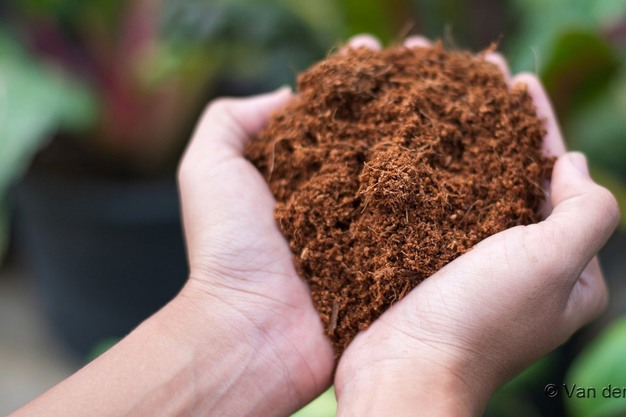
Coco is a renewable raw material that has already proven its performance in practice. This raw material forms a stable basis for a peat-free mixture. Van der Knaap has been processing coco in its rooting media and substrates for many years. Coco has good properties for cultivation: it has a high air holding capacity and absorbs water easily.
For more information:
Van der Knaap
[email protected]
www.vanderknaap.info