A company like Netafim knows exactly what to do with this year's HortiContact theme. According to Stefan Bakker, product manager at Netafim, water and nutrients should reach the plant as uniformly as possible through the maze of pipes. That might sound simple, but in reality, it involves quite a bit of technology.
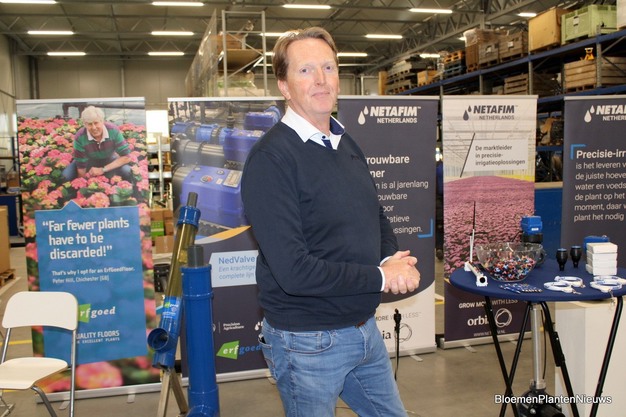 © Annet Breure | HortiDaily.com
"We are not in the Volkswagen Beetle Club"
There is nothing wrong with a classic Volkswagen Beetle. Perfect for a leisurely drive in your spare time. But when you need to cover long distances on a regular basis, it's far more comfortable to be behind the wheel of a modern car.
It's the same with drippers.
"We still sometimes come across the (French) capillary dripper," says Stefan. "It was originally developed when growers first switched from open field cultivation to substrate. I call it the Volkswagen Beetle of drippers. It gets the job done, it delivers water, but there's no consistency between drippers, so you certainly don't get uniformity. And that's exactly what a modern grower needs for optimal production."
Stefan explains that the Kameleon dripper delivers exactly that. "This model is self-closing and pressure-compensating, making it ideal for large-scale installations. It doesn't matter how long the irrigation lines are, the distribution is always spot on. Uniformity is guaranteed."
There's also a solid middle-ground option for shorter irrigation lines: the Woodpecker dripper.
"It's not self-closing or pressure-compensating, but it's still worlds apart from the French capillary, Cobra, or Capinet drippers," Stefan notes. "Sometimes the Woodpecker is the perfect solution, especially if your greenhouse still has some 'legacy quirks' in the water transport system. The trick is to keep the irrigation lines short. That way you can still achieve a high level of uniformity."
Blockages
A complete blockage is easy to spot: the plant wilts. A partial blockage is trickier. The plant is still alive, but it's underperforming, and it can take a while before you notice something's wrong.
To prevent mechanical clogging, filter as thoroughly as possible and keep your water system clean. Check both the quality of your source water and the size of the orifice the water has to pass. And whatever you do, don't start "pressing things through."
A filter works much like a kitchen colander. When you drain spinach, some of it stays in the colander, but a little water always seeps through. If you start pushing the spinach down, suddenly more gets forced through the holes, and that's when trouble starts.
This is where the "marble run effect" comes in. At the bottom of a marble run, there's often a funnel. Drop one marble at a time, and everything flows smoothly. Dump in a whole handful at once, and the funnel clogs. Drippers behave the same way, a few particles are no problem, but if too many arrive at once, even small ones, the system gets blocked.
Stefan explains, "If you use your filter the wrong way, you're effectively forcing soft, biological debris through the mesh. That's exactly what leads to blockages."
For more information:
Stefan Bakker
Netafim
M: +31 6 13237160
O: +31 174 525446
[email protected]
www.netafim.nl