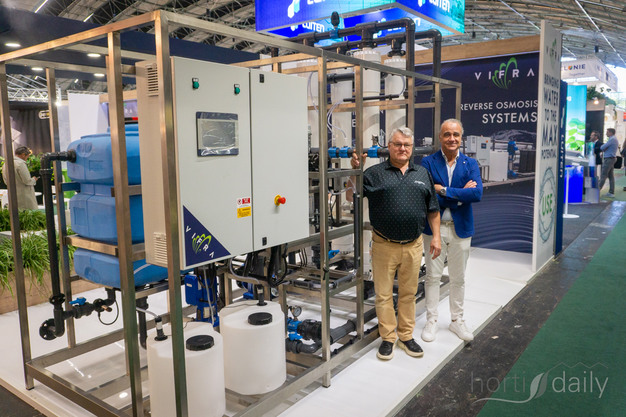
With increased recirculation demands and viral pressures in tomato production, greenhouse growers are reviewing existing water sanitation methods for both efficacy and impact on nutrient profiles. At Lakeshore Veggie Growers in Leamington, Ontario, an ultrafiltration system from Vifra has been operating for four months as an alternative to thermal pasteurization. Jay Colasanti of Lakeshore Veggie Growers outlines how the system fits into their broader water management strategy. "We're seeing new resistant varieties coming out, but until we have full access to them, we have to manage risk through water and climate."
 © Arlette Sijmonsma | HortiDaily.com
Heirloom varieties
Lakeshore Veggie Growers produces a range of heirloom varieties, including red, yellow, pink, brown, and purple Marmande types. With commercial attention on viral resilience and flavor preservation, heirlooms present unique challenges and value. "We have five main varieties right now," Jay says. "They each carry a different flavor. That's still the most important factor." Although viral-resistant cultivars are entering the market, they are not yet widespread among heirlooms. In the meantime, water disinfection remains a primary line of defense.
The decision to install the Vifra ultrafiltration system was primarily driven by increasing pathogen and disease pressure, and specifically to protect the company from Tomato brown rugose fruit virus (ToBRFV). The ultrafiltration membrane acts as a physical barrier to the virus, effectively removing it from the recirculating water without relying on chemical or thermal treatment. "The membranes remove anything larger than their pore size—virus particles, microbial solids—but nutrients can pass through."
Testing
Jay reports that they conducted testing to confirm the virus could be filtered out. "We've had some testing done with the Rugose virus, and it proved positive that we were able to remove and kill whatever the virus was through the membrane. The virus was larger than the membrane, so it couldn't pass. It has to break down and be gone." The ultrafiltration membrane acts as a physical barrier to the virus, effectively removing it from the recirculating water without relying on chemical or thermal treatment. The system is currently installed in what Jay refers to as their "home facility"—a smaller greenhouse where they test infrastructure before scaling. "It's our smaller facility. Not a large-scale operation, but if it's successful—and so far it is—we'll install it in our other greenhouses."
Greenhouse climate
Unlike pasteurization, which Lakeshore had used previously, the Vifra ultrafiltration system does not add heat to the water stream. This is a functional consideration given the greenhouse's climate. "Pasteurization is effective," Jay explains, "but it raises the recirculating water temperatures. We can't afford that during the growing season. We get too warm in the summer."
Ultrafiltration is now one of three water sanitation systems operating in different facilities at Lakeshore. The other two are ozone treatment and ECA (electrochemical activation). Each system has tradeoffs, but Jay sees ultrafiltration producing the best combination of pathogen control and nutrient retention. "Ozone works well, but it also kills nutrients. The ECA system doesn't give us the same results. With ultrafiltration, we're keeping more nutrients while removing viruses."
Recirculation
Growers in Ontario and other regions face increased regulatory constraints on discharge water. In this context, recirculation and internal water reuse are no longer optional. "Our regulatory systems don't allow us to use the recirculating water for other purposes," says Jay. "We can't even put it on the lawn. So we need to find ways to reuse it internally, and that's where this comes in." A key technical benefit of the ultrafiltration is the lower water loss during system flushing. "Reverse osmosis typically loses over 10% of the water through backflush," Jay says. "This system is under 5%. So we can recirculate almost all of the water. That was important in our decision."
Climate and water management in a 2025 growing facility
The installation in Leamington is part of a broader shift toward integrating climate and water management tools to handle increasingly variable growing conditions. Lakeshore Veggie Growers also uses Vifra's fogging and dehumidification systems. "We started with their dehumidification system. Expensive, but effective," Jay says. "Then we added the fogging system. We get more control over humidity during hot days." And especially these weeks, that's something to look out for. "Even if the fogging system only is active one week per year, it's worth it, as it saves us from major problems."
Jay points to direct production benefits. In their heirloom tomato crops, dry periods can lead to physiological disorders such as blossom end rot, triggered by calcium transport issues. "When the climate in our region spikes in temperatures and dives in humidity levels, the fog system mitigates these effects on the plant with consistency in rotational shots of fog a couple of meters above the crop, creating an evaporative cooling effect", he explains. "And adding the humidity into the air, which helps reduce the stress on the plant and supports its fruit without creating issues that lead to blossom end rot on the fruit."
Water quality and climate control systems are increasingly being evaluated as insurance mechanisms against crop loss. The logic is economic rather than technological. "If we avoid losing fruit during a short weather event, that pays for the system," Jay adds. "It's an insurance."
For more information:
VIFRA S.r.l.
[email protected]
www.vifraitalia.it