 © Suvena
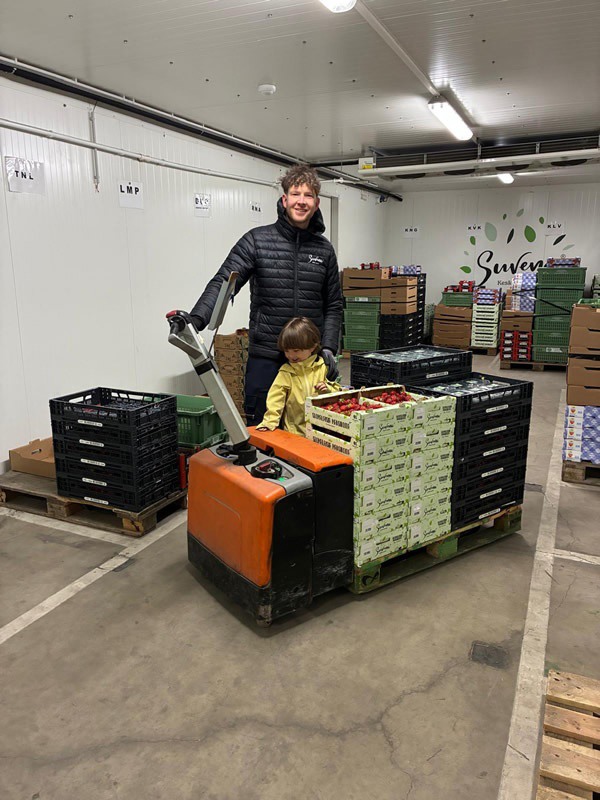
Climate change has significantly affected Finnish strawberry cultivation in recent years. Last year, barely any kilos were harvested due to winter damage. Most strawberries in Finland are still grown outdoors. This year, the question is whether there will be enough labor to bring in a good harvest from the fields. We take stock with Erik Guldemond of Suvena (pictured right with son Karlo, aged almost four).
Erik, whose father is Dutch and mother Finnish, lived in the Netherlands until he was 23, but has now lived in Finland for 16 years. "Because I have both nationalities, I had to do a year of military service in Finland. Then I stuck around here and started for myself."
"All spring, we've had cloudy and cold weather, with only two days above 24 degrees. Since last week, the temperature suddenly shot up to 26–30 degrees, and now we've gone to the other extreme," Erik says. From early April to mid-October, Suvena sells soft fruit, starting the season with imports from Spain and the Netherlands, then switching to Finnish-grown fruit later. "The months outside that period aren't of interest to us. In the pre-season, we sell Dutch strawberries from April to June. The Spanish strawberries we sell in 1-kilo boxes."
Cards shuffled differently this year
"Outdoor growers still dominate strawberry cultivation in Finland, but this area is shrinking. It used to be 4,000 to 4,500 hectares, but now it has dropped to 3,500 hectares. Field strawberries traditionally thrived well here, and growers would use the plants for three to five years. Winters often offered good natural protection, enabling large summer harvests," Erik says. "But that's no longer a given. The weather is changing here, too, and the older varieties are wearing out. Last year, we had 30-degree heat for three to four weeks in May, and by mid-July the outdoor season was finished after just two or three weeks," he recalls. This season is very different. "Finnish growers only started picking in mid-July, which is extremely late, and the harvest is large."
 © Suvena
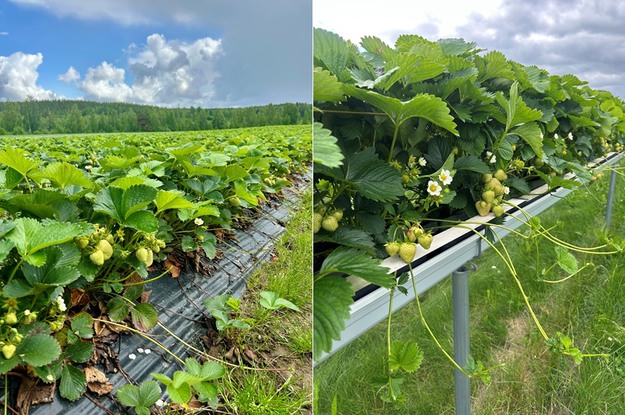
Left: Verdi strawberries grown in Suonenjoki, 25 June 2025.
Right: Falco strawberries on racks in Laitikkala, 10 July 2025
Those fluctuating outdoor volumes remain the biggest challenge for Finnish traders. "If you're getting 5,000 kilos a day from a grower one week and just 500 kilos the next, that's hard to manage," he says. "So to have security as a trading company, you need protected cultivation," Erik says. "We do have small-scale greenhouse production here. That started in mid-May, two weeks later than hoped, because 30 April, Labour Day, is a major sales day, and growers try to have the first strawberries ready on that day. Greenhouse supply came in slowly this year, which kept prices high. But the quality was excellent. We also grow strawberries in tunnels here in Finland, and that production has increased a lot over the last four to five years. That supply also came in one to two weeks late this year, with lower volumes and high prices."
 © Suvena
Unlike strawberries, Finnish raspberries are now grown entirely under protection. "That has increased sales, as the outdoor season used to last just two to three weeks, which was unworkable. Now, Finland is self-sufficient in raspberries from June through October. Blackberry production here is still very limited. However, people are increasingly switching to new varieties, such as Sweet Royalla." Still, Erik does not expect a major expansion in protected cultivation. "It's currently done by a limited group of growers. They're doing well and expanding gradually, but the sales potential in Finland is limited. We don't export and don't need large volumes to supply the punnets. Oversupply happens quickly. Outdoor crops are still slightly more attractive to the trade, but the quality, appearance, and longer availability of protected crops offer more opportunities and certainty for buyers. Consumers also benefit in the long run, enabling more sales throughout the chain."
 © Suvena
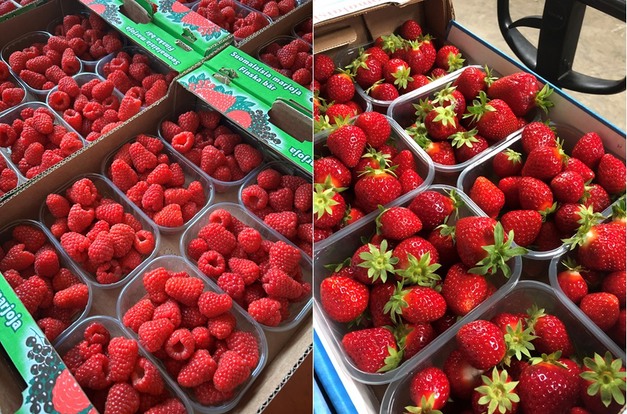
Left: Finnish raspberries in 8x175g - vajolet variety
Right: Finnish Favori strawberries from tunnel cultivation in 8x400g. Finnish consumers don't want layered strawberries; they find it unnatural.
Empty freezer shelves last April across Finland
Last year's strawberry shortage led to a challenging start to the season. "In Finland, the frozen industry is large and buys fresh, de-crowned strawberries in summer, which are sold to consumers year-round in 250g to 1kg bags. But last year, the industry could source so few strawberries that by April, freezer shelves in all Finnish supermarkets were empty. This was a tough blow, especially as May is traditionally the best month for the frozen industry due to events like Mother's Day and school exams. We benefited in the fresh trade because when we entered the market with the new crop in May, our sales were much stronger."
 © Suvena
"For the frozen industry, it's fortunate that this year's crop is large, but now the challenge is that growers still aren't delivering enough due to ongoing heat. Picking and de-husking strawberries is at least 30% slower than harvesting for the fresh market. So in 30-degree heat, everyone prioritises fresh picking. And with the heat, the large harvest is over in just two to three weeks anyway. The changing strawberry varieties also pose challenges. The old varieties produced a large volume in a short time, which led to surpluses and easy procurement for the industry. The new varieties spread their production more gradually, and the changing climate certainly plays a role as well."
Shop-in-shop concept
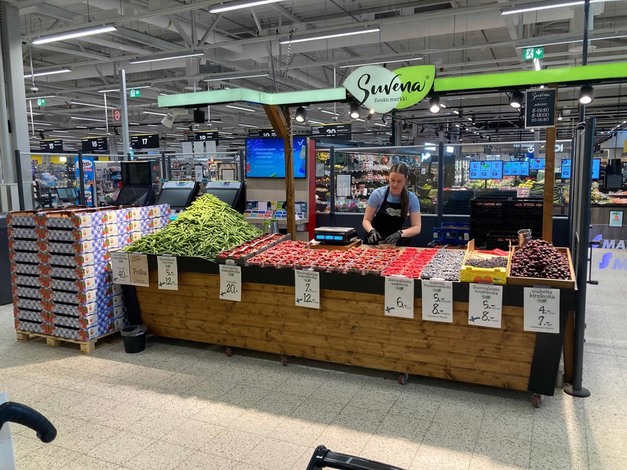
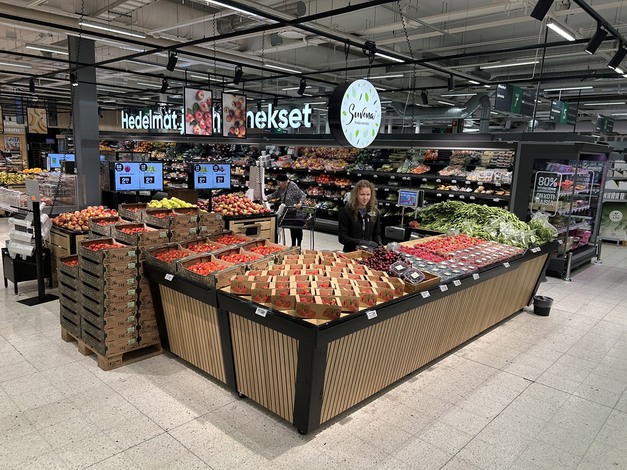
Sales at Suvena, Finnish for "summertime," take place largely via a shop-in-shop concept, which is unknown in the Netherlands and rarely seen in Europe. It originated from Finland's short, hectic open-field strawberry season and the country's long travel distances. "Strawberries grown in Finland, with their high brix levels, are very sweet but also fragile. In the past, their quality was so soft that if picked on Monday, they had to be sold on Tuesday. That doesn't work with a large chain using central procurement and distribution centres in a country the size of Finland. That's why there are always small local companies that sell soft fruit in and around supermarkets in season, for a commission or a stall fee. The advantage for the supermarket is that they don't need to manage anything, and the shelf always looks good."
 © Suvena
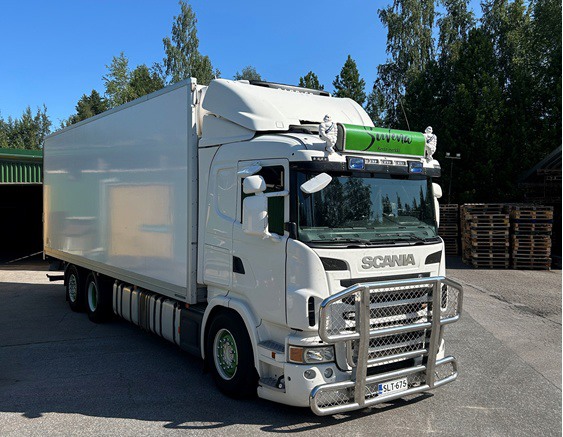
Suvena's truck drives 550 km a day, 6 days a week, during the busy months, to collect strawberries directly from growers. This season, Suvena even has to turn double stifts to get everything hitched.
Currently, Suvena operates at 16 supermarket locations with its own sellers; during the peak of the season, its staff count rises to 75. "We cooperate with one chain and have outlets in the Tampere region, Finland's second-largest city. We also have a few stands in shopping centres and now sell soft fruit at the main train station in Tampere, where many people pass through. Every year, we still see growth. We supply a small amount to wholesalers, but our main focus is the end consumer. We always select the tastiest and best-looking strawberries, aiming for repeat purchases. If you had a delicious strawberry yesterday, you want that same strawberry again today."
 © SuvenaFor more information:
Erik Guldemond
Suvena Oy
+358445845482
[email protected]
www.suvena.fi