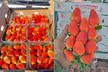
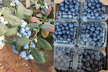
The peak season for strawberries is over, and customer demand has declined noticeably. Deliveries were also limited, with rainfall in the growing regions restricting availability. The condition of the fruit deteriorated in some cases, leading to an increase in quality issues. Returns from the food retail trade made it difficult to place regular goods in some cases.
 © BLE
© BLE
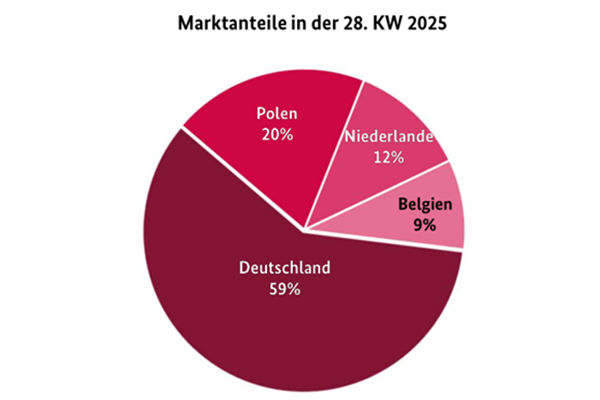
Despite all the adversity, prices remained stable and even rose slightly in some cases. However, price increases were rather rare. For the most part, prices tended to fall. Domestic offers dominated the range. Polish deliveries followed in terms of importance, but only played a major role in Berlin. Supplies from the Netherlands and Belgium were merely supplementary and were completely absent from the Hamburg wholesale market.
Click here for the full market and price report.
Apples
Imports from overseas dominated the market: Braeburn and Tenroy Gala came mainly from New Zealand, while Elstar and Tenroy Gala were the main varieties from Chile. South Africa contributed mainly Braeburn and Granny Smith to the market.
Table grapes
Italian loads were in the foreground, led by Black Magic and Victoria. Many IFG and Arra varieties followed in terms of importance. Deliveries from Italy increased. Imports from Egypt also intensified slightly.
Cherries
Although the campaign was entering the home stretch, deliveries from Germany increased once again. The quality of domestic fruit was generally impressive.
Plums
After domestic Ruth Gerstetter had already arrived in previous weeks, the Katinka season has now begun. Domestic Juna and Herman were also available.
Peaches and nectarines
Spanish deliveries clearly dominated, followed by Italian imports in terms of importance. Availability was not particularly abundant, with some reports of rather limited supplies in some places.
Apricots
The season is already well advanced: the quality of the loads was no longer consistently convincing. Turkish sugar apricots were in high demand among customers; their quantities had fallen sharply compared to last year.
Bananas
Demand was sufficiently in line with supply. As a result, retailers had very little reason to modify their previous demands.
Cauliflower
German offers dominated the market, with Polish, Belgian, and Dutch deliveries supplementing the market in some areas. Availability increased slightly.
Lettuce
Overall, availability improved significantly. Demand was not always able to keep pace. In some places, sellers therefore lowered their asking prices.
Cucumbers
Availability was rather scarce. Prices tended to rise, in some cases quite sharply. Both smaller and larger sizes became noticeably more expensive.
Tomatoes
Dutch and Belgian supplies continued to dominate the market. They were supplemented by domestic produce, whose presence increased slightly.
Sweet peppers
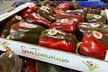
Dutch loads dominated the market. In terms of volume, they were followed by Turkish imports and domestic and Belgian loads. In some cases, there were also some Polish supplies available.