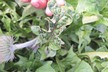
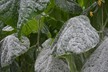
Dead Japanese beetles (Popillia japonica) have been discovered in Belgium, prompting the Federal Agency for the Safety of the Food Chain (FAVV) to issue a warning. Adult beetles feed on the leaves, flowers, and fruits of more than 400 plant species, including corn, grapes, strawberries, roses, and a wide range of deciduous trees. This makes them a serious threat to agriculture, horticulture, and natural ecosystems.
The beetles were found in a warehouse belonging to a metalworking company. The discovery was made by a vigilant employee. A follow-up inspection at the site revealed a second dead beetle among recently delivered metal parts, which were traced back to a supplier located in a known infested area in northern Italy.
Although only dead specimens were found, the FAVV is treating this initial detection with great seriousness. Popillia japonica is classified as a harmful invasive species and is listed as a priority quarantine pest by the European Union. This means that strict measures are legally required to prevent its introduction and spread, as outlined in Implementing Regulation (EU) 2023/1584.
Swift and targeted action
The FAVV immediately stepped up surveillance in the area surrounding the company. Traps have been installed to determine whether any live Japanese beetles may be present in the region. So far, no additional specimens have been found in the traps. Monitoring efforts will continue over the coming months to ensure early detection and rapid response if necessary.
The Japanese beetle has been present in Italy since 2014 and in Switzerland since 2017. The adult insect measures about 1 cm in length and is easy to recognize thanks to its metallic green head and copper-colored wing covers. It's clearly visible to the naked eye and can be safely picked up by hand.
However, this pest is often mistaken for other beetle species commonly found in Belgium, such as the rose chafer or the May beetle. What sets the Japanese beetle apart is a series of five distinctive tufts of white bristle hairs along each side of its abdomen, plus two more at the tip, a key identification feature.
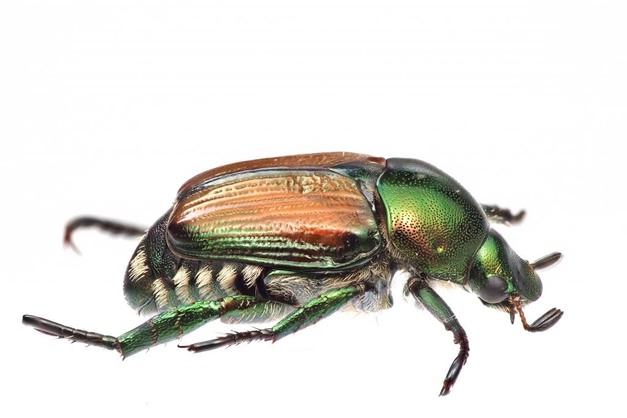 © EPPO/Gilles San Martin (CRA-W)
Popillia japonica male adult - ©EPPO
Harmful impact on agriculture and nature
The Japanese beetle poses a significant risk to agriculture, ornamental horticulture, and natural ecosystems. Adult beetles feed on the leaves, flowers, and fruits of more than 400 plant species, including corn, grapes, strawberries, roses, and various deciduous trees. Meanwhile, the larvae feed on grass roots, causing damage to pastures, sports fields, and lawns.
In regions where the species becomes established, it can reproduce rapidly and cause extensive damage. In the United States, where the beetle has been present since 1916, damages amount to hundreds of millions of dollars annually. Within Europe, in addition to northern Italy, the beetle is also found in the Azores (Portugal) and Switzerland, two popular holiday destinations.
The Japanese beetle is a hitchhiker
The recent findings confirm that the Japanese beetle spreads mainly through human transport. Adult beetles often hitchhike on vehicles—such as trucks, airplanes, trains, cars, and caravans, or on goods like camping gear and luggage coming from infested regions. The larvae can also be present in soil or growing media, such as potting compost used for container plants.
For example, a beetle was recently found in Spain inside the luggage of a traveler returning from Italy. In France's Alsace region, beetles were caught in traps placed near a train station and a highway rest area. Similar cases are reported in Germany, Switzerland, and Slovenia, where beetles from infested areas are regularly intercepted in traps installed along major transport routes.
In Belgium, pheromone traps are deployed annually to detect the beetle early and prevent local populations from establishing. The FAVV sets traps at 40 strategic locations across the country, focusing on points of entry and transportation hubs, such as airports, freight depots, and truck stops, as well as public green spaces near high-risk areas. These traps are monitored throughout the beetle's active flight season, which runs from early June to late September.
What to do if you suspect a sighting?
Professionals who suspect they have seen or captured a Japanese beetle are asked to report it as soon as possible to the local FASFC control unit via the reporting form. Consumers can do this via the ObsIdentify app or via www.waarnemingen.be. When the app recognizes the beetle based on the uploaded photo as the Japanese beetle, FASFC is automatically notified, and further follow-up of the report takes place. Knowledge and quick action are crucial to preventing the establishment of the species in Belgium, according to the FASFC.
Source: FASFC