In recent decades, the amount of agricultural land in Latin America treated with commercial biological control agents has grown from 4 million hectares in 2000 to more than 62 million hectares in 2024. This growth has primarily occurred in crops such as soy, corn, and sugarcane. In 2000, natural enemies such as predators and parasitoids were primarily used. This has changed in favour of the use of microbial agents based on fungi, bacteria, and viruses. Microbial agents now represent 70% of the market.
 © Embrapa, Brazil
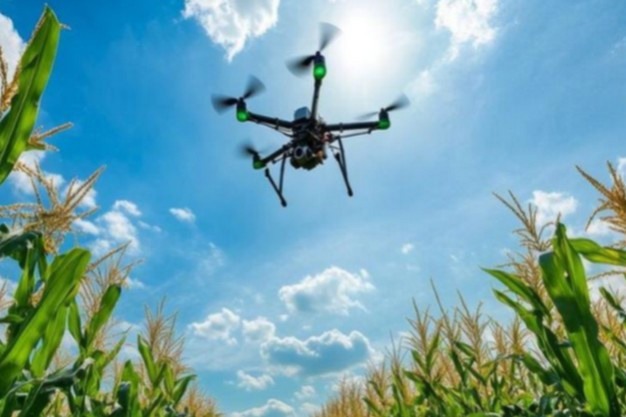
Prof. Joop van Lenteren (Wageningen University and one of the authors of the article* on which this news item is based) concludes that this significant growth in the use of microbial agents is due to the drastically shortened approval procedures for these agents (2 years in Brazil, compared to more than 10 years in Europe), the ease of application using drones and spray equipment that farmers already have available, their favourable price, and their reliability.
As per the study: During the past 30 years, augmentative biological control (ABC) has received increasing interest and is now applied in a large diversity of crops on many hectares in Latin America and the Caribbean. Around the year 2000 4.35 million hectares were estimated to be treated with ABC, in 2018 this had grown to 31.4 million hectares, and the estimate for 2024 was about 62 million hectares. Many factors explain this dramatic increase, the most important being (a) the development of microbial agents that are relatively cheap compared to macrobial agents, easy to produce, store and apply, and reliable, (b) the fine tuning and drastic shortening of registration procedures, (c) a change in attitude towards use of alternatives for chemical pesticides among young farmers. However, there are also factors frustrating implementation of ABC of which the most important are the lobbying activities of the synthetic pesticide industry and lack of application of the true cost principle for these pesticides which makes them unrealistically cheap. Major differences with other world regions are that in Latin America ABC is almost exclusively applied in the open field, is often not based on development of resilient systems and changed in the 21st century from mainly using macrobial control agents to increased applications with microbial control agents.
*Source: van Lenteren, J.C., Bueno, V.H.P., Bettiol, W. 2025. Latin America has the largest area under augmentative biological control worldwide, mainly with applications in open field crops. Biological Control, Volume 207, August 2025, 105827, https://doi.org/10.1016/j.biocontrol.2025.105827