Spain is the leader in melon exports from March to October, a period that seed companies are interested in extending as much as possible. Interesting news has been reported in this regard during Rijk Zwaan's Global Melon & Watermelon Event.
The idea behind lengthening production cycles is also to reduce import costs. Juan Francisco Martínez, melon cultivation specialist at Rijk Zwaan, says: "Our best-selling Piel de Sapo in Spain is the Bravura RZ, especially because it is increasingly planted in greenhouses in the off-season and overlaps with the Brazilian campaign. In other words, it is planted in August and harvested in October, when the Brazilian production is available. Despite the more limited amount of light and heat at that time, Bravura RZ melons still reach high sugar levels and have a good post-harvest."
 © Rijk Zwaan
In fact, on top of its good flavor, it offers extra profitability because "it can be consumed in November, a time when there are usually no domestic melons available and the fruit needs to be imported. In the past, the Piel de Sapo we ate at Christmas was kept in storage and consumed at the end of the year. That has now changed, and the one we have these days comes from Brazil, but with Bravura RZ, we could go back to consuming domestic melons," says Martínez.
Minijack RZ lengthens the export campaign
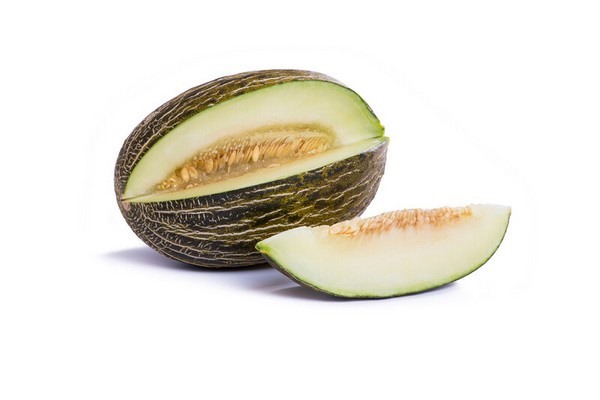
When it comes to Piel de Sapo melons, "we work with two lines. One with calibers suited for the domestic market, ranging between 3 and 4 kg, which includes the Mesura RZ, Flechaverde RZ, and the new Ciclope RZ. The latter is intended for late transplants in the regions of Murcia and La Mancha. It has good roots and hardiness, and it's a vigorous, very productive plant that adapts well to adverse conditions. It tolerates abiotic stress very well, and its flesh is semi-firm. Moreover, it has a good taste, with high sugar levels. It also ripens very quickly, which entails lower production costs. Of course, it is resistant to powdery mildew and aphids."
The other Piel de Sapo line is intended for exports, with calibers ranging between 1.5 kg and 2 kg. "We are developing them under the Melissimo concept. We have the Bravura RZ, Dolzura RZ, and Ricura RZ, and for late cycles, Minithor RZ. The newest is the Minijack RZ, which is the smallest variety that allows the export program to be extended," says Martínez.
Minijack RZ is a late transplant. "With the summer and the heat, calibers mostly become very large, but this one remains small, with good fruit set, high sugar levels, optimum shelf life, and, most importantly, high productivity. With Minijack RZ, it is possible to continue producing melons for export at times when this becomes challenging due to the heat and so extend the export season," says the manager.
 © Rijk Zwaan
According to Martínez, yellow melons "dominate the European melon market." He says that the most outstanding varieties for Rijk Zwaan are the Nival RZ in the early segment, the Yacal RZ for the medium cycle, and the Witral RZ for the late cycle. This allows a consistent supply of good-sized melons with a nice bite."
Cantaloupe and Charentais and the point of harvesting
The most outstanding Cantaloupe is the Zinasol RZ, an early or extra-early melon with orange flesh and good capacity to develop in adverse conditions. Martínez says that "it changes color and is marked around the stalk, making harvesting easier. The range is completed with the Paniol RZ for the medium cycle and the Frivol RZ for the late one."
As for the aromatic Charentais, the latest addition is the Thorens RZ, which is characterized by the plant's vigor, a suitable size for early crops, and the capacity to remain in good condition on the plant, which helps reduce the number of harvests. It also has a good post-harvest and a nice aroma and flavor."
For more information:
Juan Francisco Martínez
Rijk Zwaan
Tel.: +34 609 851 471
[email protected]
www.rijkzwaan.es