Greenhouse tomatoes are generally destined for fresh consumption, with interesting market prospects particularly for the small berry types (cherry, mini plum, mini san marzano, and others), which are much appreciated by young consumers.
In Italy, around 7,400 hectares have been invested in table tomatoes (average for the four-year period 2021-2024) thanks to favourable soil and climate conditions, with production reaching 670 thousand tonnes in 2024, with a growing trend: +29% compared to the first year (ISTAT data 2025). Cultivation takes place in low-tech greenhouses or cold tunnels to extend the production cycle and optimise irrigation management and defence, in order to be sustainable.
The S.I.M.P.L. - Innovative strategies for monitoring and preventing the contagion of downy mildew (Phytophthora infestans) and powdery mildew (Leveillula taurica) project financed by the University of Verona using iNEST Spoke 7 (Smart Agrifood) resources, proposes the introduction of microclimatic sensors associated with forecasting modelling to support decisions that impact phytopathological management, in particular of the aforementioned diseases.
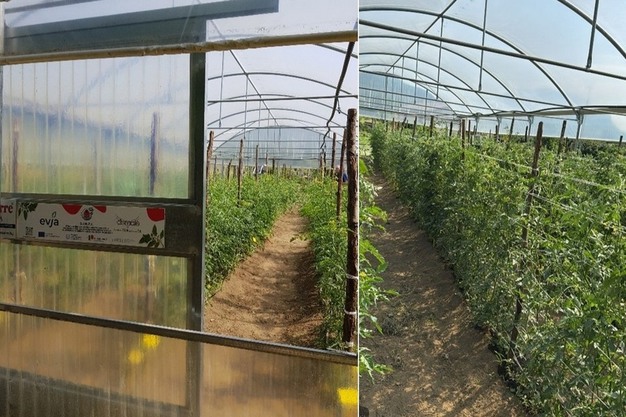 © progetto S.I.M.P.L.
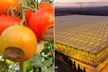
Cold greenhouse at the De Maio farm (Forino, AV) hosting the experimental cultivation of cherry tomatoes for the canning industry within the S.I.M.P.L. project
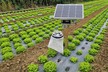
As project leader, EVJA srl coordinated the activities and led technological implementation, providing its patented technology through the system comprising the microclimatic control unit equipped with temperature, solar radiation, air and soil humidity sensors, powered by a photovoltaic panel and connected to the software part of the system. The decision support system (DSS) continuously processes the microclimatic factors of the soil-plant system and estimates phytopathological risk levels based on environmental determinants for the development of target pathogens. This information, communicated to operators via a device, supports more precise operational choices than the traditional calendar-based approach.
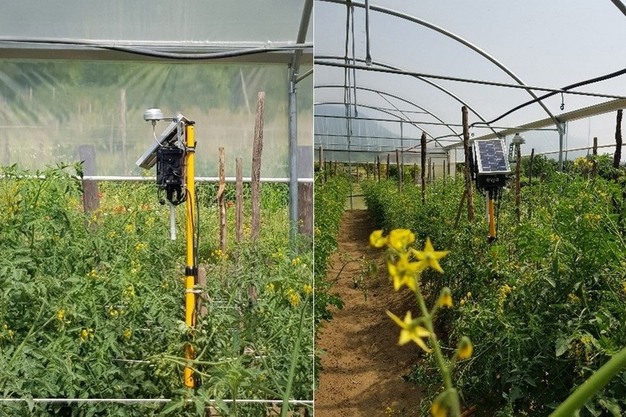 © progetto S.I.M.P.L.
Control unit with microclimatic sensors positioned inside the greenhouse.
In order to implement the DSS, an experimental trial of unheated greenhouse cultivation of cherry tomatoes was set up at the De Maio farm in Forino (AV). Transplanting was carried out on 23 April, on a single row with a spacing of 40 cm and of 1.2 m between rows, for a plant density of 2.08 m-². The strip-plot experimental design involves the comparison of two cultivars with indeterminate growth - Intuitivo (HM Clause) and Prymello (Vilmorin) - subjected to the traditional and precision irrigation regimes. The latter is managed by the DSS which, based on the actual evapotranspiration model, suggests irrigation interventions (carried out with drip lines) to maintain an adequate volumetric water content in the soil.
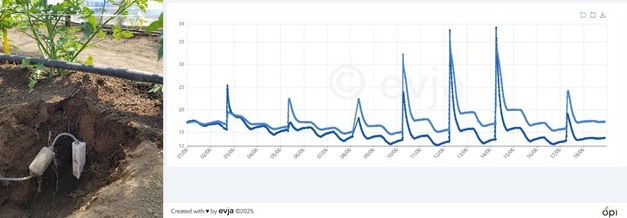 © progetto S.I.M.P.L.
Trend of volumetric soil water content estimated by DSS based on 15 cm probe measurements. Light blue (traditional irrigation), dark blue (precision irrigation with DSS)
A treatment with a patented formulation from the agricultural company Oasis Srl, i.e. a biofungicide-nematocide containing microorganisms with biofumigant action, was also applied to all experimental factors. In the first part of the crop cycle, during the vegetative growth phases, continuous monitoring of the soil and climate values provided by the sensors installed in the greenhouse together with the control unit made it possible to effectively modulate irrigation.
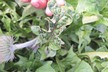
At the same time, the general phytosanitary condition of the crop was monitored, with particular attention to the appearance and spatio-temporal spreading of the powdery mildew and downy mildew infections. The first downy mildew attacks were recorded on the basal leaves. At the end of the campaign, the visual inspection data will be cross-referenced with the outputs of the phytopathological models in order to validate the system.
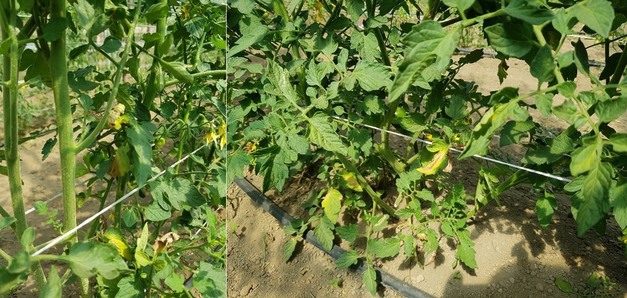 © progetto S.I.M.P.L.
Basal leaves of a tomato crop affected by symptoms attributable to downy mildew attacks
The use of DSS based on predictive modelling and IoT systems represents a crucial element for integrated pest management and irrigation, allowing significant technological advancement even in low-input greenhouse contexts.
For more information:
www.simpl-project.com

EVJA S.R.L.
Via Benedetto Brin, 63
80142 Naples - Italy
+39 0810063832
[email protected]
www.evja.eu