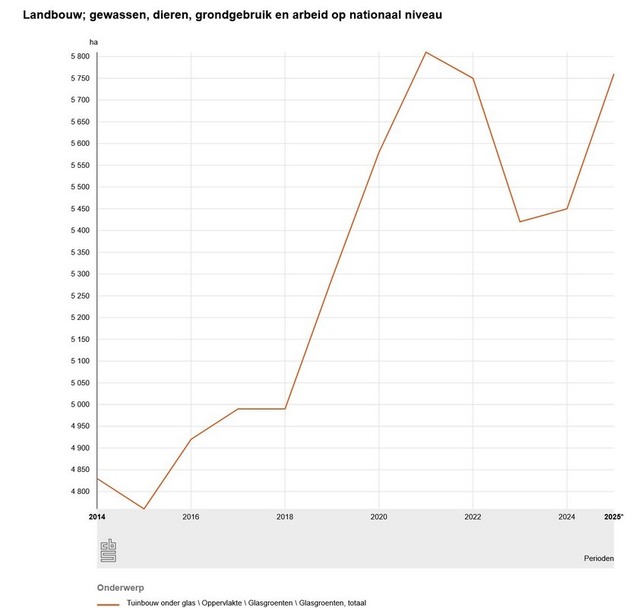
The area of greenhouse vegetables in the Netherlands will increase to 5,760 hectares by 2025, according to new, provisional figures from CBS. The statisticians report a notable rise in the acreage of peppers and tomatoes in particular.
The sweet pepper acreage will grow by 130 hectares to reach 1,660 hectares. Red peppers account for the largest share at 960 hectares (+80 compared to 2024), followed by yellow at 260 hectares (-30) and green at 130 hectares (+10). The acreage for 'other' peppers increases by 70 hectares to 310.
Tomato acreage is set to increase by 180 hectares, reaching a total of 1,910 hectares. With 1,020 hectares, vine tomatoes cover the largest area, marking a 100-hectare increase. The area for loose tomatoes will be 370 hectares (+40), while cherry tomatoes will expand by 40 hectares to 520 hectares.
The number of greenhouse vegetable farms has decreased by 50, bringing the total to 1,030, according to the preliminary figures.
 © CBS
© CBS
Figures for floriculture crops under glass, tree nursery crops under glass, fruit under glass, and other horticultural sectors are not yet available from CBS. The provisional data for 2025 come from the agricultural census.
It is important not to conclude too early from the latest provisional figures. For the agricultural census, CBS asks growers to report the total area under glass, which must also include space required for cultivation, such as paths in greenhouses. Other vegetables such as endive, courgette, lettuce, radishes, herbs, and melon are also included in the CBS count. Figures were also published earlier this spring for 2024. At that time, CBS provided additional explanations to clarify discrepancies between the two types of data collection.