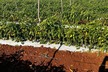
With the U.S. set to impose a levy on imported Mexican tomatoes starting mid-July, Mexican growers are intensifying efforts to oppose the measure, citing potential harm to both countries. The move has united Mexican producers with U.S. partners and President Claudia Sheinbaum's administration in lobbying efforts.
Walberto Solorio, president of the Baja California Agricultural Council, representing 120 tomato growers, mentioned the difficulty in negotiations, stating, "It's very difficult to negotiate with someone who shows no interest in negotiating." Despite the challenges, he emphasized, "We are going to keep knocking on the door. We are not giving up."
Mexican tomato exporters recently convened in Washington, D.C., with Mexican Agriculture Minister Julio Berdegué, U.S. buyers, distributors, and retailers opposing the U.S. import fee. Berdegué described the meetings as "extremely cordial and productive," but specific outcomes were not disclosed.
Starting July 14, Mexican tomato growers face a 17.09% "anti-dumping" duty at the U.S. border, as announced by the U.S. Department of Commerce. This follows the withdrawal from the Tomato Suspension Agreement that, since 1996, exempted Mexican tomatoes from levies under certain conditions.
Mexico's Economy Ministry notes that over half of the country's tomato crop, valued at over US$ 3 billion, is exported to the U.S. This export growth has been fueled by Mexico's expanding greenhouse production, with the country now supplying nearly 70% of fresh tomatoes consumed in the U.S.
President Claudia Sheinbaum indicated potential retaliatory measures, including duties on U.S. chicken and pork legs. The Florida Tomato Exchange has long led the charge against Mexican imports, alleging unfair pricing practices.
The U.S. Department of Commerce stated that its decision aims to allow U.S. growers to compete fairly. California and Florida are key U.S. producers, though Florida is Mexico's main competitor in fresh tomato production.
Mexican growers, often connected with U.S. companies, argue that the levy would increase consumer prices and reduce variety choices. Texas A&M University reported that Mexican tomato exports support nearly 47,000 U.S. jobs.
Solorio highlighted Florida's competitive challenges, noting, "they lack the technology, the water, the climate, the workforce; they have many disadvantages, but they don't see it that way."
In Baja California, where 80% of the tomato crop is exported, the impact of the levy could be substantial, affecting both growers and the regional economy. Solorio noted the region's dependency on exports due to its geographical isolation and the infeasibility of the national market.
Source: Mexico News Daily