This week's forecast calls for precipitation totaling up to 1.5 inches through next Wednesday, May 21, with lighter rains this week and heavier rains mostly towards the end of that time range.
Partly to mostly cloudy with scattered showers and thundershowers are possible Wednesday, May 14, especially during the late afternoon and early evening. It'll be a warm and dry Thursday during the day with showers and thunderstorms developing again Thursday night. Some strong storms are possible Thursday evening. It'll be mostly sunny, dry and warm Friday. Showers will develop again overnight Friday into early Saturday. Cloudy and cooler this weekend into early next week. Rain possible again next Tuesday.
High temperatures from the mid-70s S to the low 80s in the northwest Wednesday, and 70s to low 80s Thursday and Friday, cooling back to the 50s in the north to 60s late this weekend. Low temperatures generally in the 50s through Friday, cooling to the 40s this weekend.
Medium range outlooks call for cooler and wetter than normal weather during the last week of May.
Spray tank cleanout
Residual herbicide left in boom ends, lines or tanks can cause issues down the line when making subsequent applications. Take 3 minutes to listen to some educational Canadians talk about sprayer rinsing procedures with some cool visuals or read more here.
Calibration
Spring time is the best opportunity to lock in your output rate with a range of machines, settings and products. When it comes to spreading granular fertilizer, some folks can't mix their own blends and apply each ingredient separately. In this case, it can pay to calibrate each individual product you intend to spread because the flight dynamics of their particles are influenced by their shape, size, density and hardness. So, blending a custom mix is an attractive option, requiring only one calibration to dial in the effective swath width.
However, some of the same factors that influence flight also influence how well granules mix. For example, denser particles tend to work their way to the bottom in a blend, while larger particles tend to shake up to the top, which can result in an uneven application. Brittle, or soft particles can be ground into dust by the weight of other harder particles and agitation. Therefore, it can be useful to compare particle sizes, densities and hardnesses before making a blend.
Herbicide formulations
Recent changes to formulation of Roundup products sold for homeowner use are detailed in this recent publication by Erin Hill. The product still may be called Roundup but may now contain different active ingredients, which can cause confusion. Check it out to make sure you are using the proper product in the right area and use case.
Beginning farmer
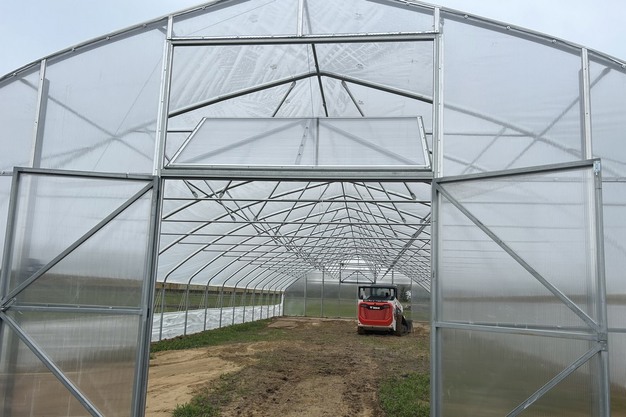
If you are a beginning vegetable grower and have many questions, reach out to an educator in your region. You can also explore this beginning farmer curriculum, where you may find answers to many of your questions.
 © Salta Mambetova, MSU Extension
Crop updates
Asparagus: Monday's warm daytime and overnight temperatures pushed asparagus into overdrive in west central Michigan after patchy freezes late last week.
Keep an eye out for asparagus beetles along field edges of known hotspots. Growers know where they have had problems before; the edges of those fields are the best place to check. Carbaryl and Assail (active ingredient acetamiprid) are both effective and have one-day preharvest intervals. This article on control just got updated based on the latest Michigan State University (MSU) research.
 © Ben Werling, MSU Extension
Purple spot can appear during harvest with the highest risk when extended rainfall is coupled with cool weather. Something to keep an eye out for in the week ahead depending on the forecast.
The cold weather late last week brought up a question for those with center pivots: Should I irrigate ahead of a freeze to get some freeze protection? This practice is most beneficial if soils are dry and irrigation is applied so soil is moist when the sun is out. As explained in the Michigan State University Extension article, "Should I irrigate ahead of the coming freeze?", soil that has moisture in it can better absorb and transfer heat from the sun into the soil profile during the day and back upwards towards the surface and plant canopy at night.
Brassicas and greens
Brassicas of all kinds are being transplanted or direct seeded in the field. Lettuce is being planted out in the field. Cabbage white butterflies, also known as imported cabbageworm adults, are flitting around cabbage fields. Cabbage maggot has been observed feeding on plant stems along field edges.
Growers are still seeing wind damage on some crops that were affected in late April. Some crops showed delayed symptoms of wind damage, but wind and sandblasting have certainly been reported on transplants/seedlings and other crops.
Cucurbits
Cucumbers and summer squash are being planted outside. Melons and watermelons are being planted outside on black plastic.
In the world of vine crops, there are some genetic terms you may see in a seed catalog. Michigan State University will define them and what it means for field arrangements and spacings.
Monoecious: A plant that makes both male and female flowers to ensure pollination. A profusion of male flowers usually emerge first, followed by a succession of female flowers, after which both types of flowers continue to emerge along the vine through the season. Temperature affects the ratio of male to female. Plant at typical density. No isolation required.
Gynoecious: A plant that makes predominantly female flowers, with some males. These plants tend to yield more fruit because they focus less energy on male flowers. Only a few pollen-bearing male flowers are needed to pollinate many females. Additionally, when purchasing a gynoecious variety, there is often a 5-15% addition of "sire" seed mixed in that is monoecious, ensuring there is a distribution of male flowers across the planting. Plant at typical density. No isolation required.
Parthenocarpic: A plant that will set fruit without pollination. Under average conditions, parthenocarpic cucumber and pickle varieties should not produce male flowers at all. When male flowers are not around, the fruit that is produced will be seedless. These varieties are not dependent on flower sex ratios and therefore will continue to produce fruit through temperature swings. This can be a desirable trait for some. Plant at half density. Isolation from gynoecious and monoecious varieties is recommended.
Some zucchini and summer squash varieties have parthenocarpic traits but still make male flowers. This can potentially help level out pickings when temperatures change the sex ratio of flowers, but this is not well understood.
Seedless: Can refer to a parthenocarpic pickle or cucumber, or to a triploid watermelon. Watermelons that have three copies of their chromosomes are called triploid, and when they are pollinated by a standard diploid variety, the mismatch in chromosome copies will make a fruit that is seedless. Plant at typical density. Requires one standard seeded diploid plant for every three or four seedless triploid plant. Also, seedless triploid watermelons can benefit from a separate, high-temperature seed-starting process from other vegetables.
There are two common ways to trellis high-tunnel cucumbers. One is the single-leader system where you are essentially pruning the plant as a single vine and trellising it vertically up a wire in similar fashion as you would manage indeterminate tomatoes. At each node on the main stem of the cucumber plant you will find a leaf, tendril, fruit and sucker. Pinch off the young sucker leaving the leaf, fruit and tendril intact and wind the main stem around your trellis string. Once the plant reaches wire or purlin where the vertical string is connected, you can either a) lower and lean the plant if you have excess trellis string to let out, or b) use the "umbrella method" where you leave a few suckers to become new leaders that are allowed to grow back downward. There are several variations on the umbrella method, find more information in this Penn State Publication.
The other main practice is training the vines up horticultural netting stretched horizontally, forming more of a wall of cucumber foliage. This does not typically require as much pruning and can be even more productive than a single-leader system.
Fruiting vegetables
Early planted greenhouse tomatoes are full of green fruit and flowers. Field plantings of tomatoes have begun in southern Michigan, on bare-ground and black plastic mulch. Eggplant and peppers have started to be transplanted out in the field on plastic mulch.
Twisting, constricted, stringy, bendy stems are what we call epinasty. Tomatoes are like canaries in a coal mine with their environmental sensitivities and show epinastic growth in response to many things. Abiotic causes of epinasty can be the result of several issues, but most are due a hormonal imbalance (internal or external) causing unrestricted/uneven growth.
Source: Michigan State University