Fusarium pepper wilt in greenhouses has become the top disease threat in Ontario, infecting nearly 400 acres in 2024 and triggering urgent research into its biology, diagnostics, and control. In this May 2025 update, we chart the wilt's spread, highlight the jump from 36 to 48 FOSC strains, and the overall research progress about this pathogen.
The pathogen, tentatively identified as belonging to the Fusarium oxysporum species complex (FOSC), has been the focus of intensive research efforts as scientists race to understand its biology, develop detection methods, and establish effective management strategies. Recent findings indicate that the fungal complex is more diverse than previously thought, with 48 species or strains now identified in 2025, up from 36 reported just a year earlier.
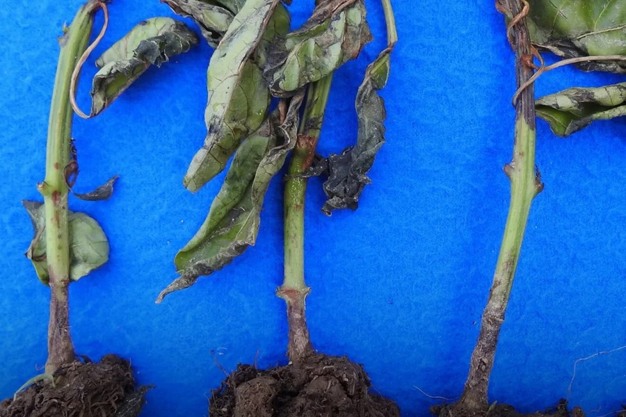 © Vegetable Pathology, Long Island Horticultural Research & Extension Center, Cornell University
Current state of fusarium pepper wilt (greenhouses) in Ontario (May 2025)
The Fusarium pepper wilt in greenhouses for Ontario's pepper production remains concerning in 2025. The disease first appeared in Ontario in 2021-2022, with confirmed cases increasing significantly by 2023 across Ontario, British Columbia, and the Netherlands. By 2024, the impact was severe enough to cause approximately 400 acres of crop loss in Ontario alone, leading to notable market shortages. The 2024 growing season ended earlier than usual (October-November), specifically due to the disease pressure (Fusarium blamed for shortage of Canadian greenhouse-grown bell peppers).
While comprehensive data for the 2025 growing season is still emerging, the disease continues to be a primary concern for greenhouse pepper growers. The Ontario Greenhouse Vegetable Growers (OGVG) and its members are actively coordinating research and investing in new technologies to mitigate the impact. Daniel Terlizzese, Research, Innovation & Plant Protection Lead at OGVG, has indicated that their "multifaceted strategies look promising to combat the disease," though specific details about 2025 losses are not yet fully quantified.
The situation has placed significant pressure on the Canadian greenhouse industry, with growers needing to source bell peppers from alternative regions such as British Columbia and the Netherlands, where production has remained more stable. This has created market disruptions and likely affected pricing for consumers across Canada.
 © Institute of Food and Agricultural Sciences - University of Florida
Identification of Fusarium pepper wilt greenhouses & diversity of the Fusarium oxysporum species complex (FOSC)
The causal agent of the greenhouse pepper wilt has been tentatively identified as belonging to the Fusarium oxysporum species complex (FOSC). This is a large and diverse group of related Fusarium species, making precise identification challenging. What makes this outbreak particularly interesting is that Fusarium oxysporum is prevalent in greenhouse systems but typically didn't cause severe disease in peppers in the past. In fact, some nonpathogenic F. oxysporum strains have even been used as biological control organisms (Getting to the Root of Novel Greenhouse Pepper Wilt).
Recent research presented by Cara McCreary at the Lower Mainland Horticulture Conference in January 2025 revealed significant new findings about the pathogen's diversity (Inside view: Nature or Nurture?Greenhouse Canada). According to her update, the number of species or strains isolated in the Fusarium oxysporum species complex has increased to 48, up from 36 reported in March 2024. This represents an addition of twelve new strains identified in just one year, highlighting the complex and evolving nature of the pathogen. Interestingly, not all of these strains are pathogenic – some appear to be beneficial species.
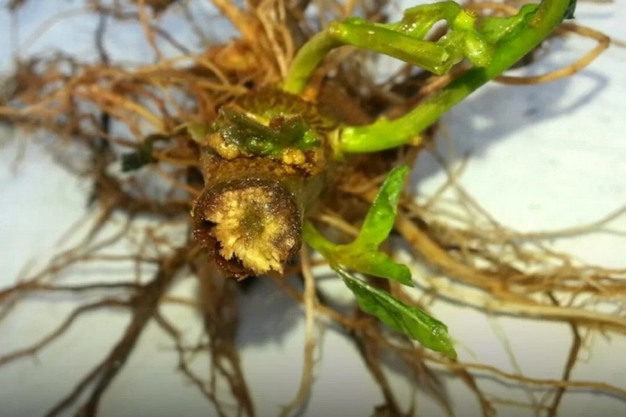
The disease manifests primarily as a root and crown rot in greenhouse peppers, causing reduced growth, sudden wilting, and in severe cases, plant death. Affected plants develop brown-black discoloration and necrosis on crown and root tissues, but notably, there is no discoloration of the vascular tissue, which distinguishes it from traditional Fusarium wilt diseases.
Pathogen Clarification: The causal agent is confirmed as part of the Fusarium oxysporum species complex (FOSC), a genetically diverse group with both harmful and benign strains. The pathogenic variants cause root/crown rot without vascular discoloration, distinguishing them from classical Fusarium wilt.
Impact of Fusarium pepper wilt on greenhouse pepper production
The economic impact of this disease outbreak has been substantial for the Canadian greenhouse vegetable industry. In 2024, approximately 400 acres were lost to the disease in Ontario alone, representing a significant portion of the province's greenhouse pepper production. This has led to noticeable shortages in the Canadian market (Fusarium blamed for shortage of Canadian greenhouse-grown bell peppers).
The shortage has forced distributors to adapt by sourcing bell peppers from alternative regions. Ray Mastronardi, Vice President of Sales for Del Fresco Pure®, explained that the impact of Fusarium pepper wilt has substantially reduced the bell pepper supply compared to previous years. To meet demand, suppliers have been sourcing peppers from British Columbia and the Netherlands, where production has remained more stable, as well as from Leamington, Ontario, though in reduced quantities. Additional supply is coming from California's field-grown red peppers.
The 2024 growing season ended prematurely (October-November) due to disease pressure, further exacerbating the supply shortage. The pricing has consequently remained high due to the combination of shortage and steady demand. While specific 2025 production data is not yet available, the ongoing research and management efforts suggest that the industry continues to grapple with this challenge.
Detection & qPCR diagnostics for fusarium pepper wilt in greenhouses
Currently, there is no detailed information about specific detection methods for this particular Fusarium strain. However, given the complexity of the Fusarium oxysporum species complex and the ongoing research, detection likely involves both traditional techniques like culturing and microscopy and modern molecular methods to identify the specific strains involved.
At Healthy Hydroponics, we provide services to identify the Fusarium oxysporum species complex and individual Fusarium species. We are currently working with OMAFA and AAFC to identify the Fusarium involved in the current bell pepper disease.
The aggressive Fusarium oxysporum strain affecting greenhouse peppers in Ontario represents a significant challenge for the Canadian greenhouse industry. Since its emergence in 2021-2022, it has caused substantial crop losses, with approximately 400 acres lost in Ontario alone in 2024. The research indicates that this is a complex pathogen belonging to the Fusarium oxysporum species complex, with 48 strains identified as of January 2025.
The ongoing collaborative research efforts by OGVG, OMAFRA, Agriculture and Agri-Food Canada, and private sector partners offer hope for a better understanding and eventual management of Fusarium pepper wilt in greenhouses.
For more information:
Healthy Hydroponics
www.healthyhydroponics.ca