This spring has featured a real north-south difference. Degree day totals base 50 degrees Fahrenheit are a few days behind normal in the Upper Peninsula, ramping up to one to two weeks ahead of normal in the southeast Lower Peninsula. Temperatures for the past week showed that same north-south split. Most of the state received rain, with heavier rain to the southeast.
Calibration
Spring time is the best opportunity to lock in your output rate with a range of machines, settings and products. When it comes to spreading granular fertilizer, some folks can't mix their own blends and apply each ingredient separately. In this case, it can pay to calibrate each individual product you intend to spread because the flight dynamics of their particles are influenced by their shape, size, density and hardness. So, blending a custom mix is an attractive option, requiring only one calibration to dial in the effective swath width.
However, some of the same factors that influence flight also influence how well granules mix. For example, denser particles tend to work their way to the bottom in a blend, while larger particles tend to shake up to the top, which can result in an uneven application. Brittle, or soft particles can be ground into dust by the weight of other harder particles and agitation. Therefore, it can be useful to compare particle sizes, densities and hardnesses before making a blend.
High tunnel stressors
It is a time of excitement and transition in high tunnel and hoophouse production spaces. Nights are still low enough to require heat, and daytimes are high enough to require full open venting. Plants get a lot of mixed signals during this time. Mixed veg and flower houses see a lot of turnover and handling as well, which can introduce issues.
One such issue is aphids. Several growers have reported aphid issues in hoophouses that took in incoming flowers, and/or kept perennial plants overwinter. This is a troublesome issue best handled by prevention and staging incoming plants for treatment before entering the main area.
Curling tomato leaves in the spring high tunnel is almost entirely caused by the odorless and colorless ethylene gas, produced by combustion heaters. As we get warmer days, and venting increases, we tend to see less of this issue. For more information, see the e-Gro Alert, "Epinasty, malformation & bud abortion, what are the possible causes?"
Sometimes, cool-season leafy greens are grown in hoophouses. These can tolerate freezing temperatures, and vents can be opened for these earlier than warm-season crops. Why would you want to open the vents for these? Because humidity gets too high, leaves stay wet, and diseases take off. Another approach is to turn on the heater in the early morning because warm air can "hold" more water, meaning that as air warms it absorbs liquid water from the surface of leaves.
An interesting case this spring demonstrated another way that water is absorbed from leaves. In this case, too much water. A grower overwintered chickens in their hoophouse and then moved them out and used that space for growing out their vegetable transplants after popping seeds in the germination chamber. They were experiencing overnight leaf burn, and progressive dieback along the edges of leaves across all species uniformly. The issue ended up being ammonia gas emanating from the chicken manure.
As a gas that is lighter than air, ammonia rises and absorbs water from wherever it can, to become ammonium, and then sinks back down to the surface. It will steal water directly from plant leaves, which desiccates them. This is likely why they looked brown and crispy from the outside-in as ammonia sucked water from their guttation points. This also happens in corn fertilized by anhydrous ammonia in compacted soils where the furrow doesn't close behind the injection shank.
Crop updates
Asparagus: Asparagus harvest has started on some west central Michigan farms, and is on tap on others. Harvest continues in southwest Michigan.
Cutworms are one of the first pests that can very spottily appear. Most growers applied either chlorpyrifos or permethrin with their herbicides, both are effective. If issues still pop up, permethrin is an effective product with a one-day preharvest interval.
Brassicas and greens
Brassicas of all kinds, such as kale, cabbage, broccoli, bok choy and collards, are being transplanted in the field. Some plantings are partially flooded in areas from recent rains. Winter greens in high tunnels are winding down while spring greens are growing well.
Cabbage maggot eggs were present this week in one west central Michigan brassica planting. This is a high risk life stage where cole crops are susceptible to root damage from maggot feeding. For leafy and heading brassicas, cabbage maggot damage is worst on younger plants early in the season.
Verimark can be applied as a tray drench to transplants to provide effective control. It will also provide early season flea beetle and caterpillar control. Covering rows to exclude flies from egglaying is the go-to for non-chemical control. Ideally, row covers should be placed out after planting. If there is a delay, flies can lay eggs at the base of growing plants that will hatch into maggots. Make sure to only use row cover on ground that did not have brassicas last fall. Otherwise, flies could emerge under the cover. Growers have observed crops like radish suffer when under frost cloth. Covers advertised as insect netting allow more air movement to keep temperatures cooler while providing the same protection. Insect netting will also keep flea beetles and caterpillars out if the edges are sealed.
Cucurbits
Cucumbers and squash transplants are being seeded. Melon transplants are growing in the greenhouse and waiting for warmer weather. Planting cucumbers into high tunnels is picking up.
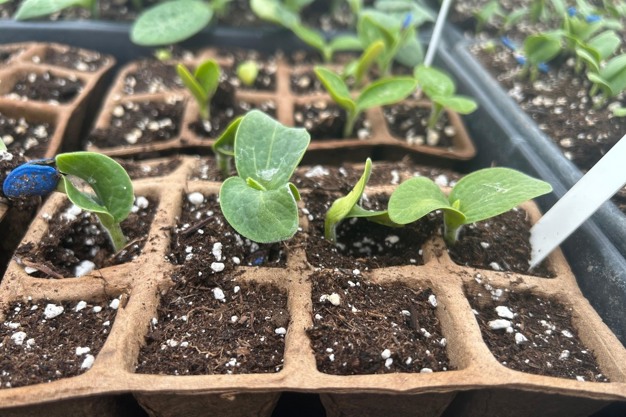 © Salta Mambetova, MSU ExtensionBiodegradable seedling trays and pots, such as Jiffy pots, are not new; however, one grower has observed over the years that cucumber and melon seedlings perform better in these pots, as they minimize root disturbance
Some farms sow cucurbits into raised beds with plastic mulch. This may provide some of the benefits of plastic mulch while using seeds instead of transplants. This can be done on a small scale with jab planters. These are basically a long tube with hole openers at the end. You pull a trigger to open the hole and drop the seed in. There are also pull-behind units that do the same thing without the need for manual labor (though machines always need fussing with!).
Fruiting vegetables
High tunnels are full of tomatoes at flowering stage and fruit set. Some hoophouses are still being planted with tomatoes and peppers. Starting with healthy, vigorous looking transplants is crucial for maximizing yield potential. Seedlings that are already showing some stress from inadequate water, nutrients, light, heat, etc. may be more susceptible to transplant shock when planted. Planting field tomatoes will begin soon on most farms.
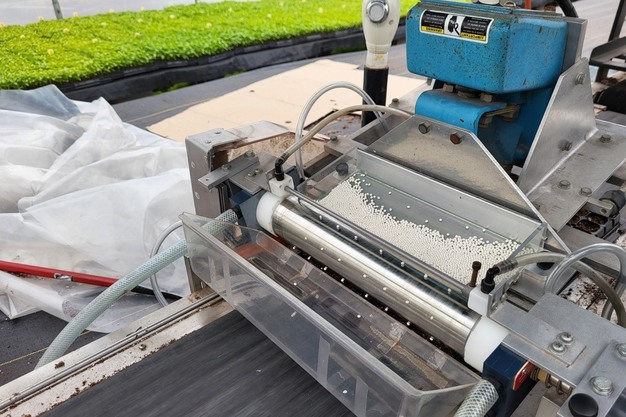 © Chris Galbraith, MSU Extension.Drum seeder completing the seeding of a flat with pelleted pepper seed. Seeding equipment can dramatically improve efficiency when handling many flats
Intercropping is a popular practice for maximizing usage of high value tunnel space. Common pairings are low-growing crops like lettuce, green onions or basil planted at the base of tomatoes after they are established. This makes use of bed space that would otherwise be open season for weeds to grow. This can be a good way to "stack" crops if you are not using a plastic mulch or landscape fabric for weed suppression.
Root crops
High winds last week caused some wind damage on early plantings in more than one location.
Cabbage maggot eggs were present at the base of turnips in at least one field this week. Thankfully, many brassica root crop growers have been using up their chlorpyrifos for early-season plantings, since it won't be legal to use after June 30.
As we move into a post-chlorpyrifos world, post plant applications may be needed. Placement is challenging and may be a key to getting the most out of these applications. Michigan State University Extension is working with growers to test different ways to get insecticide to the base of plants where eggs are laid.
Source: Michigan State University