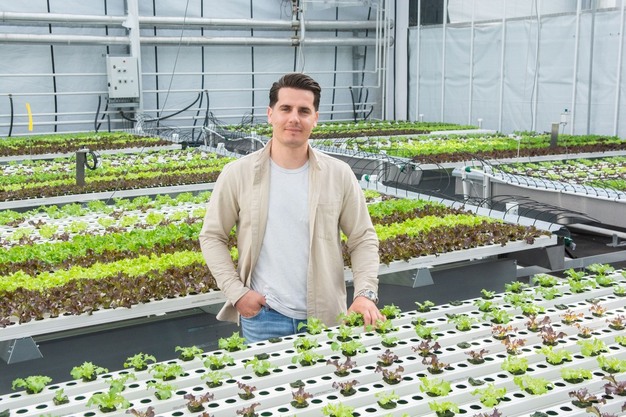
"The transition to sustainable, high-tech agriculture is no longer a luxury - it's a necessity." That's what Denis Laci concludes when summarizing the developments in the leafy greens market. After several years of building expertise in both the crop and the industry, he recently started a horticultural consultancy firm Agranom, providing services exclusively to CEA leafy greens high-mid tech growers around the world. In this new chapter, he follows his passion while actively supporting the global development of the CEA leafy greens industry. "It has been quite a journey so far", he reveals.
 © Agranom
The journey started six years ago, after Denis completed his agriculture studies on the island of Crete. Motivated by a deep interest in hydroponics, he relocated to the Netherlands to kick-start his career. His first role was as an assistant grower and R&D lead at Dry Hydroponics, a hydroponic system supplier based in Schipluiden. There, he developed hands-on knowledge of leafy greens cultivation, learning to overcome the unique challenges of hydroponic systems while gaining a broader understanding of this fast-evolving market. His next step brought him to the Delphy Improvement Centre, where he collaborated on advanced research trials with leading suppliers, delivered technical training and workshops, and provided consultancy support to various high-tech facilities across Europe. It was during this period that Denis discovered his true passion: educating and empowering growers to improve their systems, reduce costs, and avoid critical mistakes in construction, equipment choice, and operations.
"The idea of starting my own company came after realizing how overwhelming the leafy greens CEA field has become," Denis shares. "New technologies and products are constantly emerging, making it difficult for growers and investors to know where to focus, what to avoid, and how to build a long-term profitable business." This insight laid the foundation for Agranom—a consultancy firm focused exclusively on leafy greens (lettuce and herbs). The goal? "To bridge the gap between emerging technologies and practical execution, ensuring that clients are well-informed and strategically guided every step of the way."
He highlights the broader market shift driving this decision. "Today's agriculture industry is under increasing pressure to become more sustainable. There's growing demand for pesticide-free, peat-free, and resource-efficient production methods—paired with regulatory and environmental pressure to reduce water use and environmental impact. The transition to sustainable, high-tech agriculture is no longer a luxury—it's a necessity," he says. "In northern climates, CEA is already becoming the standard, driven by harsh outdoor conditions, high labor costs, and greater access to funding.
Southern countries are now catching up, he sees. "Greece, for example, recently announced €600 million in funding for new high-tech greenhouse projects starting in 2025. Spain is rapidly transitioning from open-field to CEA cultivation, while Mexico is developing high-tech lettuce and high-wire crop facilities—an idea that seemed unrealistic just a few years ago."
The most significant advancements in scale, technology, and automation are currently seen in regions like northern USA, Canada, and the Middle East. "With easier access to capital and customers who value low-pesticide, low-carbon products, these regions are driving demand for premium-quality produce and are more able to recoup the high costs of CEA investment." At the same time, greenhouse technology has taken a major leap forward. "Climate control and automation systems have reached new levels of precision, allowing for growing conditions that closely mirror fully indoor environments. Meanwhile, leafy green varieties are being specifically bred for hydroponic cultivation under artificial lighting, delivering more consistency and higher yields. "
Denis explains how one of the earliest challenges of hydroponic systems—especially D.W.C and N.F.T setups—was managing water quality, root health, and system disinfection. "Today, there are advanced technologies that address these issues effectively, making year-round cultivation more reliable, even in extreme climates. This minimizes investment risk, particularly for newcomers entering the CEA space. And perhaps one of the most transformative innovations of recent years? The semi-closed greenhouse. This system offers a powerful combination of energy efficiency and high yields, enabling growers to reach production levels of 100–120 kg/m²/year in fully automated operations—setting a new industry standard."
However, with opportunity comes complexity, which is why at Agranom, education is the first foundation stone. The company offers tailor-made training programs combined with hands-on workshops conducted at commercial CEA facilities in the Netherlands. These immersive experiences allow participants to observe, learn, and apply real-world best practices. The second core offering is end-to-end project management. Agranom has developed a structured seven-step guidance strategy to support growers and investors from the initial concept development phase all the way through to construction, cultivation, and daily operations.
For more information:
Agranom
Denis Laci
+31 (0)6 392 30 106
[email protected] 
www.agranom.nl