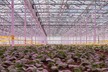
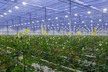
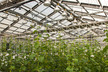
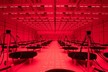
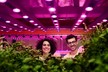
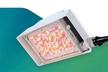
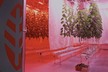
Hort Americas is partnering with a U.S. greenhouse vegetable grower to determine if intracanopy/intercanopy LED lighting can improve tomato yields with the potential to increase revenue.
A critical factor in growing greenhouse vegetables is ensuring the crops are produced in an environment that not only maximizes yields but consistently produces predictable yields. A U.S. greenhouse tomato grower in the Midwest had installed high-pressure sodium (HPS) lamps to maintain the proper top light levels year-round to maintain consistent fruit production. The HPS lamps were used to provide supplemental light from November to March.
The tomato greenhouses are equipped with environmental sensors that measure light levels outside the greenhouses, at the top of the plant canopy, and in the lower one-third of the canopy. Sensors also collect data on the substrate moisture level, relative humidity, carbon dioxide level, temperatures inside and outside the greenhouses, and airflow rates. A Priva environmental control system collects the data, enabling the grower to evaluate the data in order to manipulate the crops and environment to maximize fruit yields.
In addition to manipulating the environment, different plant dimensions are measured, including stem diameter and length, leaf length, number of tomato fruit clusters, and the speed at which plants flower. Using the data collected by these sensors, the grower can measure changes to the plants and establish a basis for steering the tomato crop. Collecting this data and analyzing it is particularly important when growers are looking to implement new technology that can improve plant growth and/or crop yields.
Read the full article at hortamericas.com