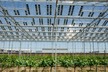
In the greenhouse of Alexandre Cudet and Patrice Brestaz in Troinex Switzerland, since the end of August, it's not just the cherry tomatoes that bring color. Between the glass and the energy screen, modules with special glasses have been installed, which split sunlight into natural spectral colors.
These are specifically dichroic mirrors, which filter light, explains Jonas Roch from the start-up Voltiris SA in Lausanne. The physicist officially founded the company in March 2022 with Nicolas Weber and Dominik Blaser; they currently employ 11 people.
Their idea: Generating solar power in the greenhouse without compromising crop yields. Roch explains how it works: "We filter out the light that the plant doesn't need for photosynthesis and concentrate it on a narrow solar cell, which then produces electricity."
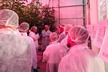
Greenhouse grower Alexandre Cudet finds the concept interesting and provides a part of the greenhouse for a pilot project. The initial area covered 100 m2 this summer. "The measurements in the first weeks show that the light filtering is within the expected range," Roch notes with satisfaction.
In the next phase, the area will be expanded to 1000 m2 to gather more data in the upcoming entire growing season. The focus is on – in addition to power output and mechanics – the development of tomato yields.
Nicolas Weber is optimistic: "In experiments by Agroscope with basil, tomatoes, and peppers, there was no reduction in yields under the filters."
In addition to the project in Geneva (financed by Romande Energie and supported by the Federal Office of Energy, Swiss Climate Foundation, and Services Industries Genevois), another one is coming up in the Basel region. Moreover, additional modules are installed in greenhouses across various plant cultures in the Netherlands, France, and Spain.
If the system proves successful in practice with no reduction in crop yields, the costs and returns of the Voltiris modules will determine whether businesses choose to invest.
Source: https://www.lid.ch