Bayer is underpinning its commitment to innovation for regenerative agriculture with a €220 million investment in research and development at its Monheim site. This is the company's largest single investment in its crop protection business in Germany since the foundation stone of the Monheim campus was laid in 1979. "Bayer stands for sustainable innovation and future technologies - and the new facility at the Monheim site is another prime example of this," said Bill Anderson, Chairman of the Board of Management of Bayer AG. "We invest in research and development, in high-tech facilities, and, above all, in our first-class scientists."
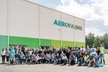
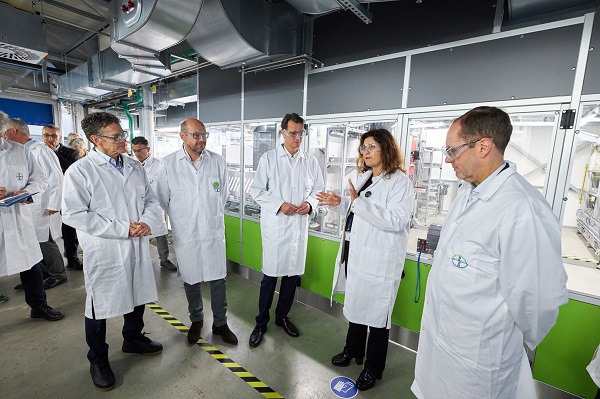 Visit to the research laboratory and greenhouse at the Monheim site: Bill Anderson, Axel Trautwein, Hendrik Wüst, Rachel Rama, Frank Terhorst (from left).
In the presence of North Rhine-Westphalia's Minister President Hendrik Wüst, Bayer's agricultural division today opened the construction site for its new buildings in Monheim with a traditional ground-breaking ceremony. "The chemical industry is systemically important for our entire economy. Bayer's decision to locate here confirms North Rhine-Westphalia's attractiveness for investment and innovation. The aim is to reconcile climate protection with industry and good jobs and thus maintain competitiveness in the long term," Hendrik Wüst emphasized.
"Bayer will be conducting research here on innovations that we need for sustainable agriculture. The investment at the Monheim site points the way forward for the future of the company and for North Rhine-Westphalia as a business location. At the same time, it is an important signal on the way to becoming a climate-neutral industrial state."
The investment will create a new building complex with laboratories, offices, and a greenhouse, providing space for around 200 employees. The five-story main building will have 28,000 square meters of usable space. A flexible laboratory design will allow the laboratories to be easily adapted to future regulatory requirements. The anticipated construction time for the new buildings will be approximately three years. Full commissioning is planned for 2026.
Work in the new complex will focus on the safety of crop protection products for humans, animals, and the environment. The new facility thus reinforces Bayer's approach to developing and bringing to market new crop protection solutions that have an even better environmental profile than before, thereby significantly further reducing the impact of agriculture on the environment. This is also in line with one of Bayer's sustainability goals to reduce the environmental impact of its crop protection products by 30 percent by 2030.
"Looking to the future, we need to radically transform today's agricultural production and move to regenerative agriculture that can produce more with less while conserving more of our natural resources," said Frank Terhorst, Head of Strategy and Sustainability at Bayer's Crop Science Division. "To do that, we need to go beyond established safety standards and develop breakthrough innovations with better environmental profiles." To do so, the company relies on openness and collaboration. "Farmers' livelihoods and food supplies worldwide depend in no small part on the acceptance of our products by consumers and regulators worldwide. We are convinced that with this important investment, we are not only accelerating the development of new crop protection products but also underlining our strong commitment to transparency and dialogue," Terhorst adds.
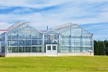
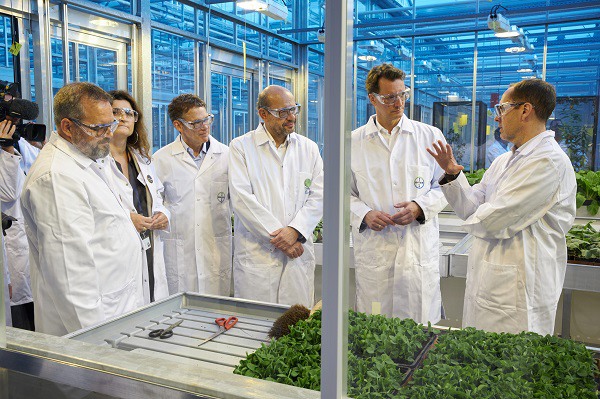 In the greenhouse: Matthias Berninger, Rachel Rama, Bill Anderson, Axel Trautwein, Hendrik Wüst, Frank Terhorst (from left)
Best conditions for comprehensive safety assessments
Both in Europe and in other regions of the world, strict policy and regulatory frameworks ensure that crop protection products are safe when used as intended and do not have unacceptable effects on the environment. "We address all regulatory concerns and use robust metabolism, human and environmental data for thorough risk assessments of our active ingredients," emphasized Dr. Axel Trautwein, Head of Regulatory Science at Crop Science. "The new building will now enable testing and studies under even better conditions."
In addition to modern residue analysis and metabolism studies to evaluate safety for humans, activities will focus on environmental safety. This includes exposure and effects studies, for example, in aquatic and soil organisms, wild birds and mammals, and pollinators such as honeybees and bumblebees, to gain a holistic understanding of the environmental impact of pesticides.
AI helps develop new crop protection products
The new research and development facilities will also make a decisive contribution to a completely new approach to innovation in crop protection. Bayer's product portfolio already performs very well in terms of environmental impact. However, the company is determined to reduce these impacts even further and go beyond established standards.
"With our new disruptive innovation approach, CropKey, we are now designing molecules instead of just testing and selecting them as we did in the past," explained Rachel Rama, Head of Small Molecules at Crop Science. With the help of data science, early safety testing, modeling, and artificial intelligence, Bayer researchers are thus developing the new molecules using huge amounts of data and machine learning. "With our investment in the new building, our researchers, as well as future top talents, will have a state-of-the-art high-tech working environment."
Building complex is part of Bayer's "Concept for the Future"
The investment is also an important cornerstone of the agreed "Future Concept" for the company's site in Germany. "Today's news is a very positive message for all Bayer employees - in Monheim and far beyond," said Heike Hausfeld, Chairwoman of the Bayer General Works Council and Vice Chairwoman of the Supervisory Board. "It shows that the company is backing up its words with action and that the chemical industry is investing in the future, even in these times and also at the German site."
Bayer has already invested in the future viability of its German sites in the past three years, for example, €180 million in the expansion of production capacities for modern crop protection at the Dormagen site.
For more information:
www.bayer.com/de