Natural enemies used in biological pest control sometimes need support to establish in a crop in the long term. This support can be ensured by providing supplementary food in the crop, such as pollen or Artemia cysts. However, this supplementary food can also be eaten by certain polyphagous pests. The Business Unit Greenhouse Horticulture and Flower Bulbs investigated the impact of different supplementary food treatments on populations of the pest Thrips parvispinus and its natural enemy Transeius montdorensis in pot-anthurium. They showed that providing supplementary food to T. montdorensis did not have any positive effect on T. parvispinus populations nor any negative effect on biological control of this pest.
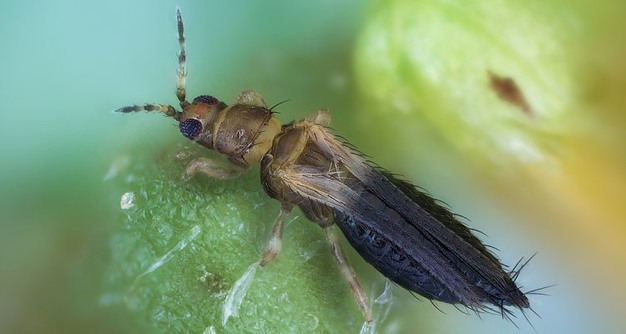
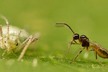
Thrips parvispinus (pepper thrips) originally came from South-East Asia. It arrived in the Netherlands a few years ago and started causing serious damage in Anthurium greenhouses, among other crops. Thrips parvispinus adults and larvae cause damage to Anthurium plants by feeding on leaves and flowers. The predatory mite Transeius montdorensis is an effective natural enemy against T. parvispinus, but it struggles to establish itself in Anthurium plants and therefore needs to be reintroduced often in the crop. Growers often release supplementary food like pollen to help T. montdorensis survive in the crop. However, T. parvispinus is a polyphagous pest that is able to feed on many types of food, including pollen.
To understand the consequences of using supplementary food in crops infested by T. parvispinus, WUR focused on three supplementary food treatments: Typha pollen, Artemia cysts ('shrimp-like' eggs), and the prey mite Thyreophagus entomophagus. The research first took place in the laboratory to look at the effect of these 3 treatments on T. parvispinus oviposition rate and then in a greenhouse to investigate the effects of these treatments on T. parvispinus biological control by T. montdorensis. Fresh supplementary food was provided weekly in the crop.
In the laboratory experiment, the food treatments did not have any significant effect on T. parvispinus’ oviposition rate: T. parvispinus females did not lay more eggs when they were fed on pollen, Artemia cysts, or T. entomophagus. In the greenhouse, T. montdorensis was able to control efficiently the T. parvispinus populations with all 3 food treatments, and T. montdorensis mites established significantly better when provided with Artemia cysts. These results are positive for Anthurium growers because they will allow them to use different types of supplementary food without being afraid that it will give a boost to T. parvispinus populations.
This means that biological control is not hindered by the predatory mite. Research shows that Artemia cysts provide the best results. This additional food can best be supplemented weekly to prevent the food from aging.
Source: wur.nl