A project that is unique in Germany is now becoming part of Bördegarten: as of July 1, the Wimex Group company from Köthen (Saxony-Anhalt) has taken over the commercial cultivation of sea asparagus (Salicornia europaea) from the start-up "Salifaktur." The green, leafless salt plant, also known as 'Queller' or sea asparagus, is considered a promising superfood because of its high content of vitamins and minerals. As a wild form, salicornia usually grows on seashores or on highly saline soils where conventional plants cannot thrive.
The start-up had already moved its sea asparagus cultivation to Bördegarten's high-tech greenhouse in Osterweddingen near Magdeburg at the beginning of 2023. Now the Salicornia project will also be integrated at the company level into Bördegarten and thus into the Wimex Group. "We are always looking for exciting development opportunities," says Ulrich Wagner, Managing Director of the Wimex Group. "The Salifaktur business idea is a perfect fit for us. Sea asparagus is versatile and thus complements our existing portfolio perfectly. We are happy to now also grow this superfood centrally in Germany."
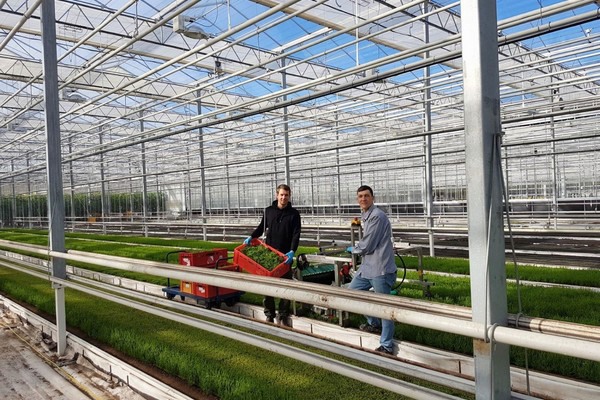 © Bördegarten/Wimex In the state-of-the-art greenhouse of the Wimex Group in Osterweddingen, Ken Dohrmann (left) finds perfect conditions for growing sea asparagus.
Building up all the know-how about salicornia
The beginnings of Salicornia cultivation date back to 2020. Back then, founders Julian Engelmann and Ken Dohrmann had been looking for their own niche in vegetable cultivation to start their own business - and discovered sea asparagus. "We became aware of it through experiments conducted by a fellow student," Ken Dohrmann reports. "After doing our own research, we realized that there was no cultivation of salicornia in Germany yet." For the two of them, this meant a unique position in the vegetable market, but it also meant that they had to develop all the practical know-how on their own. The only support they had was an expert from Belgium as a project partner. The two finally started the whole thing with the innovation project "Salt Plants from Saxony-Anhalt," which was funded within the framework of the "European Innovation Partnership" (EIP-AGRI).
In mid-2022, Julian Engelmann left the project by mutual agreement. Ken Dohrmann, an agronomist with a degree in agriculture, continued to stick to the concept, but looked for a new partner - and found Bördegarten. "The cooperation began on December 1 2022 with preparatory construction work in the Bördegarten greenhouse," he recalls. "Within just eight weeks, we were able to start cultivation." Salicornia is currently growing by 1,600 square meters in the greenhouse, and the weekly quantity is currently around 400 kilos.
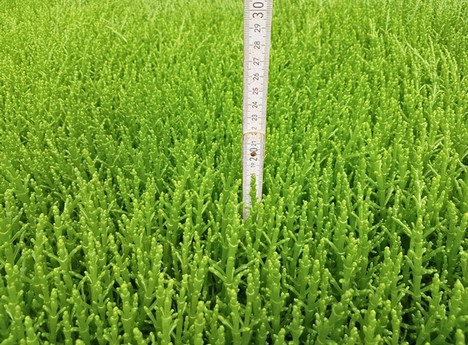
New momentum for salicornia cultivation
From the very beginning, the salicornia project has benefited from the cooperation with Bördegarten, says Ken Dohrmann. "The staff support in cultivation and maintenance alone helped a lot," he explains. "We also learned from the professional procedures in one of the most modern greenhouses in Germany. And we were now able to cultivate all year round, use the logistics, and have completely new marketing opportunities through sales contacts and the Bördegarten network. Harvesting and distribution of Salicornia take place in a small time window, after all, the sea asparagus should arrive fresh and crisp to the customers." Ken Dohrmann himself remains responsible for the sea asparagus as an employee of Bördegarten or the Wimex Group and the main contact person for all aspects of cultivation and marketing.
"By growing sea asparagus, we are expanding our portfolio. In addition to the vegetable classics, we are increasingly focusing on novelties. We hope for increasing popularity of Salicornia in all kitchens in Germany," says Michael Tepfer, Head of Strategic Corporate Development at the Wimex Group. Currently, the company mainly supplies the catering and hotel trade, and many customers come from the fish and seafood sector because Salicornia is traditionally offered together with fish. "We also deliver to a small number of regional restaurants and are regularly at the Magdeburg weekly market," Ken Dohrmann reports. In the future, vegetables will also be offered in retail stores.
Plant of the future for human nutrition
Then even more consumers will be able to prepare and enjoy sea asparagus at home. "Harvested and processed, the tips of the salt plant can be eaten fresh as a raw food or fried or blanched," explains Ken Dohrmann. "Everything that benefits from salt or herbs also benefits from sea asparagus. It tastes good in salads and with fried potatoes. Or as a salty ingredient on a slice of buttered bread."
Some gourmets also combined the salty snack with sweet fruits or nuts. But the benefits of sea asparagus go beyond the culinary: because the plant grows on the salty ground, it makes previously unusable soils available for farming and thus for feeding people. Even in areas temporarily flooded by the sea, salicornia thrives magnificently. "In our cultivation in the Bördegarten greenhouse," says Ken Dohrmann, "we use salt from natural deposits in the region around Magdeburg to fertilize the plants optimally."
Images: Bördegarten/Wimex
For more information:
Bördegarten Gemüse Vertriebsgesellschaft mbH
Köthener Str. 7 a
06369 Köthen (Anhalt) OT Arensdorf
Tel.: +49 3496 3033 10
Fax: +49 3496 3033 141
Email: [email protected]
www.boerdegarten.de