As of last August, PheroNesi has been on the market in the Netherlands. With the pheromone, tomato growers monitor the presence of the dreaded predatory bug. Nesidiocoris tenius in full, but often simply Nesi, is heat-loving. On one of the first really warm days of the year, early June, it is therefore exciting when HortiPro's Lennart Simonse enters the canteen after counting the traps. Has Nesi been spotted? Fortunately for Eric Volkering, Greenway I's site manager, no is the answer.

Lennert during an inspection tour at Greenway
"We have never really caught Nesi here," he says. Recently, though, there was a find similar to it. Both Eric's colleague who does biological control and Lennart are not sure after studying a photograph taken. All the more interesting, therefore, to see what the monitoring traps show in the following weeks, in addition to regular scouting in the greenhouse by staff and the biology specialist at the tomato grower.
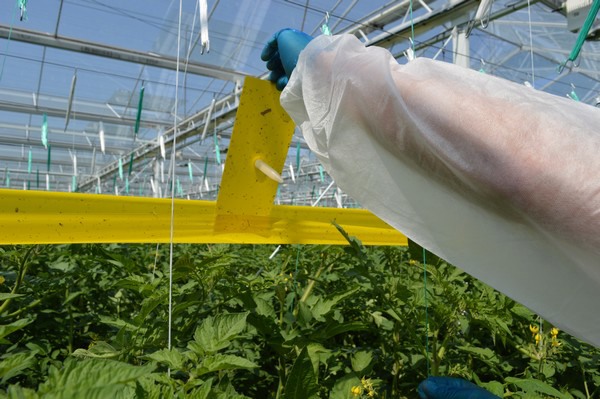
The back of the trap is not forgotten either
"You just replaced the dispensers, right?" grower Eric asks Lennart. The latter nods in the affirmative. Lennart does weekly counts at growers. At Greenway on 7 June, he replaced the dispensers with PheroNesi by inserting them into a catch plate stapled to the roller stage. This prevents the tubes from falling down.
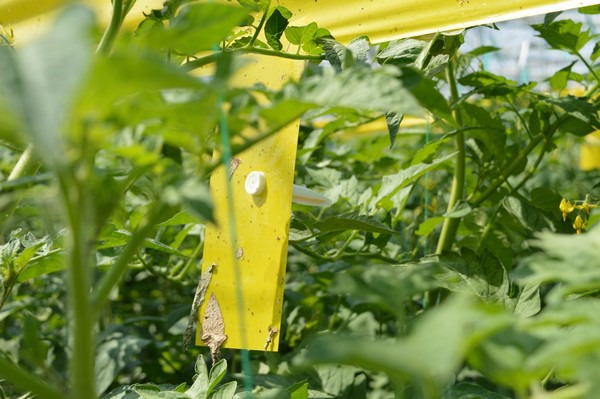
Males and females
Maybe people are wondering why you would put up pheromones for monitoring a pest that was never really there before. For grower Eric, that's not a question. "Hanging up the pheromones is a bit of work, but after that, it works almost automatically. It prevents you from having to spray, and you don't want that because then you're screwed. It costs you your biology, and each spraying also means a little growth retardation anyway." Even with the, to growers' satisfaction, very vigorous varieties this year (Greenway grows the ToBRFV-resistant varieties Lucioso and Amelioso on almost six hectares), that is never a walk in the park.
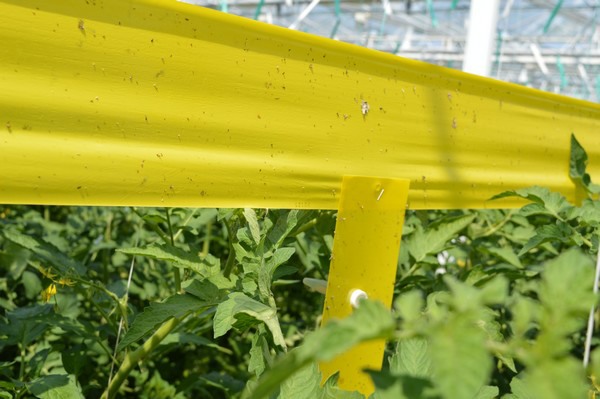
The tomato grower deploys PheroNesi to keep a close eye on whether Nesi does suddenly appear in the greenhouse. If that happens, the danger is that the predatory bug will cause damage later in the crop by breaking heads or, if Nesi gets into the truss, flower molting. "Towards the end of cultivation, it is easier to get over Nesi," says grower Eric, "but in June, that's when you really don't want to have any finds."
The PheroNesi pheromone lures both males and females to the yellow trap at the top of the greenhouse. Again, as is increasingly the case with crop protection in the greenhouse, prevention is better than cure. And for those still in doubt, pheromone specialist Eric points out another nice benefit: "It is possible to get EU-subsidies on the deployment of the pheromones."
For more information:
Eric Kerklaan and Lennart Simonse 
HortiPro
[email protected]
www.hortipro.net