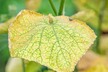
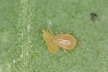
Pseudoperonospora cubensis is the causal agent of cucurbit downy mildew (CDM). This disease was confirmed on June 20, 2023, in Lenoir County on cucumbers. Disease incidence was around 1%. When observing the upper side of the cucumber leaves, chlorotic lesions were seen. On the underside of the leaf, the characteristic dark gray sporulation of cucurbit downy mildew was present (Figure 1). Both of these are all typical symptoms and signs of CDM, respectively. Sporangia, which are microscopic structures of the causal agent (P. cubensis), were seen and confirmed on the underside of the leaf using a microscope (Figure 2).
The causal agent of cucurbit downy mildew has two clades. These clades are host specific, which means that each clade has a preference for infecting a specific group of cucurbit crops. Clade 2 isolates in North Carolina have a host preference for cucumbers as well as cantaloupes. Clade 1 isolates have a preference for watermelon, squash, and pumpkin. Currently, this means that cucumber and cantaloupe crops are most at risk of CDM. This is because clade 2 isolates have arrived in the state of North Carolina via air currents. Cucumber and cantaloupe growers are strongly encouraged to take immediate action to protect their crops with effective downy mildew fungicides in North Carolina.
Read more at: plantpathology.ces.ncsu.edu