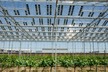
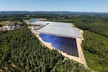
32,000 solar panels produce 18 megawatts of electricity on a summer's day. These are serious figures that come with the installation of solar panels at Hoogweg Paprika Nurseries. Growers' cooperative Oxin Growers is investing in solar panels at several members, including at Hoogweg.
Special anchoring on basin
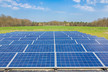
At Hoogweg, this involves installation on both water basins and the roofs of the processing halls. At Hoogweg, there is a 50-50 distribution of panels across the basins and the roofs of the various buildings. On the water basins, a system was chosen that was launched this spring by ZonopWaterbassin.nl (Aquasol Solar) in collaboration with Genap. Local supplier Zonnegilde supplies all panels, including those for the construction of solar panels on water.
At the same time as Hoogweg, two other members of grower cooperative Oxin Growers also chose solar panels on water from ZonopWaterbassin.nl (Aquasol Solar). A special feature of the projects is that the panels are anchored in a certain way.
"Thanks to the anchoring system, much less light enters the basin," Willem Verwoerd explained during the horticulture trade fair HortiContact. "That prevents algae growth. An additional advantage is that the grower receives a new embankment cloth when the anchor system is installed. The anchor system is integrated into this cloth."
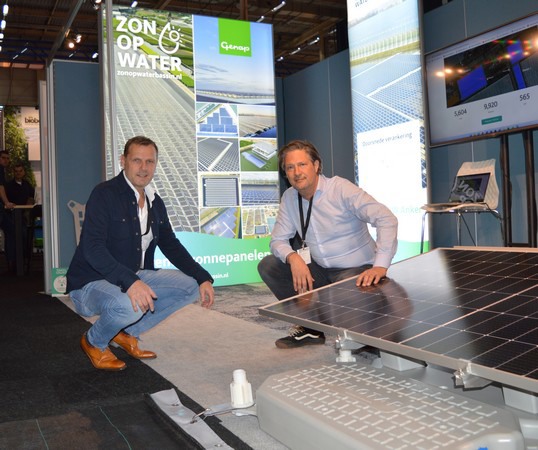
Willem Verwoerd of Zon op Waterbassin and Chretien Hendriks of Genap at HortiContact 2023 with the system developed in collaboration. In the foreground, the embankment cloth is attached to the floating solar panels as an anchor.
Making electricity sustainable too
"Better water quality in the basins is a nice added benefit," says Hans Olsthoorn, financial director at Hoogweg Paprika Nurseries, when asked about the waterborne solar panel system. The pepper grower is known for their efforts to heat greenhouses sustainably.
Hoogweg invested in a geothermal heating system not too long ago. Phase two was commissioned late last year. "We also use heat pumps to optimize cooling back," he says. The solar panels contribute to the sustainability of the heat pumps' electricity consumption.
The electricity production from the solar panels is used for the geothermal heating system, as well as for cooling plants, sorting and packaging machines, and other operating power, among others. There is no lighting.
Gas residuals and e-boiler
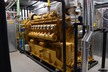
Solar panels do not generate electricity 24/7. "We will have to buy some power for nighttime as well," says Hans. "Another option we are using is to buffer the natural gas that also comes to the surface during geothermal heat extraction and burn it at night with our CHPs. This way, we generate heat, but also electricity. We can use both the heat and the electricity."
The electricity that Hoogweg does not use will eventually be converted into hot water. Oxin Growers is also installing an e-boiler at this company. This allows heat to be buffered, which can be used in the greenhouse at night.
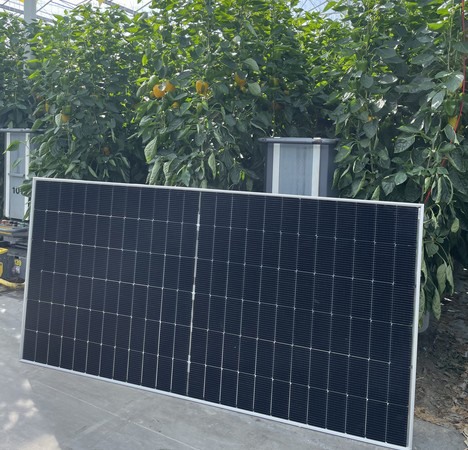
Making electricity consumption more sustainable is a logical next step for the pepper grower with its 160-hectare greenhouse. However, the energy situation might not be fully completed, even after the installation of the panels, which will start shortly and continue until the end of September. "One last piece of the puzzle could be wind energy," Hans knows. This is not yet set in stone. "The last piece of sustainability is the most difficult." What is certain, however, is that another big step has been taken with this project.
For more information:
Hoogweg Paprikakwekerijen 
www.hoogweg.nl
Willem Verwoerd 
Zon op Waterbassin
Honderdland 226
2676 LV Maasdijk
Tel.: +31 (0)6 415 14 033
[email protected]
www.zonopwaterbassin.nl