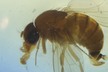
Reports of leafhopper pests in greenhouses have been rare; outdoors, however, on some herbaceous and woody ornamentals potato leafhopper is a common pest causing ‘hopperburn’ and last year several samples were submitted to the Diagnostic Lab with aster yellows, caused by a phytoplasma vectored by aster leafhopper.
hanks to assistance from Florida Dept. of Agriculture taxonomists we were able to confirm this as Eupteryx melissae, sometimes referred to as the ‘sage leafhopper.’ The adults are pale with brown or grayish elongated spots on the wings and usually 5 black spots on the head. Although plants in the mint family (sage, Jerusalem sage, catnip, mints, horehound, rosemary, etc.) are preferred hosts, ours was the first case on lavender noted by the leafhopper specialist providing the confirmation.
The literature also mentions several mallows (Lavatera arborea = tree mallow and Althaea spp.) as hosts. It’s now common outdoors in nurseries and landscapes on catmint, Nepeta x faassenii, causing small pale spots on foliage. Originally from Europe, sage leafhopper was first reported in the US in the early 1900s from western NY, California, Maryland and Massachusetts, but has become widely distributed throughout North America.
Sage leafhopper overwinters as eggs in plant stems or petioles, which facilitates introductions to new areas. In England (and possibly in milder US climates) the adults can overwinter outdoors. It appears to have multiple generations during the growing season. Two other similar Eupteryx species may also be present in our region and damaging to herb plants in the mint family, although E. melissae is the only one I have encountered in greenhouses. E. atropunctata, also from Europe, was first reported in North America (eastern Canada) over 70 years ago and has been found in New York, Michigan, Connecticut, and Pennsylvania. Mints and relatives again appear to be preferred, but others include potato, sunflower and some other composites, Althaea officinalis, A. rosea (hollyhock), Apium sp., Verbascum spp., Veronica spp., Verbena hybrida and Filipendula ulmaria.
Read the complete article at www.e-gro.org.