Choosing the right thermoplastic film for strawberries is always difficult, even more so considering the general price increases of the past few months. Many entrepreneurs are uncertain as regards the type of cover to choose. Which is better, diffused light or direct light?
During the winter months, plants do not grow much with diffused light films, with a limited production in February and March. These films are in fact particularly effective during periods when temperatures and luminous intensity increase.

When it comes to direct light covers, they provide excellent protection in February/March, but the excessive light and high temperatures cause problems such scalding and hastened ripening times from April onwards. These problems are partly solved by using lime to cool the environment underneath, however the procedure must be repeated multiple times, especially in case of heavy rain. This practice, in addition to damaging the films and shortening their duration for the following season, reduces yields.
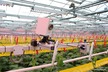
FreshPlaza has visited a strawberry crop in Basilicata owned by Angelo Andrisani, owner of Fruttitalia and president of O.P. Agorà. It is covered with Retilplast thermoplastic film Polyfilm Ultra, a plastic cover with a dual function: in winter, it has a luminous intensity of 87% (total transmittance in the PAR between 400 and 700 nm) while, during periods of strong luminous intensity, it boasts a spread light of 83% and UV transmittance of 55%.
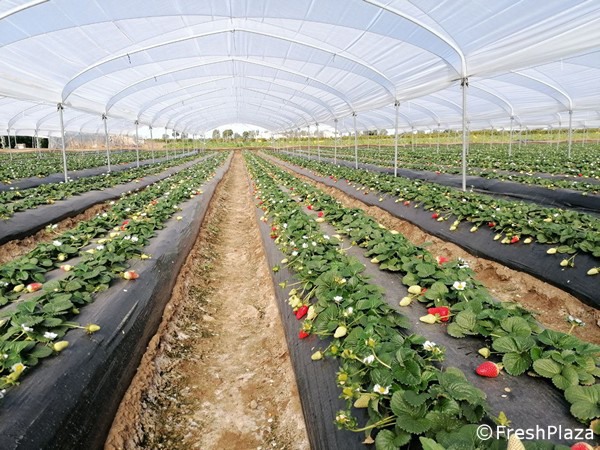 Strawberry crop covered with Polyfilm-Ultra
This cover is designed to last (5 season max) and reduce environmental impact. Thanks to its technology, it behaves as a direct light film in February/March and as a diffused light film during spring months.
"The Polyfilm Ultra film enables ideal climate and light conditions inside the greenhouse whatever the time of year, even in case of high temperatures. I wanted to experiment with this new type of cover on a Sabrosa-Candonga crop in Metaponto. Compared to direct light films, we have noticed a better development of the foliage, but the difference will be more visible over the next few weeks as spring approaches, as luminous intensity will be more aggressive and we will need to transform direct light into diffused light."
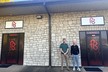
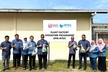
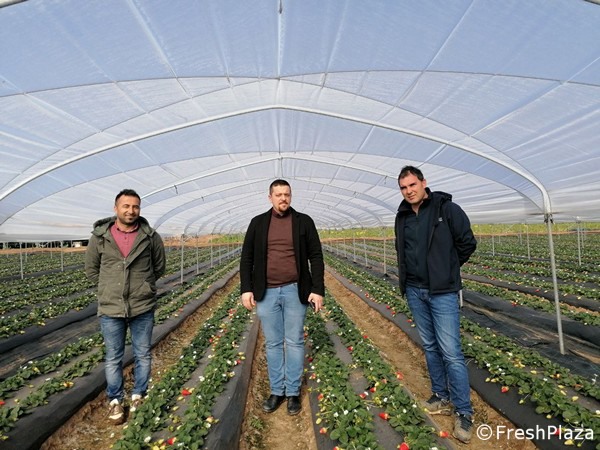 Left to right: Klody Shana (Fruttitalia partner), Domenico Laviola (agronomist) and Angelo Andrisani (owner of Fruttitalia).
"The choice to install this film was made also because our area is colder than others in Metaponto, like Scanzano Jonico and Policoro, which usually register temperatures of +2°C (especially at dawn). Our strawberry fields need more warmth and light to become productive, especially between the transplant and March."
There are multiple advantages to diffused light with high transparency:
- development of gradual heat: it mitigates the temperature difference between night and day, reducing the accumulation of humidity;
- it does not create shade under the cover, with excellent control of temperature and luminosity;
- it enables excellent control of the temperature under the cover, preventing scalding;
- it increases photosynthesis leading to uniform vegetable growth and improves fruit quality in terms of grade and color, with a significant increase of nutritional values and hastened ripening.
For further information: Retilplast srl
Area Industriale, uscita A3
84022 Campagna (SA) - Italy
(+39) 0828 45359
[email protected]
retilplast.it