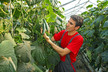
While many farmers and gardeners believe that talking to plants and crops helps them grow faster, an Israeli start-up is on a mission to translate what plants are telling farmers.
If plants could talk, what would they say? Would they ask for water, and how much? What are their needs when they are too hot or too cold? How can they be prepared for drastic climate changes? To answer all of these questions, SupPlant has created artificial intelligence-powered sensors, which are placed on plants and in the soil to monitor data and provide farmers with irrigation recommendations.
“Our vision is to digitally inform every irrigation command on earth,” Uri Ben Ner, CEO of SupPlant, told The Algemeiner. “Other than the fact that we teach farmers how to speak better plant, we let plants irrigate themselves. I know it sounds like a metaphor. It’s not. We literally let plants irrigate themselves.”
“What’s unique is our ability to understand best practices for farmers through talking to plants regarding climate changes and climate-adaptive irrigation,” Ben Ner said. “The end result is what matters to farmers either small or big. We are able to increase the yield and save water consumption dramatically.”
A fourth-generation farmer who was inspired by his grandfather, who was still farming at age 91 in northern Israel, Ben Ner recounted that the idea for SupPlant’s technology was born of the need to help farmers deal with climate change and the fast-changing weather conditions of today’s world.
Read the complete article at www.algemeiner.com.