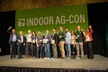
At the 65th IAEA General Conference, a side event recognized the contributions to plant mutation breeding from 28 researchers and research teams of institutions from across 20 countries – honoring them with awards for outstanding achievements. Awards were presented by the Director-General of the IAEA, Rafael Mariano Grossi, with the recorded presence of the Director-General of the Food and Agriculture Organization of the United Nations (FAO), Qu Dongyu, in a ceremony in Vienna. This recognition includes 11 Outstanding Achievement Awards, 10 Women in Plant Mutation Breeding Awards, and 7 Young Scientist Awards for significant efforts in the last decade in the development of new mutant varieties using irradiation.
"What we like to honor is the elevation of the human mind and the spirit that puts science at the service of big problems. Which is what FAO does in Rome, and we do here at the IAEA," said Rafael Mariano Grossi, IAEA Director-General. In handing over the awards, Mr. Grossi spoke about the commitment from the IAEA and FAO, via the Joint FAO/IAEA Centre of Nuclear Techniques in Food and Agriculture, to support researchers from around the world in mutation breeding.
The IAEA, in cooperation with FAO, assists experts worldwide in using nuclear techniques in agriculture, including support with irradiating seeds or other plant material in order to develop plant varieties with superior characteristics, such as drought tolerance or increased yields. This process, called plant mutation breeding, uses the plant’s own natural genetic resources to mimic the spontaneous process of mutation in the evolution of plants. It increases the pace of genetic change and allows plant breeders to select the most desirable ones from many mutant lines.
“The positive impacts of improved cultivars on food security and nutrition at local, national, and regional levels are ensuring more stable crop production in stress conditions due to the climate crisis. As well as sustaining farmer’s livelihoods and achieving the Sustainable Development Goals,” Mr. Dongyu said, noting that, “with the technical support provided by the Joint Centre, plant breeders in many countries have achieved substantial improvement through mutation breeding in a wide range of crops.”
Read the complete article at www.iaea.org.