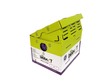
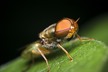
“For growers of organic glasshouse-grown vegetable crops, the gall midge Aphidoletes-System has become the backbone of their aphid programme,” says Gert-Jan De Vast, Technical advisor of Biobest. “If these growers had to choose one beneficial insect they wouldn't be without, the majority would wholeheartedly select Aphidoletes-System.”
Excellent searching ability
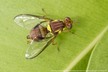
Adult Aphidoletes females are active around dusk and during the night. After mating, the females start looking for aphid hot spots. “They have a very good searching behaviour and are strongly attracted to the honeydew excreted by aphids,” explains Gert-Jan. “However, it is worth noting they can be disturbed by the release of sulphur.”
Females deposits several eggs in and around aphid hot spots; these are very small, red and bean-shaped. After about three days, the larvae hatch out and immediately start looking for aphids. On finding one, the larva stings it injecting a paralyzing poison making it immobile - while also helping to digest it.
Voracious appetite
“A single Aphidoletes larva can eat up to 100 aphids,” says Gert-Jan. “When it has eaten enough, it drops from the leaf to pupate in the top layer of soil or growing media. Occasionally a larva will pupate on the leaf, but this is rare.
“Sensitive to dehydration, the pupae ideally need some soil and slightly humid conditions. Organic growers, producing crops in open ground, have an advantage over ‘conventional’ growers - who often use ground coverings.”
Offers many benefits
Aphidoletes-System features many benefits; it controls a range of aphid species; the larvae are highly voracious; the females have very good searching ability; and they deposit many eggs. In addition, unlike parasitic wasps, the gall midge is not sensitive to hyperparasitation.
Gall midge eggs can be seen as a snack by other predators, such as Macrolophus, Orius and predatory mites. In theory, very large numbers of these predators could impact on the Aphidoletes’s overall effectiveness, however, its high fecundity wins through.
Source: Biobest Group