People across the world are becoming increasingly concerned about climate change: 8-in-10 people see climate change as a major threat to their country.
Food production is responsible for one-quarter of the world’s greenhouse gas emissions.
‘Eating local’ is a recommendation you hear often – even from prominent sources, including the United Nations. While it might make sense intuitively – after all, transport does lead to emissions – it is one of the most misguided pieces of advice, according to Hannah Ritchie of the University of Oxford.
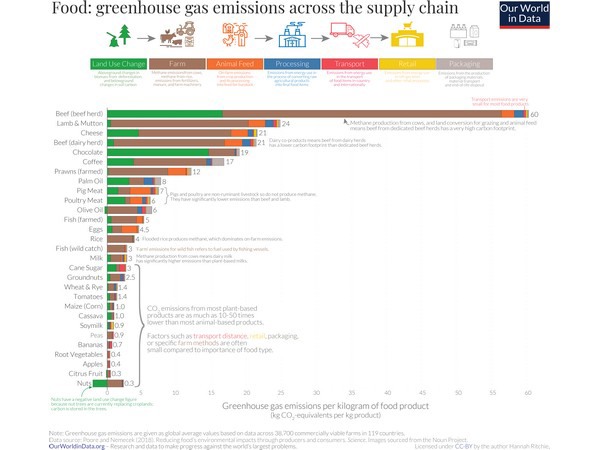
Click here for a larger version.
Eating locally would only have a significant impact if transport was responsible for a large share of food’s final carbon footprint. For most foods, this is not the case.
GHG emissions from transportation make up a very small amount of the emissions from food and what you eat is far more important than where your food traveled from.
For instance, a 2009 study estimated that importing Spanish lettuce to the UK during winter months results in three to eight times lower emissions than producing it locally. The same applies for other foods: tomatoes produced in greenhouses in Sweden used 10 times as much energy as importing tomatoes from Southern Europe where they were in-season.