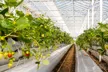
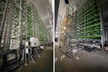
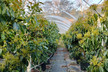
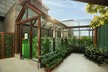
Vertical farming or city farming – the growth of plants indoors stacked in vertical layers – fully depends on the artificial lighting instead of sunlight. Philips Lighting started working on light products for indoor farming in 2010 together with HAS university and eventually created Philips GrowWise – the research centre in Eindhoven that finds optimal LED-light recipes for indoor farming and develops custom-built vertical farms projects.
Global Director City Farming in Signify, Roel Janssen, says that vertical farming has three main benefits. The first advantage of city farming is a higher yield of produce from a square meter of the floor space due to the use of multiple layers – this is very useful in the densely populated areas like Mumbai, Tokyo or Singapore, where a square meter of land is quite expensive. “On one square meter, a vertical farm can produce much more than you would have in a normal field. For example, for growing around 20 kg of lettuce on 1 m2 in California farmers use 200 litres of water per kilogram but in the GrowWise facility, we harvest 100 kg from 1 m2 with less than 2 l of water per kilogram.” So vertical farming helps to increase the yield per square meter of actual floor space.
One more merit of a vertical farm is the quality of produce, and Roel Janssen emphasises that quality is the main advantage of city farming: “The quality greatly depends on operating the indoor farm in a right way: if you make sure that the hygiene is up to the proper standards, if you automate most of your production and keep close control over the facility, you can improve the nutritional value of the crops.” Researchers of GrowWise have found light recipes to increase vitamin C content in mint and rocket, and to increase the content of volatiles (aromatic components) in basil. The strawberries that are grown in the controlled environment of GrowWise have a higher Brix value – they are sweeter than strawberries from the open field.
Nowadays lettuce is the most popular crop that is grown in vertical farms, and its quality can be improved. Janssen says: “If you have a bagged salad, often there are red varieties in there, such as lollo rosso. This lettuce is red because of the response to the ultraviolet in the spectrum of the sun. Since we grow the red variety without UV, our ‘red’ lettuce stays mostly green. Three days before the harvest we have a specific pre-harvest light recipe that triggers the colouration of the lettuce. We use a different combination of red and blue and change the daylength, which intensifies the production of anthocyanins (important antioxidants) and makes the lettuce red again after only three days of treatment. This is how we can grow the lettuce in the most optimal way, have a high yield and increased nutritional value. When the lettuce is grown outside, the accumulation of anthocyanins is gradual, and the growth is slower.”
Janssen says that the reliability of the growing process belongs to the benefits of indoor farming as well: “If you do everything properly and get no foreign bodies in your produce, you will always have a constant quality and you can have the same produce all year round.” The reliability of farming indoors also means that the growers can be flexible on the market – they can regulate the growth of produce in accordance with the demands of the customers.